
Loan payoff calculator with extra payment savings
See how much interest you save and how much sooner you pay off a loan by making extra payments. Works for mortgages and personal loans.
See how much time and interest you save by paying more each month
Related tools
How loan amortization works
With an amortizing loan, each monthly payment covers both interest and a portion of the principal. Early in the loan, most of your payment goes to interest. Over time, as the balance decreases, more of each payment reduces the principal.
This is why extra payments are so powerful early in a loan: every dollar of extra principal reduces the balance that future interest is calculated on, creating a compounding savings effect.
Strategies to pay off loans faster
- Round up your monthly payment. Paying $450 instead of $392 adds up significantly over time.
- Make bi-weekly payments instead of monthly. This results in one extra full payment per year.
- Apply windfalls such as bonuses or tax refunds directly to your principal.
- When paying off multiple loans, consider the avalanche method: pay minimums on all loans, and put extra money toward the highest-interest loan first.
The front-loading of interest
The most important thing to understand about amortization is how dramatically interest is front-loaded. On a 30-year mortgage at 7%, roughly half of the total interest you will ever pay is charged in the first ten years. By the time you are halfway through a 30-year term, you have paid off only about a third of the principal.
Example: A $300,000 mortgage at 7% over 30 years has a monthly payment of approximately $1,996. Over the full term, you pay $418,527 in interest — more than the original loan amount. In month one, $1,750 of your $1,996 payment is interest and only $246 reduces the principal. By month 360, this reverses: almost the entire payment is principal.
How extra payments work
Extra payments work by reducing the principal balance immediately. A lower principal balance means less interest accrues in every subsequent month, which means a larger share of each regular payment goes to principal — accelerating the payoff further. This compounding effect is why small extra payments early in a loan have outsized impact.
Example of extra payment savings on a $300,000 mortgage at 7% over 30 years:
| Extra monthly payment | Interest saved | Years cut |
|---|---|---|
| $100 | ~$26,000 | ~2.5 years |
| $300 | ~$68,000 | ~6 years |
| $500 | ~$98,000 | ~9 years |
The savings increase non-linearly: $500 extra saves more than 5× what $100 extra saves, because larger early reductions in principal grow through the compounding effect over more remaining months.
Avalanche vs snowball method
When managing multiple loans, two strategies are commonly used:
Avalanche method: Pay minimums on all loans and direct all extra money toward the highest interest rate loan. This minimises total interest paid and is mathematically optimal. It can feel slow if the highest-rate loan also has a large balance.
Snowball method: Pay minimums on all loans and direct extra money toward the lowest balance loan regardless of interest rate. Paying off a small loan quickly provides a psychological win and frees up that minimum payment to redirect elsewhere. Research shows the snowball method leads to higher completion rates for people who struggle with motivation, even though it costs more in interest.
For strictly mathematical optimisation, use the avalanche method. For behavioural success, the snowball method's psychological benefits may be worth the small additional interest cost.
Bi-weekly payments
Switching from monthly to bi-weekly payments — paying half your monthly payment every two weeks — results in 26 half-payments per year, equivalent to 13 full monthly payments instead of 12. This one extra payment per year reduces a 30-year mortgage term by approximately 4 to 5 years and saves tens of thousands in interest, without requiring any increase in the individual payment amount.
Not all lenders process bi-weekly payments correctly. Some hold the first bi-weekly payment and only apply it when the second arrives (effectively making it monthly). Confirm with your lender how bi-weekly payments are applied before setting this up.
Refinancing considerations
Refinancing replaces your existing loan with a new one, typically at a lower interest rate or with a shorter term. The break-even point — where the interest savings outweigh the refinancing closing costs — depends on the rate reduction and how long you plan to stay in the loan.
A rough rule: refinancing makes sense if you can reduce your rate by at least 0.5–1%, plan to stay for at least 2–3 years, and the break-even period (closing costs ÷ monthly savings) falls within that window. Extending the term while lowering the rate may reduce monthly payments but increase total interest paid — run both scenarios before deciding.
Frequently asked questions
How does a loan payoff calculator work?
Enter your loan balance, annual interest rate, and monthly payment. The calculator builds a full amortisation schedule showing every payment, how much goes to interest vs principal each month, and when the loan is paid off. Add an extra monthly payment to see the new payoff date, total interest saved, and months cut from the term.
How much interest can extra payments save?
Extra payments reduce the principal balance immediately, which lowers the interest charged on every subsequent payment. On a $300,000 mortgage at 7% over 30 years, an extra $300 per month from the start saves roughly $68,000 in interest and cuts about 6 years off the term. Larger extra payments save disproportionately more because the compounding effect has more time to work.
Why do early loan payments mostly go to interest?
This is how amortisation works. Each payment covers the interest due on the current balance first, with the remainder reducing the principal. Early in the loan the balance is high, so interest is high and little principal is paid down. As the balance falls over time, each payment covers less interest and more principal. On a 30-year mortgage, roughly half of all the interest you will pay is charged in the first 10 years.
What is the avalanche method for paying off loans?
The avalanche method means paying the minimum on all your loans and directing any extra money toward the loan with the highest interest rate. Once that is paid off, the freed-up payment rolls into the next highest-rate loan. This is mathematically optimal — it minimises total interest paid. The alternative, the snowball method, targets the smallest balance first for psychological momentum at a slightly higher interest cost.
Do bi-weekly payments really save money?
Yes. Paying half your monthly payment every two weeks results in 26 half-payments per year — equivalent to 13 full monthly payments instead of 12. That one extra annual payment reduces a 30-year mortgage by approximately 4 to 5 years and saves tens of thousands in interest without increasing the individual payment amount. Confirm with your lender that bi-weekly payments are applied to principal immediately and not held until month-end.
Does this calculator work for mortgages, car loans, and student loans?
Yes. The calculator works for any fixed-rate amortising loan — mortgage, car loan, student loan, or personal loan. Enter the current balance, annual interest rate, and monthly payment. For loans with a variable rate, the calculation applies to the current fixed period only; the schedule will change each time the rate resets.
Related articles
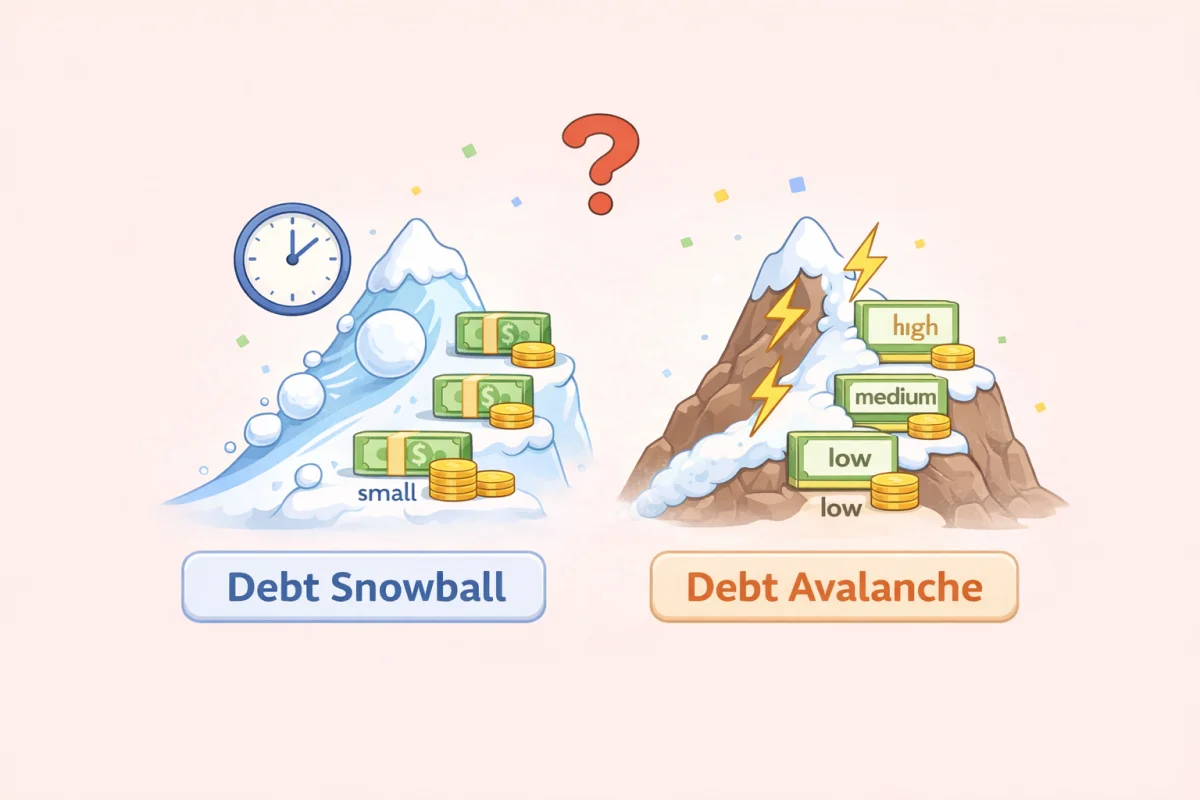 Debt Snowball vs Avalanche: Which Payoff Method Actually Works Better?
Debt snowball and debt avalanche both help you pay off debt faster, but they work differently. This guide explains how each method works, when each makes sense, and how to choose the better payoff strategy.
 Should You Pay Extra on Your Mortgage? How to Decide With Real Numbers
Extra mortgage payments can save years of interest, but they are not always the best use of cash. This guide explains when paying extra on your mortgage makes sense and when it may not.
 Should You Pay Off Debt Early or Invest? A Practical Guide to the Real Tradeoff
Paying off debt early feels safe, but investing can sometimes win mathematically. This guide explains how to compare loan payoff against investing, interest rates, inflation, and peace of mind.