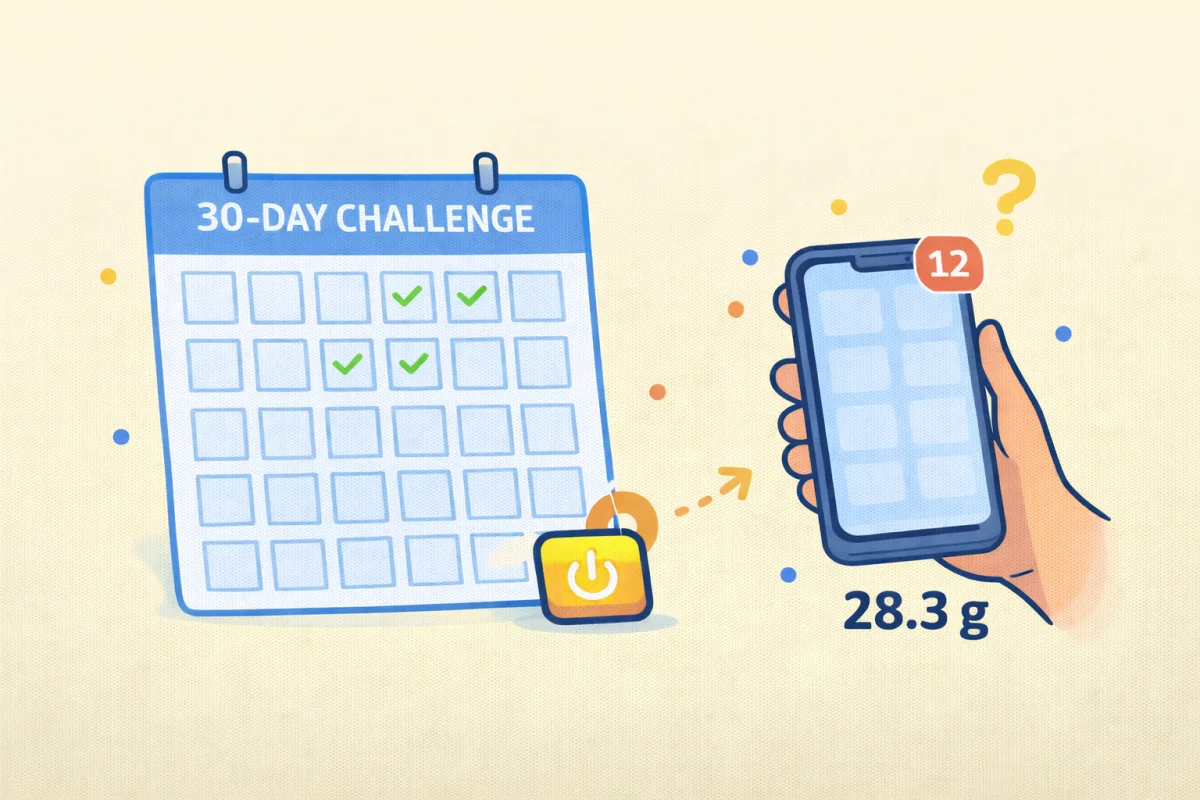
How to Start a 30-Day Challenge and Actually Finish It
Thirty days is long enough to create momentum and short enough to feel possible.
That is exactly why 30-day challenges are so popular. They turn vague self-improvement goals into something with a beginning, an end, and a daily structure. Instead of saying “I want to be more disciplined,” people say, “I’m doing this for 30 days.” That shift sounds small, but it changes the psychology of the goal completely.
It is also why people search for 30-day challenge ideas, how to start a 30-day challenge, and how to stay consistent for 30 days. The challenge format is appealing, but most people already know the real problem is not starting. It is finishing.
Why 30-Day Challenges Work So Well
The format has a few built-in strengths:
- it feels finite
- it creates daily accountability
- it removes the need to “feel motivated” every day
- it gives progress a visible timeline
A challenge is easier to commit to than a permanent identity change. Saying “I’ll do this for the next 30 days” is psychologically lighter than saying “this is my new life forever.”
That makes the challenge format especially good for:
- habits
- fitness routines
- writing practice
- reading goals
- focus and productivity experiments
If you want a structured way to build and track one, the 30-Day Challenge Builder is designed for that exact use case.
The Biggest Reason People Quit Early
Most people do not fail because the idea was bad.
They fail because the challenge was designed badly from the start.
Common examples:
- the daily task is too ambitious
- the rules are vague
- the challenge depends too much on motivation
- the outcome is not measurable
- one missed day feels like total failure
A good 30-day challenge is not just inspiring. It is survivable.
How to Pick the Right 30-Day Challenge
The best challenge is not the most impressive one. It is the one you can repeat on an ordinary day.
Good challenge ideas usually have three qualities:
- clear daily action
- low enough friction to repeat
- obvious proof that you did it
Examples:
- write 200 words a day
- walk 20 minutes a day
- read 10 pages a day
- practice a language for 15 minutes a day
- do one focused work sprint every weekday
These are better than vague goals like:
- “be healthier”
- “be more productive”
- “improve myself”
The more specific the action, the easier it is to stick with.
Make the Daily Version Smaller Than You Think
This is one of the most important rules.
People often choose the version of the challenge that matches their most ambitious self instead of their average self.
That is a mistake.
If your challenge is too heavy, you create friction every single day. If it is small enough to complete even on a bad day, consistency becomes much more likely.
A challenge you can finish imperfectly is stronger than one that collapses under idealism.
Track Completion, Not Perfection
One reason 30-day challenges work is that they create a visible chain of effort.
That only helps if the tracking is simple.
You usually need:
- a clear daily checkbox
- a visible calendar or streak
- one definition of what “done” means
Complicated tracking systems often create more resistance than momentum.
This is where challenge tools are useful: they reduce the friction between intention and proof.
What to Do When You Miss a Day
This is where many people lose the challenge for no good reason.
They miss one day and mentally convert it into:
- “I failed.”
That is not discipline. That is fragile thinking.
A better rule is:
- miss once if needed
- do not miss twice in a row
That protects momentum without turning one imperfect day into the end of the project.
Why a 30-Day Challenge Helps Productivity
The format works particularly well for productivity because it removes daily negotiation.
Instead of asking:
- “Do I feel like doing this today?”
you ask:
- “Is this today’s challenge task?”
That reduces decision fatigue and helps useful behavior happen more automatically.
For writers, creators, founders, students, and knowledge workers, this matters a lot. The challenge format is not just about intensity. It is about making consistency easier than procrastination.
Common 30-Day Challenge Mistakes
1. Choosing a Goal That Is Too Big
If the daily task is exhausting, the challenge becomes a burden instead of a structure.
2. Making the Rules Too Vague
If “done” is not clearly defined, excuses multiply fast.
3. Relying on Motivation
The point of the challenge format is to reduce dependence on mood.
4. Treating One Missed Day as Failure
That mindset destroys more consistency than the missed day itself.
A Better Way to Finish Strong
If you want to complete a 30-day challenge, the best structure is usually:
- small daily action
- visible tracking
- low-friction rules
- a recovery plan for imperfect days
That may sound less dramatic than a heroic all-in transformation, but it is much closer to what actually works.
Final Takeaway
If you want to start a 30-day challenge and finish it, the most important step is choosing a daily action small enough to survive real life and clear enough to track without debate. The challenge format works because it creates structure, not because it turns you into a different person overnight.
Use the 30-Day Challenge Builder to define the challenge, track it clearly, and give yourself a better chance of reaching day 30 without relying on willpower alone.