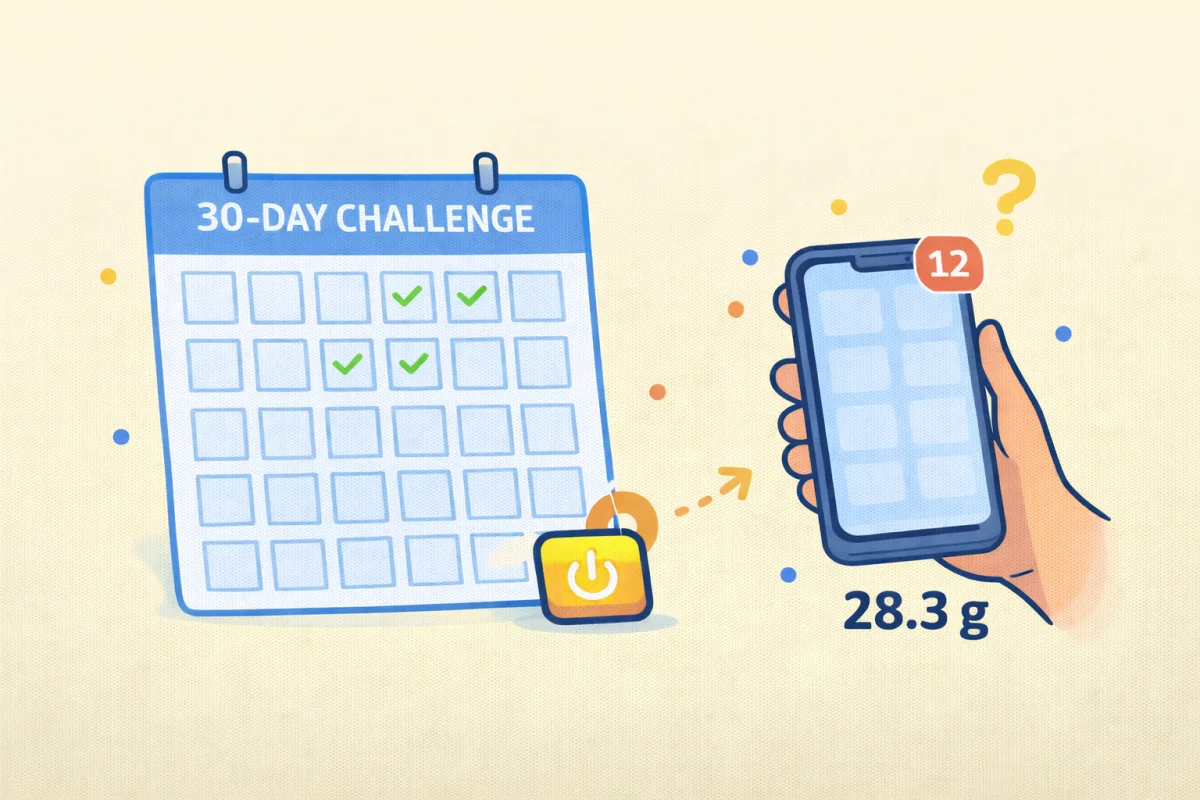
Do 30-Day Challenges Actually Work?
The short answer is: sometimes. And understanding when they work — and why they often don't — is more useful than either blind optimism or dismissing them outright.
Millions of people start a 30-day challenge every month. A significant chunk quit within the first week. Some finish and feel nothing changed. Others finish and find a habit that actually sticks. The difference between those outcomes is rarely willpower. It is almost always structure.
What the Research Actually Says About 30 Days
The popular idea that habits take 21 days to form comes from a loosely interpreted observation by plastic surgeon Maxwell Maltz in the 1960s. He noticed patients took roughly 21 days to adjust to changes in their appearance. That got turned into a self-help rule of thumb with no real evidence behind it.
A more rigorous study from University College London tracked how long it actually took people to form habits — things like eating a piece of fruit with lunch or doing 50 sit-ups after breakfast. The range was 18 to 254 days, with an average of 66 days. The simple habits (eating a specific food) formed faster. The physical ones took longer.
So 30 days is not a magic number. But it is not arbitrary either. It is long enough to get past the awkward early phase where the new behavior still requires conscious effort. It is short enough that most people can stay motivated to reach the finish line. Those two things together make it genuinely useful as a framework, even if it is not a complete solution.
When 30-Day Challenges Work Well
They work best when a few conditions are in place.
The behavior is specific and small. "Exercise more" almost never works. "Do 10 minutes of stretching before bed" has a real shot. The more concrete the action, the less room there is for daily negotiation with yourself.
There is a trigger attached to it. Habits that get anchored to an existing routine — after coffee, before lunch, right when you sit at your desk — form faster than habits that exist in a vague "sometime today" slot. If your challenge has no clear trigger, you are relying on memory and motivation, which both fade.
You track it visibly. This is one of the more consistent findings in behavioral research: visible progress creates its own momentum. A streak you can see is something you do not want to break. That is the entire psychology behind why 30-day challenge trackers work — they turn an invisible internal commitment into something physical you interact with every day.
The goal is the behavior, not the outcome. People who frame a challenge as "do 10 minutes of reading every day" tend to do better than people who frame it as "read three books." You control the behavior. You don't fully control the outcome. Tracking what you actually do keeps you focused on what you can actually influence.
When They Don't Work
When the bar is set too high on day one. Starting a 30-day fitness challenge with a 90-minute workout is a recipe for quitting by day five. The first few days feel energizing, but fatigue and life get in the way. A challenge you can complete on a bad day is far more valuable than one that only works when everything goes perfectly.
When the habit has no place in your existing routine. Adding something completely new to an already packed schedule without removing or rearranging anything else usually fails quietly. The new habit loses the real-estate battle to everything that was already there.
When you're chasing the wrong thing. A 30-day challenge to "stop procrastinating" or "be more productive" doesn't have a clear daily action. It's an aspiration disguised as a challenge. Vague goals produce vague results.
When missing a day becomes quitting. One missed day is not failure. Most people who abandon challenges do so not because they miss a day but because they treat missing a day as disqualifying. That thinking is the actual obstacle, not the missed day itself.
The Difference Between Finishing and Actually Changing
Finishing a 30-day challenge is an achievement. But it does not automatically mean the habit is built.
What finishing does is give you real data about yourself. You find out whether the behavior is sustainable, whether you enjoy it more or less than expected, and whether the results are worth continuing. That information is genuinely useful, even if the habit doesn't stick in its exact original form.
The challenges most likely to produce lasting change are the ones where the behavior starts to feel like part of who you are rather than something you are doing. That shift — from "I'm doing a 30-day challenge" to "this is just what I do" — is the real marker. It doesn't happen automatically at day 30. But 30 days of consistent repetition is often enough to get you close.
A Realistic Way to Approach a 30-Day Challenge
If you want to give yourself the best shot:
- Pick one thing, not three
- Make the daily action small enough that you'd be embarrassed to skip it
- Attach it to something you already do every day
- Track it somewhere you'll actually see it — a printed sheet works better than an app buried on page three of your phone
- Decide in advance what "missing a day" means, so you don't let one slip turn into quitting
The 30-day challenge tracker is a practical starting point. You name the challenge, generate the sheet, and print it. That physical object on your wall or desk does more work than most people expect.
The Honest Bottom Line
30-day challenges work when the goal is specific, the daily action is achievable, and there is some kind of visible tracking in place. They don't work when the goal is vague, the bar is too high, or there's no system to catch you when you miss a day.
The format is sound. What you put into it determines what you get out.