How to Measure Liquid Medications: mL vs Teaspoons vs Fluid Ounces
A prescription says 5 mL. The only measuring device you have is a kitchen teaspoon. A children's syrup says "one teaspoon" but the dosing cup has mL markings. An imported medication lists the dose in fluid ounces but your syringe is calibrated in mL.
These mismatches happen constantly, and getting the conversion wrong with medication is not a minor inconvenience — it can mean under-dosing (ineffective treatment) or over-dosing (potential toxicity). The good news is the math is simple once you know the conversion factors.
The Core Conversions
The two most important numbers for liquid medication measurement:
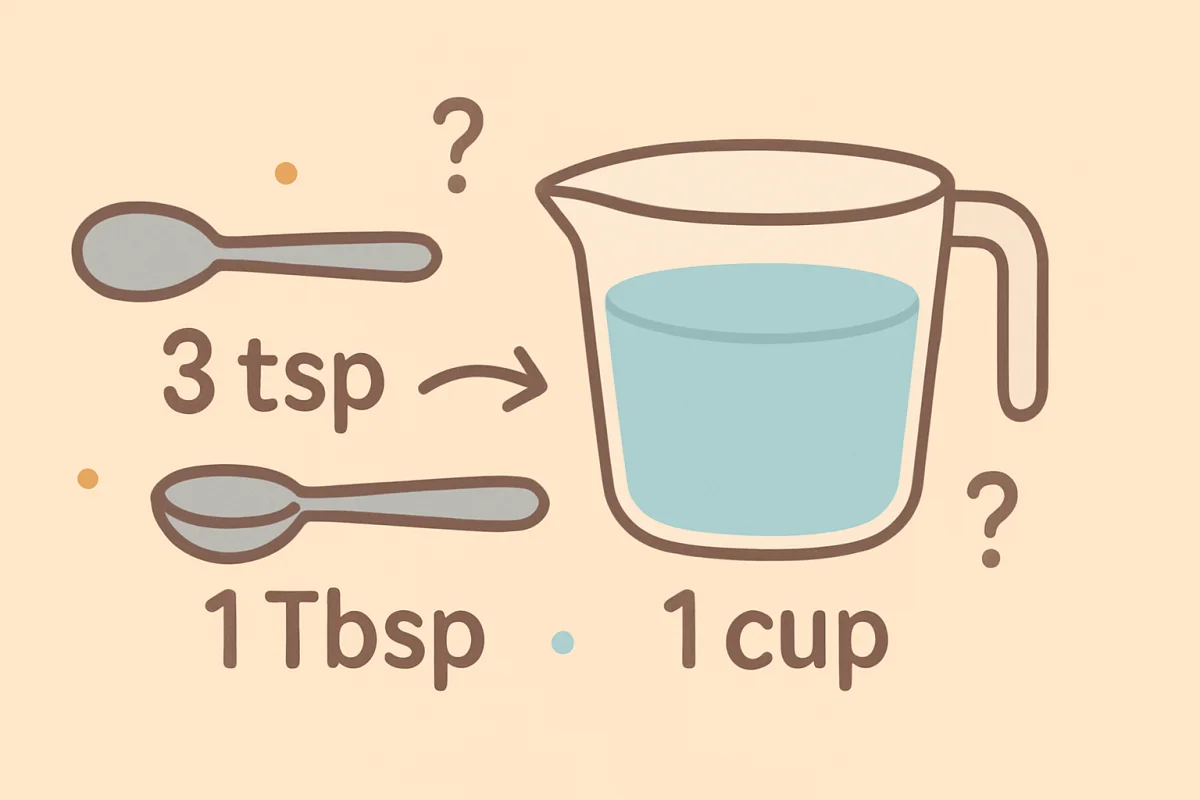
1 teaspoon = 5 mL (exactly, by US pharmacopoeial standard)
1 tablespoon = 15 mL = 3 teaspoons
1 US fluid ounce = 29.574 mL (approximately 30 mL for practical purposes)
So a prescription for 5 mL is exactly one teaspoon. A 10 mL dose is two teaspoons. A 15 mL dose is one tablespoon. These are clean, memorable equivalents.
For fluid ounces: a 1 fl oz bottle of children's medicine contains about 30 mL. A 4 fl oz bottle is about 120 mL.
Use the volume converter to check any conversion quickly, especially for less common doses.
Why Kitchen Teaspoons Aren't Accurate Enough
The "1 teaspoon = 5 mL" equivalence is exact by definition. The problem is that actual kitchen teaspoons vary significantly in volume — from about 3 mL to 7 mL depending on the spoon, how it's filled, and whether the liquid is level or heaped.
A study published in the Annals of Internal Medicine found that household spoons produced doses ranging from 2.5 mL to 7.8 mL when parents measured a "teaspoon" of liquid. For medications with a narrow therapeutic window — meaning the gap between an effective dose and a toxic one is small — this kind of variation matters.
Use a proper measuring device for medications:
- Oral syringes (no needle) are the most accurate for small doses under 10 mL. They allow measurement in 0.1 mL increments and make it easy to give medication directly into a child's cheek.
- Dosing cups (the small plastic cups that come with many OTC medicines) are accurate if read at eye level on a flat surface. Don't estimate from above.
- Dosing spoons (elongated spoons with mL markings on the handle) are more accurate than kitchen spoons but less accurate than syringes.
Never use a kitchen spoon for medication dosing. It's fine for cooking, but not for medicine.
Reading a Dosing Cup Correctly
Dosing cups have multiple scales — typically mL, teaspoons, and sometimes tablespoons or fluid ounces — which can cause confusion if you're not looking at the right one.
Always identify which scale the dose is written in and read from that scale. A common error is reading 5 mL on the teaspoon scale and getting 1 tsp, then reading 1 tsp on the mL scale and getting 5 mL — which is correct — but then accidentally looking at the tablespoon scale and pouring 15 mL.
Read the liquid level at eye level. Looking down at a cup from above will give you an inaccurate reading due to the curved meniscus of the liquid. Bring the cup to eye level, or crouch down to read it on the counter.
Common Dose Conversions at a Glance
| Dose as prescribed | mL equivalent | Teaspoon equivalent |
|---|---|---|
| ½ teaspoon | 2.5 mL | ½ tsp |
| 1 teaspoon | 5 mL | 1 tsp |
| 1½ teaspoons | 7.5 mL | 1½ tsp |
| 2 teaspoons | 10 mL | 2 tsp |
| 1 tablespoon | 15 mL | 3 tsp |
| 1 fl oz | ~30 mL | 6 tsp |
| 2 fl oz | ~60 mL | 12 tsp |
Weight-Based Dosing and Volume
Many pediatric medications are dosed by weight — for example, "10 mg per kg of body weight." This requires two conversions: first calculating the total mg dose from the child's weight, then figuring out how many mL of the liquid formulation provides that dose.
The liquid formulation's concentration is given on the bottle label as mg/mL (milligrams per milliliter). Divide the required dose in mg by the concentration to get the volume in mL.
Example: A child weighs 15 kg. The prescribed dose is 10 mg/kg. Total dose = 150 mg. The suspension is 100 mg/5 mL (which is 20 mg/mL). Volume needed: 150 mg ÷ 20 mg/mL = 7.5 mL.
This is where oral syringes are particularly useful — 7.5 mL is easy to measure in a syringe, but awkward in a dosing cup.
US vs UK Fluid Ounces
If you're using a medication imported from the UK or Europe, be aware that the imperial fluid ounce (used in the UK) is slightly different from the US fluid ounce:
- US fluid ounce: 29.574 mL
- Imperial (UK) fluid ounce: 28.413 mL
The difference is about 4%. For most practical purposes this doesn't matter — if a UK medication says "1 fl oz," treating it as approximately 30 mL is close enough. But if you're calculating doses from a bottle size ("how many doses are in this bottle?"), knowing the exact volume matters.
The label on most UK medications will also show mL equivalents, so use those directly rather than converting from fl oz.
Storing and Measuring Concentrated Medications
Some medications come in concentrated form intended to be diluted, or are prescribed in very small doses (under 1 mL). These require the most precision.
For doses under 1 mL, an oral syringe with 0.1 mL graduations is essential. Measuring 0.5 mL in a dosing cup is impractical — the volume is too small to read accurately.
If you've been given a medication without a measuring device, ask your pharmacist for an oral syringe. Most pharmacies provide them for free, and they're far more accurate than anything improvised from the kitchen drawer.
When in Doubt, Ask the Pharmacist
If you're confused about how to measure a prescribed dose — the device you have doesn't match the units on the prescription, or you're not sure whether the concentration on the label affects the volume you should give — call the pharmacy. This is exactly what pharmacists are there for, and there's no such thing as a too-basic question about medication dosing.
The volume converter is useful for double-checking conversions between mL, fluid ounces, and teaspoons, but for anything involving medication and children or narrow-therapeutic-window drugs, verify with a pharmacist rather than relying on calculator math alone.