How to Plan an Open-Plan Living and Dining Room Layout
Open-plan spaces are popular for good reasons: natural light travels further, the space feels larger, and conversation flows between areas. The downside is that without walls to define boundaries, everything can blur into one undifferentiated space that feels like nobody's room in particular.
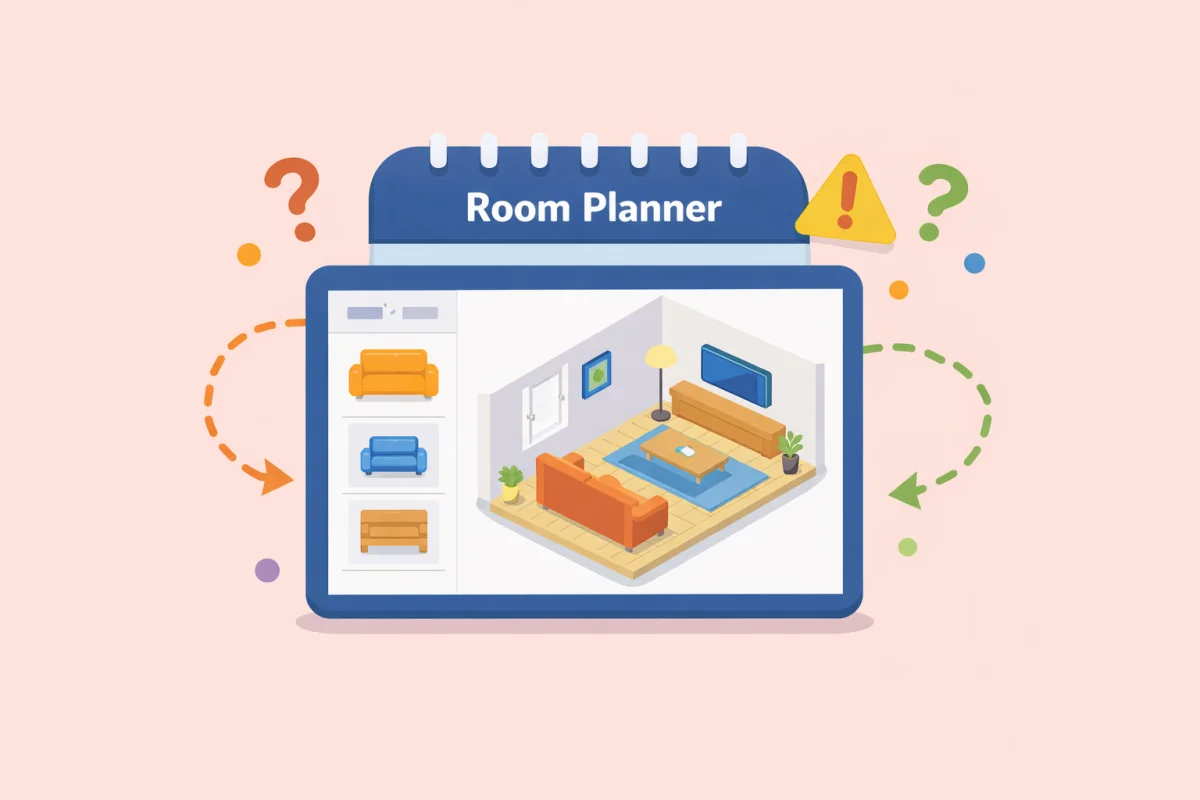
Good open-plan layout is mostly about creating zones — clear areas for each function — without building walls to do it. The Room Planner lets you test these zone arrangements in 3D before you move a single piece of furniture. This article covers the specific decisions that make open-plan layouts work.
The Core Challenge: Zones Without Walls
A combined living and dining area has two primary functions that need different arrangements:
- Dining: chairs around a table, often formal, oriented toward each other
- Living: seating arranged for conversation and screen viewing, more casual
The layout needs to accommodate both, create a clear visual distinction between them, and leave enough room to move through the space naturally.
The three main tools for defining zones without walls:
Rugs. A rug under the sofa and coffee table defines the living zone. A rug under the dining table defines the dining zone. Even if everything else is identical, rugs send a clear signal about where each zone starts and ends. This is the simplest and most flexible zone definition tool.
Furniture arrangement. Turning the back of the sofa toward the dining area creates a natural soft boundary. The sofa becomes a room divider as much as a piece of seating. The back of the sofa faces the dining area; the front faces the TV or living focal point.
Lighting. A pendant light directly over the dining table anchors it visually and functionally. A floor lamp or overhead downlights in the living zone reinforce the distinction. Different lighting creates different moods for each area.
Getting the Proportions Right
One of the most common open-plan mistakes is scaling the furniture wrong. A sofa that works in a small separate living room can look lost in an open-plan space where the ceiling and floor area are both larger.
Living zone: In an open-plan room, the sofa can often be larger — an L-shaped sofa or a large 3-seater — because the visual scale of the space supports it. Avoid the instinct to go small in an open plan; the room will feel underfurnished.
Dining zone: The table should be sized for the number of people you regularly host, not for maximum capacity. A table that seats 8 when you typically eat with 4 will dominate the space unnecessarily. An extendable table is usually the right answer — seats 4 normally, extends to 6 or 8 for hosting.
The gap between zones: Leave at least 90 cm–1.2 m between the back of the dining chairs when pulled out and any adjacent furniture or wall. When guests stand and move between table and living area, they need clearance.
Living Zone Layout in an Open-Plan Room
The living zone in an open-plan space faces a decision that separate living rooms don't: which wall to use as the focal point?
If there's a TV, it typically anchors the seating arrangement. In an open-plan space, the TV wall is often on the shorter wall — placing it on a long wall can make the viewing distance too great and leave too much floor area in front of it.
Position the sofa with purpose. Many people push the sofa against the wall farthest from the TV, leaving a large gap of unusable floor between the sofa and the coffee table. Pulling the sofa into the room — even 40–60 cm away from the wall behind it — creates a more intentional seating arrangement and better viewing distance.
Use a rug to pull the zone together. The rug should be large enough that the front legs of all seating pieces rest on it. A rug that only sits under the coffee table, with the sofas floating off it, looks undersized and fails to define the zone. In a large open-plan room, this might mean a 2.5m × 3.5m or larger rug.
Keep the living zone out of traffic paths. In an open-plan space, people move between the kitchen, dining area, and living area regularly. The seating arrangement should not require guests to walk through the middle of the seating group to reach another part of the room.
Dining Zone Layout and Table Placement
The dining table's position depends on proximity to the kitchen (for serving) and the relationship to the living zone.
Proximity to kitchen: Ideally 1–2 meters from the kitchen counter or at least in direct line of sight, making it practical to carry food. Tables placed too far from the kitchen make every meal service awkward.
Clearance around the table: Allow at least 90 cm between the edge of the table and any wall or furniture behind a chair. This lets chairs be pulled out without hitting anything, and lets people pass behind seated guests. In a tight open-plan room, 75 cm is the absolute minimum — below this, the dining area becomes uncomfortable.
Table shape:
- Rectangular: works well in elongated spaces, can seat the most people, but leaves dead corners
- Round or oval: better for conversation, no sharp corners to navigate around, works well in more square spaces
- Extendable: best of both — compact for daily use, extended for guests
Common Open-Plan Layout Mistakes
Centering the sofa in the room. An open-plan room is large, but centering the sofa leaves large awkward gaps on both sides and at the back. Instead, define the living zone clearly with the sofa anchored to one area, with the back of the sofa creating a soft boundary between living and dining.
Undersizing the dining table. A table for 4 in a space that could comfortably hold 6–8 looks lost. Size the table to match the room's visual weight, not just the number of daily users.
Ignoring circulation. In an open-plan space, there are usually multiple routes people take through the space: kitchen to dining, dining to living, living to the hallway or bathroom. None of these paths should require walking through the middle of a seating group or squeezing past furniture.
Using two small rugs. Two small rugs — one in the living zone, one in the dining zone — often look fragile rather than intentional. Err on the side of larger rugs in both zones. In the dining zone, the rug should extend at least 60 cm beyond the table edge on all sides so chairs remain on the rug when pulled out.
Testing the Layout Before Committing
Open-plan furniture is heavy and hard to rearrange once positioned. The room's furniture layout is also more consequential than a single room because the decisions affect multiple zones simultaneously.
Use the Room Planner to test several configurations before buying or moving anything. Specifically:
1. Verify that the rug size in both zones is large enough 2. Check that there's 90 cm of clearance around the dining table on all sides 3. Confirm there's a clear path from the kitchen to the dining table without going through the living zone 4. Make sure the sofa-to-TV distance is in the comfortable viewing range (roughly 1.5–2.5× the TV diagonal) 5. Verify that no furniture forces the main circulation path through the center of a seating group
Getting the layout right at the planning stage is much easier than adjusting after you've placed an 80 kg sofa.