How to Layout a Living Room with Both a Fireplace and a TV
Two focal points, one room. A fireplace on one wall, a TV on another — or sometimes both competing for the same wall. This is one of the most common layout challenges in living rooms, and it has several workable solutions depending on the room shape, where the fireplace sits, and how you actually use the space.
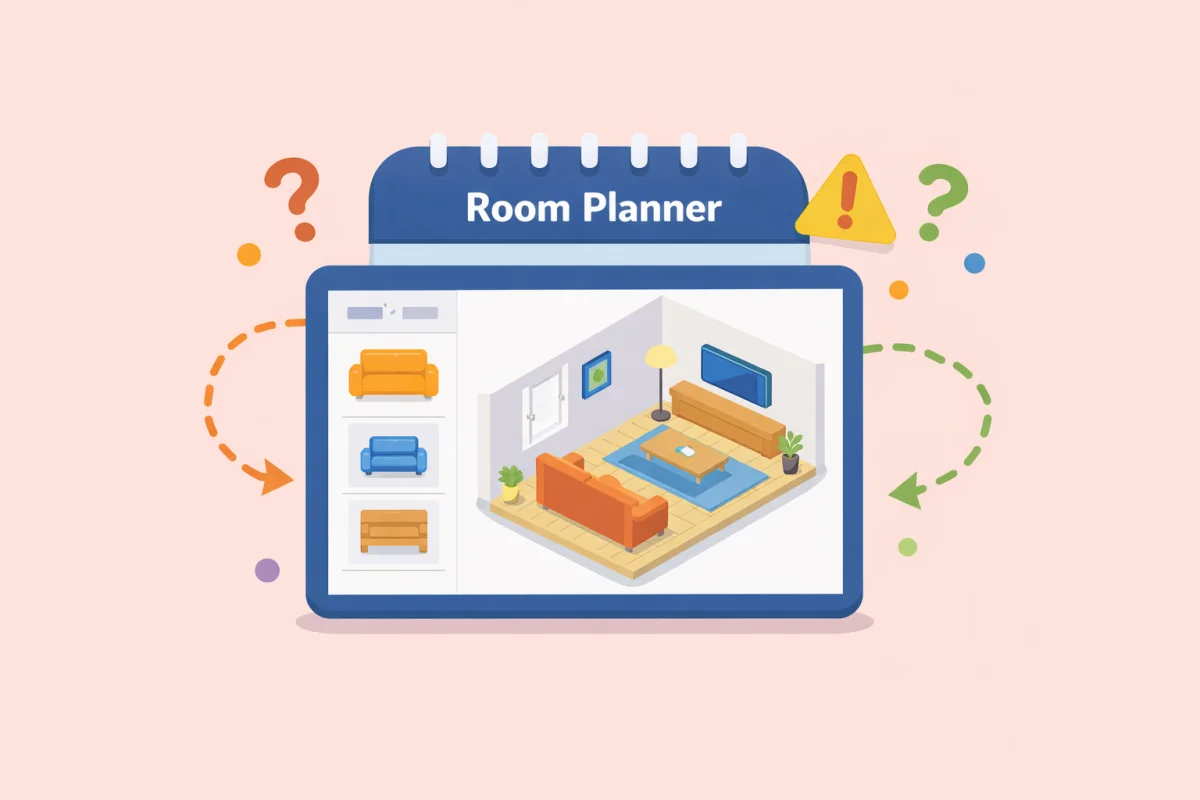
Before moving anything, map it out in the Room Planner so you can test different arrangements without lifting a piece of furniture. The isometric view makes it much easier to judge whether seating actually faces both focal points, or just one.
The Core Problem: Two Focal Points vs One Seating Zone
Most living room layouts work best when seating faces one clear focal point. The sofa, chairs, and coffee table form a natural conversation area, and everyone in it has a clear sightline to whatever the room is oriented toward.
Add a second focal point — especially one at a 90-degree angle to the first — and the arrangement stops being obvious. Where does the sofa face? Where do chairs go? How do you watch TV without turning your neck, and how do you enjoy the fireplace without ignoring the screen?
The answer depends on where the fireplace and TV are located relative to each other.
Scenario 1: Fireplace and TV on the Same Wall
This is the simplest configuration. If the fireplace has a chimney breast or a mantel, you can mount the TV above it — though that comes with tradeoffs — or position the TV to one side.
Mounting the TV above the fireplace is popular but often uncomfortable. The ideal TV viewing height is roughly eye level when seated, which is approximately 90–110 cm from the floor. A fireplace mantel typically sits at 120–140 cm, which puts the TV at 150–180 cm — too high for comfortable extended viewing. You'll tilt your neck upward constantly, and after an hour it shows.
For occasional viewing or a room where TV is secondary, it works. For a room where the TV gets regular use, mounting it above the fireplace trades aesthetics for ergonomics.
A better approach: mount the TV on a swivel bracket at a lower height beside the chimney breast, or place it on a media unit to one side of the fireplace. Both focal points are on the same wall, seating can face that wall directly, and the TV is at a comfortable height.
Seating arrangement: A three-seater sofa facing the fireplace wall, positioned 2.5–3.5 m from the TV, with an armchair angled slightly to offer both fireplace and TV views. The angled chair works as a flexible position for when the fireplace is the attraction and someone wants to face it fully.
Scenario 2: Fireplace and TV on Opposite Walls
This creates a genuine conflict — if the sofa faces the fireplace, it faces away from the TV, and vice versa.
Options:
Choose one primary focal point. Decide whether this room is more about the fireplace or more about the TV. In a family room that gets heavy daily use, the TV usually wins as the primary orientation, and the fireplace becomes a supplementary feature. In a formal sitting room used for entertaining, the fireplace often takes priority.
Place the sofa and primary seating facing the primary focal point. Add one or two chairs that can rotate or that are angled to face the secondary focal point.
Place seating in the center, angled. If the room is large enough, a floating seating arrangement in the center — sofa and chairs pulled well away from both walls — allows furniture to be angled to split the difference. Two armchairs at roughly 45 degrees give an acceptable view of both walls. It works better in rooms 5 m or wider; in smaller rooms it often feels awkward and reduces circulation.
Use a TV mount that swivels. A full-motion swivel arm for the TV lets you point it toward the seating when you're watching, and rotate it away when the fireplace is the focus. This works when the TV is on an adjacent wall or in a corner rather than directly opposite.
Scenario 3: Fireplace and TV on Adjacent Walls
This is the easiest configuration to work with. The fireplace is on one wall, the TV is on the wall to its left or right — 90 degrees apart.
Corner seating configuration: An L-shaped sofa or a sofa-and-armchair arrangement placed in the corner diagonal to both focal points gives good sightlines to both without requiring anyone to turn their head severely. The corner of the room between the two walls becomes the natural anchor point for seating.
Standard sofa with angled chairs: A sofa facing one focal point, two armchairs facing the other. The chairs and sofa form a conversation zone in between, and people can choose which focal point to face. This works particularly well for a three-seat sofa facing the fireplace, with chairs on the other axis facing the TV.
A good concrete example: fireplace on the north wall, TV on the east wall. Sofa positioned in the southwest corner, facing northeast — splitting the angle between both. Two chairs against the south wall, facing north toward the fireplace. The gap between sofa and chairs forms the seating area, the coffee table goes in the middle, and both focal points are accessible from multiple seats.
Clearance and Viewing Distance
Regardless of layout, viewing distance from the TV affects comfort significantly.
Recommended TV viewing distance by screen size:
| TV size | Minimum distance | Comfortable range |
|---|---|---|
| 43" | 1.8 m | 1.8–2.5 m |
| 55" | 2.3 m | 2.3–3.2 m |
| 65" | 2.7 m | 2.7–3.8 m |
| 75" | 3.2 m | 3.2–4.5 m |
| 85" | 3.6 m | 3.6–5.0 m |
For a fireplace, 2.0–3.5 m from the seating creates warmth without overheating. If you're placing seating equidistant between both focal points, check that it satisfies both these minimums. Seating too close to the fireplace becomes uncomfortable in winter; seating too far from the TV makes content hard to watch.
Walkway Clearance Around Furniture
Whatever layout you choose, maintain at least 90 cm of clear walkway between the sofa and any wall or large furniture piece. Between the coffee table and the sofa, 40–50 cm is the minimum for reaching across comfortably; 50–60 cm is better for getting up without squeezing.
In rooms with both a fireplace and TV creating two activity zones, there's often a temptation to pull furniture tightly together to serve both — which can block circulation paths. Test the layout in the Room Planner and trace the paths someone would walk from the entrance to each seating position, to the fireplace hearth, and to the TV. If any path requires squeezing between pieces, adjust.
When to Use Rugs to Define Zones
In larger living rooms where the fireplace and TV create two genuinely separate activity areas, rugs can delineate two distinct zones within the same room.
One seating group with a rug oriented toward the fireplace. A second seating cluster — maybe just two chairs and a small table — with a separate rug oriented toward the TV. This works in rooms above about 25 m² where there's enough floor area to support two defined areas without crowding.
In smaller rooms, two rugs compete visually and make the space feel busier. In those cases, one rug defining the main seating area works better, with the secondary focal point accommodated by seating arrangement rather than a separate zone.
Testing Your Layout
Map the room dimensions and both focal point positions in the Room Planner first. Place the fireplace as a fixed element on its wall, then experiment with:
1. TV on the same wall — sofa facing both 2. TV on the adjacent wall — L-arrangement seating in the diagonal corner 3. TV on the opposite wall — sofa facing primary focal point, chairs facing secondary
For each arrangement, check viewing distances, check walkway clearance, and look at the isometric view to see whether it feels balanced or lopsided. Most people find option 3 (adjacent walls) offers the best compromise between both focal points with the widest range of seating positions that work.