How to Plan a Dining Room Layout
Dining rooms look deceptively simple to plan. It is just a table and some chairs, right?
The problems come later. The chairs cannot be pulled out without hitting the wall. The path from the kitchen to the table is tight enough that someone carrying plates has to turn sideways. The table seats six on paper but feels cramped in practice because the room is smaller than it looked.
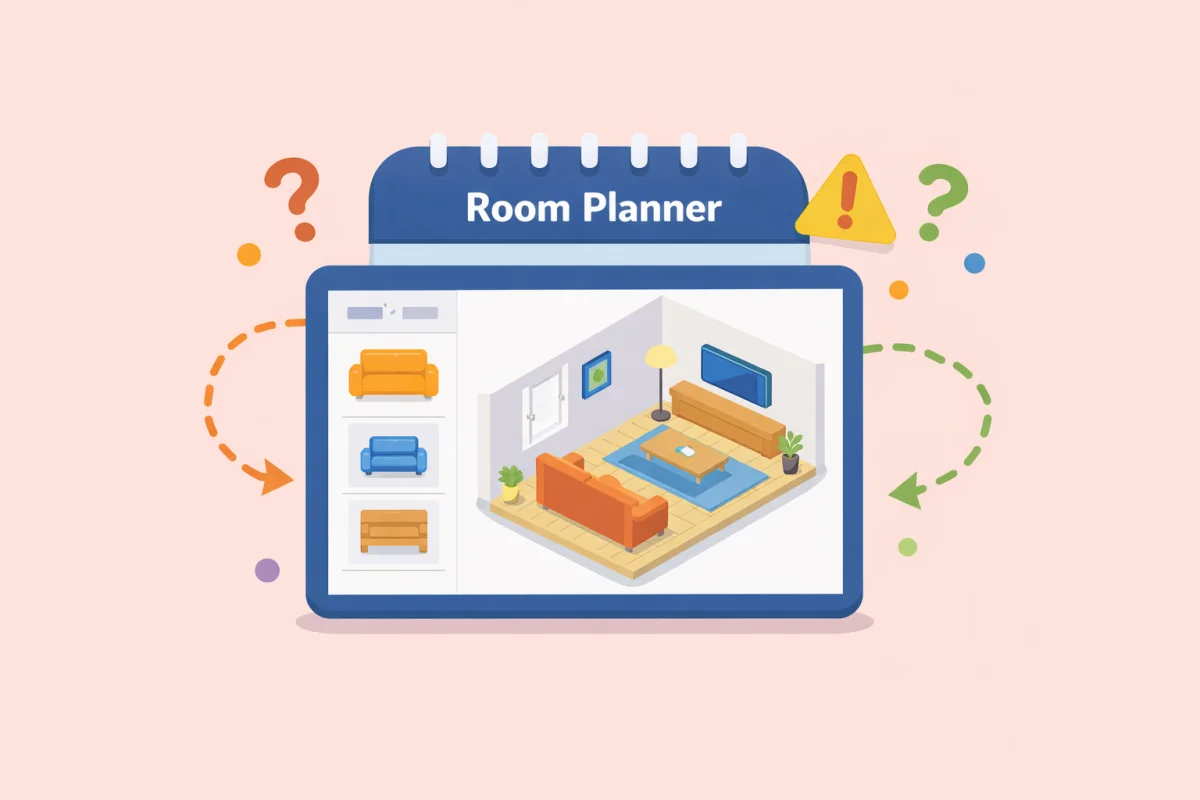
These are fixable problems — but only if you catch them before committing to furniture. The Room Planner lets you test layouts in 3D with accurate dimensions before anything is moved or bought.
Start With Clearance, Not the Table
Most people start dining room planning by choosing a table. A better starting point is understanding how much clearance the room needs, and then figuring out what table fits within that.
The key clearances:
Chair pull-out space: You need at least 90 cm between the edge of the table and any wall or obstacle. This gives someone room to pull out a chair and sit down without scraping the wall behind them. 100–110 cm is comfortable; anything under 75 cm is genuinely difficult to use.
Walk-behind clearance: If people need to pass behind seated diners — which happens constantly during a meal — you need at least 105–120 cm from the table edge to the wall or sideboard. This allows a person to squeeze through; for comfortable passage with food or plates, 120 cm or more is better.
Door swing clearance: Any door that opens into the dining room needs its full swing arc to be clear of furniture, including chairs pulled out from the table.
Run these numbers against your room dimensions before you look at any tables. What remains is the maximum table footprint your room can support.
Choosing the Right Table Size
Once you know the available footprint, choosing a table becomes much simpler.
A rough guide for table sizes and what they seat comfortably:
| Table size | Seats comfortably |
|---|---|
| 120 cm round | 4 people |
| 90 × 150 cm rectangle | 4–6 people |
| 90 × 180 cm rectangle | 6 people |
| 90 × 210 cm rectangle | 6–8 people |
| 100 × 240 cm rectangle | 8 people |
| 120 cm round | 4–5 people |
| 150 cm round | 6 people |
Allow roughly 60–70 cm of table width per person along the sides, and 45 cm per person at the ends of a rectangular table. Below these minimums, elbows are touching and the experience is uncomfortable.
The extension table option: In a small dining room that needs to accommodate more guests occasionally, an extension table is worth considering. A table that seats four comfortably every day but can extend for six or eight at Christmas is often a better fit than one that permanently maximises capacity at the cost of daily usability.
Round vs Rectangular Tables
The shape choice affects both capacity and traffic flow.
Rectangular tables work best in rectangular rooms. They align naturally with the room geometry and make good use of the space. The long sides seat the most people, and the short ends are good for hosts or guests who need easy access in and out.
The downside: corners are wasted space. Seating six at a rectangular table places two people at each end in positions that can feel socially isolated from the people across the table.
Round tables create more equal seating — everyone can see and talk to everyone else naturally. They also have no corners, which means they use space more efficiently relative to their seating capacity.
The downside: round tables do not fit rectangular rooms as well. A large round table in a narrow rectangular room leaves awkward triangular dead space in the corners. Round tables also cannot seat as many people in a given footprint as a rectangular table can.
Oval tables split the difference — the round seating dynamic without as much corner waste, but they take up more room than a round table of similar capacity.
In a small room, a round table almost always works better than rectangular. In a larger, properly proportioned room, rectangular is usually the better choice.
Traffic Flow Through the Dining Room
A dining room is not just a place where people sit. It is also a path.
Think about the routes that need to work during a meal:
- From the kitchen to the table (carrying food)
- From the table to the kitchen (clearing plates)
- Around the table to reach different seats
- To and from any sideboard or drinks storage
These paths need to be clear without requiring seated diners to move their chairs. The 90–120 cm clearance guidelines above are built around this. If a route through the room requires navigating past pulled-out chairs, you will know it every time you have guests.
When planning the layout, trace the main routes through the room and check whether they work with the table and chairs in position. This is where the Room Planner is most useful — it is much easier to see traffic flow problems in a visualised layout than to imagine them in a blank room.
Sideboard and Storage Placement
A sideboard, buffet, or drinks cabinet in the dining room adds useful storage but reduces the available clearance if placed carelessly.
The best position is usually along a wall that is not on a main traffic route — ideally not the wall between the dining room and the kitchen. Placing it on a side wall keeps it accessible without adding another obstacle to the most-used paths.
A sideboard that requires diners to move their chairs to access it during a meal is in the wrong place.
If the room is tight, consider whether a sideboard is actually necessary or whether the storage function could be better served elsewhere. One less piece of furniture often makes a small dining room noticeably more usable.
Lighting and Its Effect on Perceived Space
Lighting is a planning consideration, not just a finishing touch.
A pendant light or chandelier over the dining table should be centred above the table — not centred in the room. If you plan to move the table from its current position, or if the room has no existing light fitting, check where the light will fall before finalising the table position.
A single ceiling light in the wrong position will be at the wrong height over the table (pendant lights are typically hung 70–90 cm above the table surface) and will require either rewiring or an awkwardly long cord.
If the ceiling has a central light fitting and you want the table off-centre for layout reasons, this is the moment to decide which takes priority — the furniture position or the light fitting.
Practical Layout Sequence
1. Measure the room, including door positions and swing arcs 2. Mark out the required clearances to find your maximum table footprint 3. Choose table shape and size based on that footprint and your seating needs 4. Check that chair pull-out and walk-behind clearances are met 5. Trace the kitchen-to-table traffic route and confirm it works 6. Place any sideboard or additional storage last, on a non-traffic wall 7. Confirm the ceiling light position relative to the final table position
Test the layout in the Room Planner before committing. Dining tables and chairs are heavy, and a dining room rearrangement is a two-person job. Getting it right before moving anything is worth the time.