How to Layout a Shared Bedroom for Two Kids
Two kids, one room. It's a common situation and a genuine layout puzzle — you need to fit two beds, two sets of storage, and ideally some sense of personal space, all without the room feeling like a furniture warehouse.
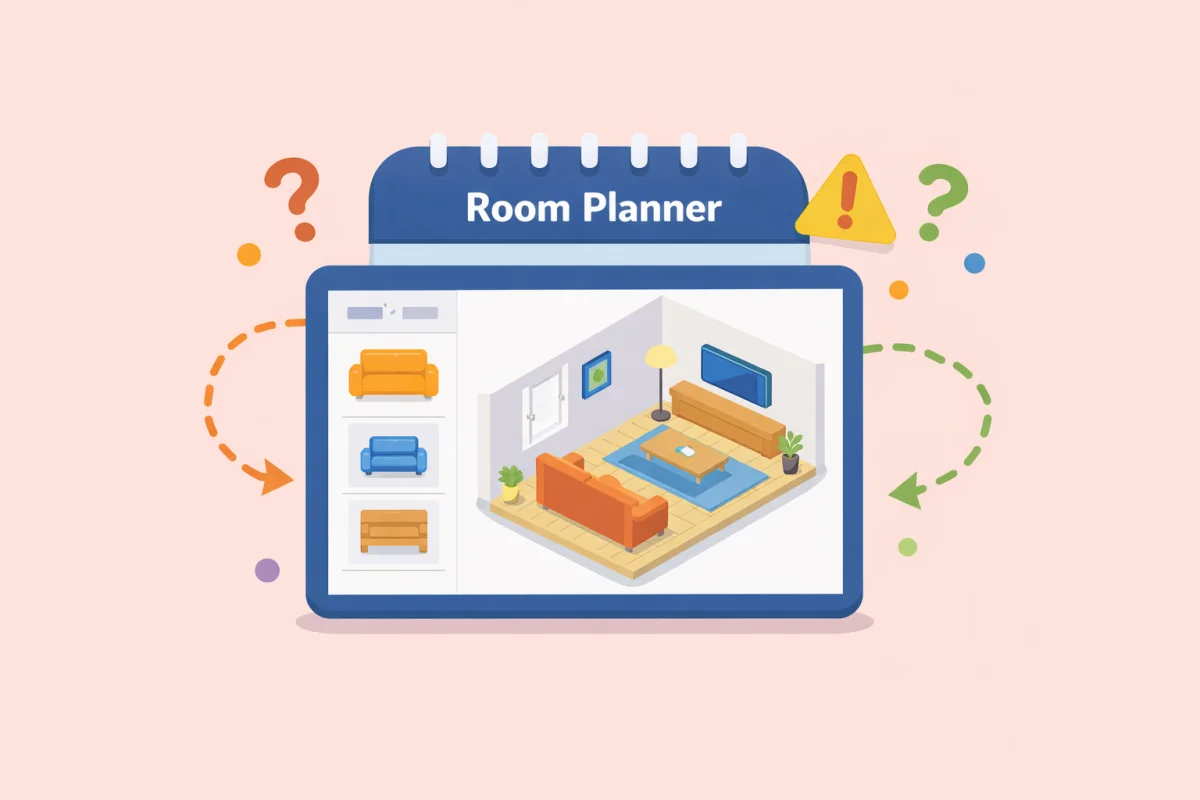
Use the Room Planner to map out your room dimensions and test different configurations before moving anything. This article covers the main layout approaches for shared kids' bedrooms, how to think about zoning, and what clearances actually matter.
Start With the Beds: Three Main Approaches
The bed arrangement defines everything else in a shared kids' room. There are three realistic options, each with trade-offs.
Bunk Beds
Bunk beds are the most space-efficient solution. A standard bunk frame occupies roughly the same floor area as a single bed — around 90 cm × 200 cm — while sleeping two. That leaves significantly more floor space than two separate beds, which matters enormously in a small room.
The trade-offs are real: the top bunk requires a ladder (which takes floor space and can be a hazard for younger children), and the lower bunk may feel dark and confined. Kids under 6 are generally advised to sleep on the bottom bunk for safety reasons.
In terms of layout, push the bunk bed against a wall — usually a long wall, away from the door. Leave 60 cm clearance on at least one open side for access. The ladder can run along the end or the side depending on the frame; check this before committing to a wall placement.
L-shaped bunk configurations — where one bed runs perpendicular to the other — are available and solve the "two beds against one wall" challenge in a square room. They're more expensive and harder to find, but they can work well in rooms where a straight double bunk would block a window or door.
Twin Beds Side by Side
Two twin beds against the same wall is the most familiar layout — it mirrors hotel twin rooms and works well when the room is wide enough. The combined footprint of two twin beds with a nightstand between them runs to about 250–270 cm wide: two beds at 90 cm each plus 60–80 cm gap (or pushed together with a shared nightstand in the center).
This layout works best in rooms at least 3.5 m wide, which allows two beds along one wall with 60–90 cm of clear floor space in front. In narrower rooms, it feels immediately cramped.
The advantage over bunk beds: no ladder, both beds are equally accessible, and neither child has a "worse" sleeping position. The disadvantage: it uses significantly more floor space, leaving less room for desks, storage, and play.
Twin Beds on Opposite Walls
Placing each bed against opposite walls divides the room into two personal zones. This works well for older children who want separation and for siblings with different sleep schedules — one can read with a lamp without disturbing the other.
In a narrow room (under 3 m wide), opposite-wall beds make the floor space between them feel like a corridor rather than a room. In a room at least 3.5 m wide or longer, the gap between the two beds becomes usable floor space — a play area by day.
For rooms that are longer than they are wide, consider placing beds at each end of the long dimension. This maximizes the clear space in the center and gives each child a "end" of the room to call their own.
Zoning: Creating Personal Space Without Walls
Even when two children share a room, a sense of individual territory matters — especially as they get older. You don't need physical walls to create zones.
Visual division with rugs: A rug under each bed (or on each "side" of the room) signals territory. Two different rugs create instant visual separation without any furniture rearrangement.
Bookshelves as dividers: A low bookcase (80–100 cm high) placed perpendicular to the wall — not blocking the room, but creating a partial division — separates the two sleeping areas without blocking light or making the room feel smaller. Each child has storage accessible from their side.
Color or bedding: Different colored bedding, one photo wall per child, or different colored storage bins give each child a distinct zone even in a shared layout. This matters more than it sounds for children who feel their space isn't "theirs."
Curtains on tracks: In bunk bed arrangements, a curtain on the lower bunk gives the bottom sleeper privacy and a sense of enclosure. Some children love this; others find it claustrophobic — test before committing to a curtain rod installation.
Storage: The Part Most Plans Get Wrong
Shared kids' bedrooms almost always run short on storage because the planning focuses on beds and forgets everything else. Two children generate twice the clothing, books, toys, and general accumulation of one.
Built-in storage under beds: Beds with drawers underneath are worth the premium in a shared room. A standard bed with two under-bed drawers adds significant storage without any additional floor footprint. Bunk beds with built-in stairs (rather than a ladder) often include drawer storage in each step.
Wardrobes: Two children need two separate wardrobes or a single large wardrobe clearly divided. Shared wardrobes without dividers result in constant conflict over whose clothes are where. A visual divider — a different colored hanging rail, a piece of tape — is enough for younger children. Separate wardrobes are better if space allows.
Desk storage: If each child has a desk or homework area, that desk should have its own storage — at minimum a drawer or a small set of shelves. Shared desk areas almost never work long-term because each child's materials migrate into the other's space.
Wall-mounted shelving: In a room with limited floor space, vertical storage is the answer. Wall-mounted shelves above each bed or desk double the usable storage without touching the floor plan. Keep heavy items low and light items (books, soft toys) higher.
Clearances That Matter in a Kids' Room
Kids move differently from adults — they run, jump on furniture, pull things off shelves without looking. The clearance rules for a kids' room are slightly different from a standard bedroom:
- 60 cm minimum between the end of a bed and any piece of furniture — children getting up in the night will walk through this space in the dark
- 90 cm in front of wardrobes — enough to fully open doors and pull out drawers while crouching
- 60 cm beside each bed — useful for making the bed, for a parent to sit and read bedtime stories, and for the child to access storage underneath
- Clear floor space for play — aim for at least a 1.5 m × 1.5 m clear area, even in a small room. This is where Lego gets built, games get played, and things happen on the floor. A room without this feels purely functional.
The Room Planner lets you test different configurations and verify these clearances before committing to a layout. Place the beds first, add the wardrobes, then check whether 90 cm of clearance exists in front of each one and whether there's usable floor space remaining.
Age-Specific Considerations
Under 6: Safety is the priority. No top bunks. Leave clear floor space. Avoid furniture with sharp corners at head height. Storage should be accessible to the child without climbing.
6–10: Children this age want some personal space and ownership over their area. Distinct zones matter. Each child should have a surface for drawing, building, or crafts — even if it's a small desk or a clip-on shelf.
10+: Increasingly, older children need a quiet desk for homework. If the room has two children of this age, two separate desks are more important than anything else. They may also want the ability to close off their sleeping area — a curtain on a track, or a loft bed with space underneath for a desk, gives them some separation.
Different ages: When siblings have a significant age gap, their needs conflict. A 4-year-old needs floor space and accessible toy storage. A 12-year-old needs a quiet desk and privacy. If possible, a loft bed for the older child (with desk space beneath) and a low single bed for the younger child can work in the same room — the older child's zone is physically elevated and slightly separate.
A Practical Planning Sequence
1. Measure the room accurately: length, width, door swing arc, window positions, and any built-in alcoves. 2. Enter those dimensions into the Room Planner. 3. Place the beds first — this is the non-negotiable anchor. Try bunk bed position, then same-wall twins, then opposite-wall twins. 4. Add wardrobes — check that doors can open fully. 5. Add desk or homework surfaces if needed. 6. Check clearances: walkways, wardrobe fronts, beside each bed. 7. Identify the remaining clear floor area — is it at least 1.5 m × 1.5 m? If not, reconfigure.
The sequence matters because the common mistake is placing storage first, fitting it against every wall, and then wondering why the beds don't fit comfortably. Beds first, storage second, floor space as a deliberate outcome rather than whatever's left over.