How to Layout a Master Bedroom with Ensuite
A master bedroom with an ensuite is one of those rooms that looks straightforward on paper — bedroom here, bathroom there — but in practice there are a surprising number of ways to get the layout wrong. The ensuite door placement, the wardrobe position, and the bed orientation all affect each other. Get one wrong and you end up with a door that opens into a bedside table, or a wardrobe that blocks natural light, or a bed that sits awkwardly off-center with no good reason why.
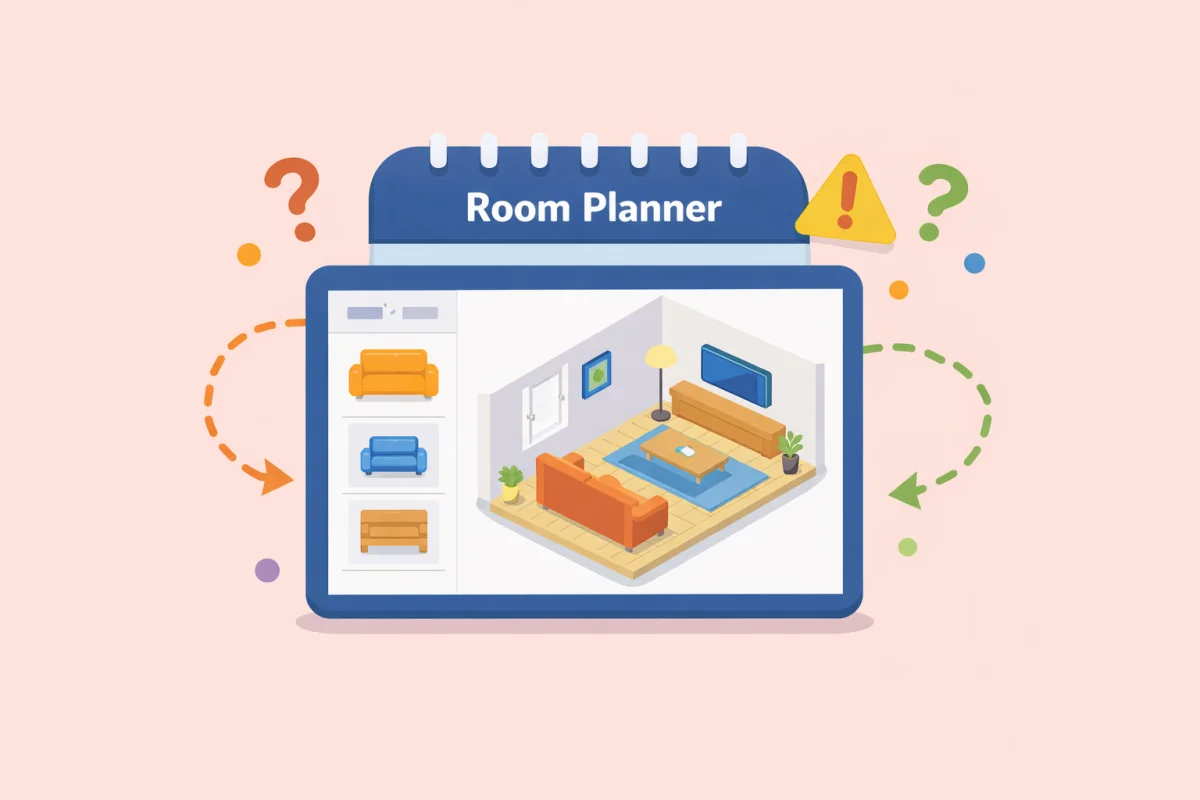
Working through the layout with the Room Planner before making any decisions saves the kind of frustration that only reveals itself when furniture is already in position.
Start by Mapping the Fixed Elements
Before you touch the furniture, mark the immovable elements on the plan:
- Door positions — the main bedroom entry door and the ensuite door
- Windows — where natural light comes from and whether any window is above a potential bed position
- Power outlets — bedside outlets, TV outlet location, USB points
- Radiator or HVAC — heating and cooling units that can't be blocked
In a master bedroom with ensuite, the ensuite door is often the most constraining element. It creates a zone around it that's effectively unusable for large furniture — you need clearance for the door to open fully, plus at least 60–70 cm of standing room in front of it. That zone typically takes a chunk out of one wall.
Map all of this before placing a single piece of furniture. The Room Planner lets you set room dimensions accurately and place these anchor points first.
Bed Placement in a Master Bedroom
The bed is almost always the first piece to place. In a master bedroom it's typically a double (135 × 190 cm), king (150 × 200 cm), or super king (180 × 200 cm). Each of those sizes creates a substantially different planning problem in the same room.
The most common bed placement is centered on the main wall opposite the entry door. This works because:
- The bed faces you as you enter, giving the room a clear focal point
- The wall is usually the longest uninterrupted surface
- It keeps circulation paths clear on both sides
Aim for at least 60 cm on each side of the bed for comfortable access. In smaller rooms this may require a 75–80 cm clearance on one side and 60 cm on the other. Anything less than 60 cm on both sides makes getting in and out of bed feel cramped.
When to Place the Bed on a Side Wall
Sometimes the main wall isn't the best option — particularly when:
- The ensuite door is on that wall and creates a clearance conflict
- A window is centered on that wall and you'd be sleeping under a window
- The room is long and narrow, making a side wall placement more balanced
In a long narrow room (e.g., 3.5 m × 5 m), placing the bed on the short wall and the wardrobes along the long walls often uses space better than the reverse.
Wardrobe Layout Around the Ensuite
Most master bedrooms have built-in or fitted wardrobes. These typically run along one or two walls and can be 60–65 cm deep, which eats into floor space significantly.
The key constraint with an ensuite is that the wardrobe shouldn't block the bathroom door path. Two layouts that work well:
Option 1: Wardrobes flanking the ensuite door If the ensuite is on the back wall, built-in wardrobes on either side of the ensuite door make efficient use of the space while keeping the access path clear. This is a very common configuration in newer builds.
Option 2: Wardrobes on the opposite wall If the ensuite is on a side wall, wardrobes along the opposite wall keep the room clear and balanced. You get a clear walking path from the bedroom door to the ensuite without navigating around furniture.
What to avoid: Placing a wardrobe so that its doors open into the ensuite door swing zone. If both sets of doors are open at the same time — which they will be — you need them to clear each other with at least 10–15 cm to spare.
Ensuite Door Clearance and Traffic Flow
The ensuite is usually used at least twice daily, often in the dark or half-asleep. The path from bed to ensuite needs to be clear of trip hazards.
Measure the ensuite door swing carefully. A standard internal door opens 80–90 cm wide. If it opens into the bedroom, you need that full arc free of furniture. If the door opens inward into the ensuite, this is less of an issue for the bedroom layout — but you need to account for it in the bathroom plan instead.
The most comfortable bedrooms have a clear 90–100 cm unobstructed path from one side of the bed to the ensuite. This is easy to achieve in larger rooms but requires deliberate planning in rooms under 12–14 m².
Placing Additional Furniture
Once the bed, wardrobes, and ensuite clearance are sorted, the remaining furniture slots around them. Common additions in a master bedroom:
Bedside tables — typically 45–60 cm wide, 40–50 cm deep. If access on both sides of the bed is tight, smaller floating bedside shelves can replace floor-standing tables.
Dressing table or vanity — best placed near natural light (by a window) rather than against a windowless wall. A vanity that faces a window gets good natural light for getting ready without casting shadows.
Chest of drawers — works well in the space between a wardrobe and a corner, or under a window where a full-height wardrobe wouldn't fit.
TV — if the bedroom has a wall-mounted TV, it typically goes on the wall facing the foot of the bed. Avoid placing it where it requires the bed to be off-center or where glare from a window hits the screen.
Chair or bench — at the foot of the bed if the room allows it. A 45 cm clearance between the bed end and the foot of the room is usually the minimum comfortable space. A bench works in this gap; a chair needs at least 60–70 cm.
How Room Shape Affects the Layout
Square rooms (e.g., 4 m × 4 m) give the most flexibility — the bed can face almost any wall without creating an awkward layout. The challenge is avoiding a layout that looks directionless.
Rectangular rooms (e.g., 3.5 m × 5.5 m) work best when the bed is placed on the short wall and wardrobes run along the longer walls. This feels more balanced and leaves better circulation space.
L-shaped or irregular rooms often result from the ensuite being carved out of a larger space. The bed almost always goes in the regular rectangular section, with wardrobes filling the alcoves or awkward corners.
Testing the Layout Before Committing
The practical test before moving furniture is to walk the path:
1. From the bedroom door to the bed 2. From the bed (both sides) to the ensuite 3. From the wardrobe(s) to a clear standing space 4. Around the bed end to reach the other side
If any of these paths require turning sideways, squeezing past furniture, or opening one door before another, the layout needs adjustment. The Room Planner makes it easy to try multiple arrangements without any physical effort — move the bed to a different wall, swap wardrobe positions, test different door clearances — before committing to anything in the actual room.