How to Arrange Furniture in a Living Room
Living rooms are usually the hardest rooms to arrange well.
Unlike a bedroom, where the bed tells you where to start, a living room has more options. Sofa here or there? TV on the long wall or the short one? Coffee table in the center or pushed to the side? Every choice affects the next one, and a bad starting decision tends to make the whole room feel off.
Most living room arrangement problems come down to one of three things: furniture that is too big for the space, everything pushed against the walls, or no clear sense of what the room is actually for. Fix those, and the room usually falls into place.
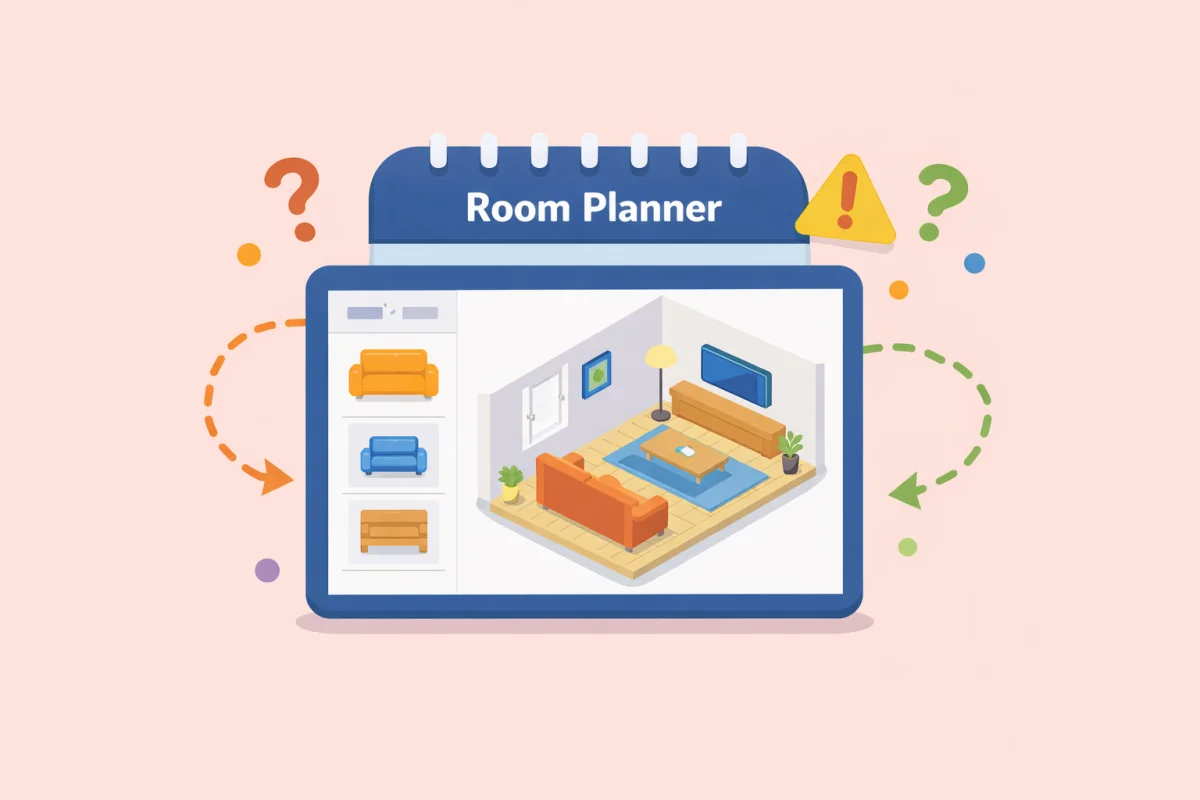
If you want to test layouts before moving anything, the Room Planner lets you try different configurations in a 3D isometric view.
Decide What the Room Needs to Do First
Before placing anything, figure out the room's main job.
Some living rooms are primarily for watching TV. Others are conversation-focused, or double as a home office, or need to function as a kids' play area part of the time. A room that tries to do all of those things equally usually ends up doing none of them well.
Pick the primary function. Then plan the layout around that. If it's mostly a TV room, the seating arrangement should face the screen clearly. If it's a conversation room, the seating should face inward toward the group.
That single decision will resolve most of the tricky choices.
Start With the Sofa
In most living rooms, the sofa is the anchor piece — the same way a bed anchors a bedroom.
Place it first, then build around it.
A few things to decide before committing to a sofa position:
- Which focal point should the sofa face? (TV, fireplace, window)
- How does the sofa placement affect the main walking path through the room?
- Is there enough space behind or beside it for movement?
- Does the placement leave room for side tables or lighting within easy reach?
One thing many people get wrong: pushing the sofa directly against the wall to "create space." This can actually make a room feel smaller and more disconnected. Pulling the sofa even 20–30 cm away from the wall often makes the space feel more intentional and more comfortable to sit in.
Build the Seating Area Around a Focal Point
Every well-arranged living room has a clear focal point — one thing the room is organized around.
Common focal points:
- a TV unit or mounted screen
- a fireplace
- a large window with a view
- a feature wall
Arrange the main seating so it faces the focal point and so people sitting can see it comfortably without turning their heads at an awkward angle. In a TV room, that usually means the screen should be roughly at eye level when seated, and no farther than about 3–4 metres away for comfortable viewing.
If you have multiple seating pieces — sofa and two chairs, for example — arrange them so they form a rough U or L shape around the focal point. That creates a natural group without leaving anyone with their back to everything.
Clearance: The Part Most People Skip
Living rooms feel cramped not because the furniture is too large, but because there is not enough space left around it.
Practical clearance guidelines:
- Main walkway through the room: at least 90 cm
- Clearance in front of the sofa to a coffee table: 35–45 cm — close enough to reach a drink, far enough to move through
- Space behind chairs if people need to walk behind them: at least 60 cm
- Door swing clearance: any door that opens into the room needs space to open fully without hitting furniture
Run through these before finalizing any layout. It is easier to spot problems on paper or in a planner than after you have shoved a sofa into position.
The Coffee Table Question
A coffee table that is too large does more damage than most people realize.
It blocks circulation, makes the room feel heavy, and crowds the seating. A smaller table — or two smaller ones — often works better in a tight space.
The general rule: the coffee table should be about two-thirds the length of the sofa, and roughly the same height as the sofa cushions or a few centimetres lower.
If the room is small, consider alternatives: a pair of nesting tables, an ottoman with a tray on top, or a low bench. These are easier to move and free up visual space.
Rugs Define the Zone
A rug can make or break a living room layout, and it is often placed badly.
The most common mistake: a rug that is too small. A small rug floating in the center of a large seating group looks disconnected and shrinks the room visually.
For most living rooms:
- All the main seating pieces should either sit fully on the rug, or have their front legs on it
- The rug should extend at least 20 cm beyond the edges of the coffee table
If the rug cannot meet that minimum, it is probably too small for the space.
TV Placement Specifics
If the room includes a TV, its placement affects everything else.
A few things to check:
- Avoid placing the TV opposite a window if you can. Glare makes daytime viewing painful.
- The center of the screen should sit roughly at seated eye level — around 100–110 cm from the floor for most sofas.
- The TV wall should be perpendicular to the main window where possible, which reduces glare and gives better sidelight.
Mounting the TV too high is a very common mistake. It looks dramatic in the showroom and causes neck strain at home.
What to Do When the Room is Small
Small living rooms reward restraint.
A smaller sofa — or a loveseat — almost always works better than a large sectional. One accent chair often adds more usability than two. A small coffee table keeps the center clear.
Think about what the room actually needs and remove one piece you are only keeping out of habit. Most small living rooms improve with less furniture, not more.
Light also matters. Furniture that blocks natural light makes a small room feel darker and tighter. Keep the space around windows clear where possible.
Test the Layout Before Moving Anything
Living room furniture is heavy. Moving a large sofa three times to find the right spot is exhausting, and doing it with a full coffee table in the way is worse.
Testing the layout first — on paper or in a digital room planner — saves real effort. The Room Planner is designed exactly for this: enter the room dimensions, place the furniture pieces, and see how the arrangement looks in 3D before committing to any of it.
It takes a few minutes to set up and usually reveals at least one problem that would have been painful to discover after the fact.
A Simple Sequence That Works
If you want a reliable starting point:
1. Measure the room carefully 2. Identify the focal point 3. Place the sofa facing the focal point, not flush against the wall 4. Add secondary seating to complete the group 5. Place the coffee table at the right clearance distance 6. Check all walkways and door clearances 7. Add the rug last, sizing it to anchor the whole seating group
That order prevents the most common mistakes and gives you a layout that actually works before you buy or move anything.