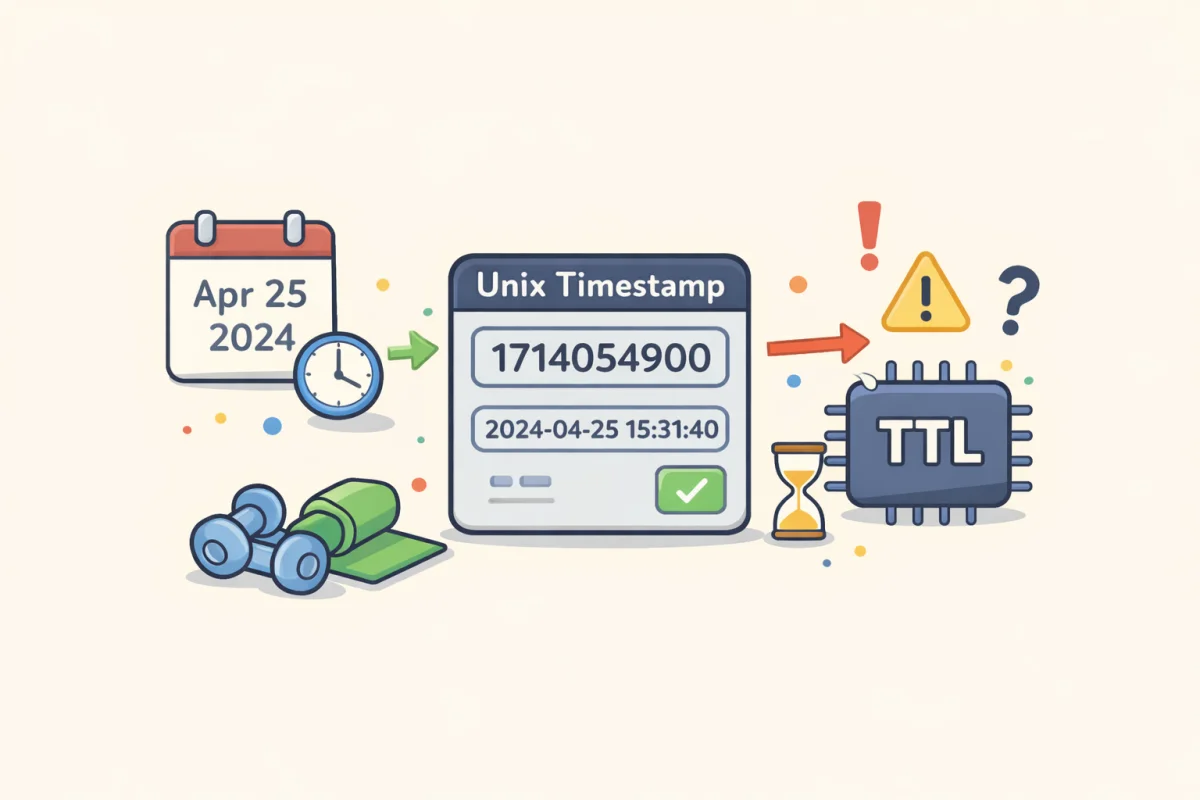
Unix Timestamp and the Year 2038 Problem Explained
On January 19, 2038, at exactly 03:14:07 UTC, a large number of computer systems will experience what is effectively a date overflow — the Unix timestamp equivalent of Y2K.
The cause is not mysterious or complicated. It comes down to one decision made in the early days of Unix: storing the current time as a 32-bit integer. That was a reasonable choice in 1970. In 2038, it runs out of space.
To check what a timestamp value represents right now, the Unix Timestamp Converter converts any timestamp — including the problematic 2,147,483,647 — to a readable date instantly.
How Unix Timestamps Work
A Unix timestamp is the number of seconds that have elapsed since January 1, 1970, at 00:00:00 UTC. That starting point is called the Unix epoch.
Right now, the timestamp is somewhere around 1,712,000,000 — a 10-digit number growing by one every second.
The timestamp is used everywhere in computing: server logs, API responses, database records, authentication tokens, file system metadata, and operating system internals. It is a convenient format because a single integer represents a precise moment in time, is easy to compare and sort, and is timezone-agnostic.
What a 32-Bit Integer Can Hold
A signed 32-bit integer can hold values from −2,147,483,648 to 2,147,483,647.
When Unix was developed, timestamps were stored as signed 32-bit integers. The maximum value — 2,147,483,647 — corresponds to 03:14:07 UTC on January 19, 2038.
One second later, the counter overflows. A signed 32-bit integer cannot hold 2,147,483,648, so it wraps around to the largest negative value: −2,147,483,648. When interpreted as a Unix timestamp, that negative number represents 20:45:52 UTC on December 13, 1901.
The practical effect: any system that stores timestamps as a signed 32-bit integer and does not handle this overflow will suddenly represent dates in 1901 when 2038 arrives.
Why Y2K Is a Useful Comparison
Most people have heard of Y2K — the concern that computer systems storing years as two digits (99 for 1999) would fail when rolling over to 00, which could be interpreted as 1900 rather than 2000.
The Year 2038 problem is structurally similar:
- Both are caused by a storage format that seemed adequate when chosen
- Both only manifest at a specific date threshold
- Both affect many systems simultaneously
- Both are fixable, but require deliberate migration effort
The key difference is scale. Y2K affected mainly date strings and two-digit year fields in applications. The 2038 problem affects a fundamental data type (32-bit integer) used at the operating system level across countless platforms.
Which Systems Are Actually at Risk
Not at risk:
- Modern 64-bit operating systems (Linux, macOS, Windows on 64-bit hardware) — they use 64-bit time representations
- Most modern applications built on 64-bit platforms
- New systems built after 2000 that used 64-bit integers from the start
Potentially at risk:
- Embedded systems running on 32-bit processors — these are widespread in industrial equipment, medical devices, automotive systems, network hardware, and consumer electronics
- Legacy software compiled for 32-bit systems that stores timestamps as
time_tand was never updated - Old databases where timestamp columns were defined as 32-bit integers
- File systems that store file modification times as 32-bit values (ext3 on Linux, for example, has this limitation)
- Some network protocols that encode timestamps in 32-bit fields
The embedded systems category is particularly concerning because these devices often have long operational lifespans, run stripped-down operating systems without automatic updates, and may not be economically viable to replace or update.
Real-World Implications
Industrial and infrastructure systems
Control systems for power grids, water treatment, manufacturing, and building management often run on embedded hardware with decades-long lifespans. A programmable logic controller (PLC) installed in 2005 running on 32-bit firmware might still be operational in 2038 — and might behave unexpectedly when the timestamp overflows.
Financial systems
Banking and trading systems often run legacy software on mainframes or older 32-bit platforms. Any system that stores transaction timestamps as 32-bit integers could produce incorrect timestamps or reject transactions with dates calculated past the overflow point.
IoT devices
The proliferation of cheap, low-power microcontrollers in IoT devices means millions of devices with 32-bit time representations are being deployed and will remain in service past 2038. Consumer routers, smart home devices, industrial sensors — many run 32-bit Linux kernels or bare-metal firmware without any 2038 mitigation.
File systems
File metadata — creation time, modification time, access time — is stored by the operating system. On systems using 32-bit time fields for this metadata, files could appear to have modification dates in 1901 after the overflow. This would break backup software, version control systems, and anything that uses file modification time for comparisons.
What Happens to 64-Bit Systems
A signed 64-bit integer can hold values up to 9,223,372,036,854,775,807.
As a Unix timestamp, that maximum value represents the year 292,277,026,596. There is no practical concern about 64-bit systems running out of timestamp space — the universe will have long since ended before that number is reached.
Most modern operating systems migrated to 64-bit time representations well before 2038:
- Linux on 64-bit hardware has used 64-bit
time_tsince the early 2000s - Linux on 32-bit hardware addressed the issue in kernel version 5.6 (released in 2020), which uses a 64-bit time interface on 32-bit systems
- macOS moved to 64-bit time in OS X 10.6 (2009)
- Windows uses 64-bit
FILETIMEstructures, which are safe past the year 30,000
The remaining risk is in systems that explicitly store timestamps in 32-bit integer columns in databases, or in network protocol fields defined as 32-bit, rather than relying on the OS time_t type.
The Fix
The solution is conceptually simple: replace 32-bit timestamp storage with 64-bit. In practice, this requires:
1. Updating the data type used to store timestamps in code (int32_t or time_t on 32-bit → int64_t or time_t on 64-bit) 2. Migrating database columns from 32-bit integer or TIMESTAMP fields (which are often 32-bit in older MySQL and similar systems) to 64-bit alternatives 3. Updating network protocol implementations where 32-bit timestamp fields are part of the protocol specification 4. Recompiling or replacing firmware on embedded devices
For software running on 64-bit platforms, the fix is often a recompile with a 64-bit time_t. For embedded systems on 32-bit hardware, it may require hardware replacement.
The effort required varies enormously. A well-maintained web application running on modern infrastructure probably needs minimal changes. A legacy industrial control system with custom firmware and no active development team is a much harder problem.
How Long Do We Have?
At the time of writing (April 2026), there are about 12 years until January 19, 2038.
That sounds like enough time. For actively maintained software systems, it probably is — the changes are well understood and can be planned and executed systematically.
For the long tail of abandoned software, unmaintained embedded devices, and legacy infrastructure running on 32-bit hardware, 12 years is not as comfortable. The devices that are hardest to update are also the ones most likely to still be running in 2038.
The organisations that should be most concerned are those running 32-bit embedded systems in critical infrastructure — and those are exactly the organisations least likely to have the budget and institutional knowledge to address it proactively.
The Year 2038 problem is not going to cause planes to fall out of the sky on January 19, 2038. But some systems will behave incorrectly, some logs will show nonsensical timestamps, and some devices will need emergency attention. The closer you are to critical infrastructure on 32-bit hardware, the more it is worth checking now rather than later.