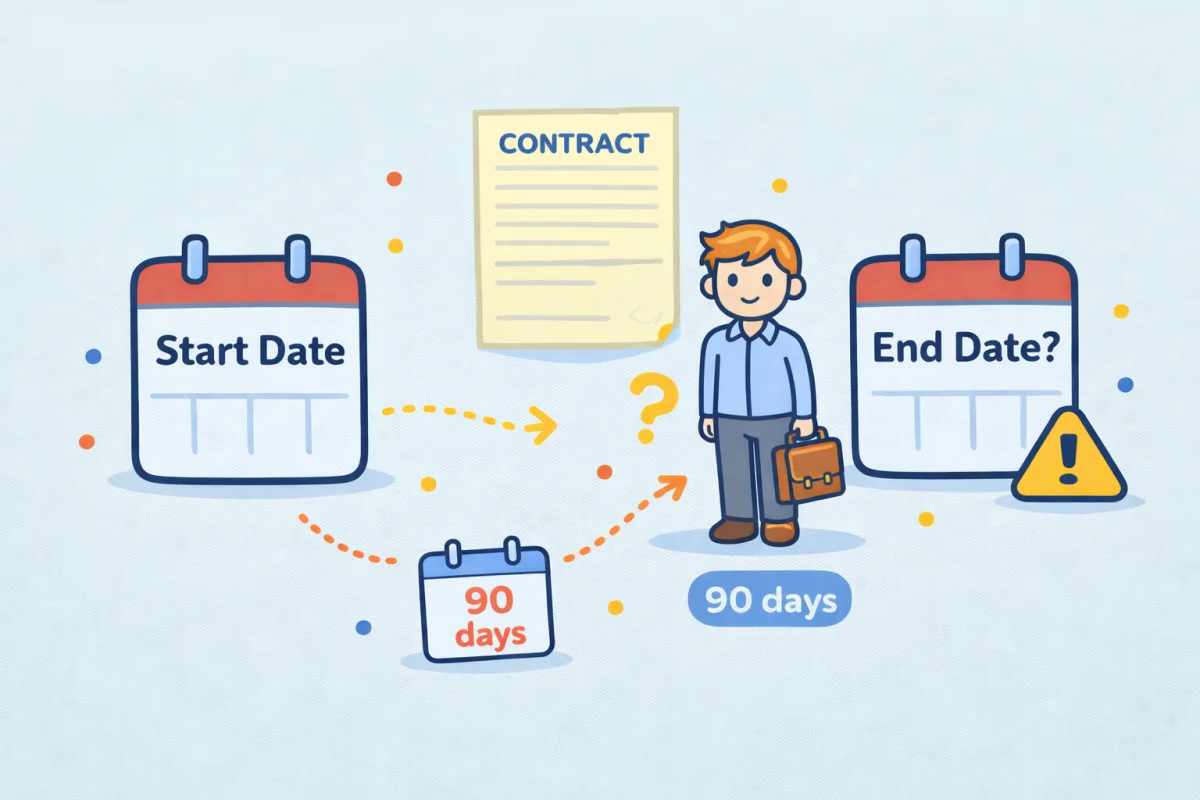
How to Calculate Your Notice Period End Date
Resigning from a job or terminating an employment contract triggers a notice period, and the end date matters — it determines your last working day, when your final paycheck is due, and when you can legally start a new role. Notice periods sound simple: "one month's notice" or "four weeks' notice." But the exact end date isn't always obvious, particularly when the resignation falls near a month-end or a public holiday.
The Date Calculator computes the end date precisely — enter your resignation date and add the notice duration to get the exact date. This article explains how the calculation works and where the common errors happen.
The Difference Between Weeks and Months
Notice periods come in two forms, and they produce different results:
Weeks: Fixed. Four weeks is always 28 calendar days. The end date is exactly 28 days after the resignation date.
Months: Variable. One month from January 31 is February 28 (or February 29 in a leap year) — not March 3. One month from March 31 is April 30. The end date lands on the same calendar day in the target month, clamped to the last valid day if that day doesn't exist.
This distinction matters. An employee who resigns on January 31 with one month's notice finishes on February 28 — only 28 days later. An employee who resigns on February 28 with one month's notice finishes on March 28 — 28 days later as well. But an employee who resigns on March 31 with one month's notice finishes on April 30 — also 30 days, landing on the last day of April because March 31 + 1 month clamps to April 30.
If your notice period is stated in months and you resign near the end of a month, check the specific end date with the Date Calculator rather than estimating.
When Does the Notice Period Start?
The start date of the notice period depends on the employment contract and jurisdiction. Two common conventions:
Starts on the day of resignation. Day 1 of the notice period is the day you hand in your resignation. If you resign on April 7 with four weeks' notice, the period runs April 7 through May 4, and May 4 is your last day.
Starts on the day after resignation. Some contracts specify that the notice period begins "the day following receipt of notice." In this case, April 7 resignation means the period starts April 8, and the last day is May 5.
Check your contract. If it's silent, the default in most common law jurisdictions is that notice starts running from the day it's given, not the day after. But this varies by country and by collective agreement, so don't assume.
Working Out the Exact Last Day
Once you know the start date and the duration, the end date calculation is straightforward with the right tool.
Example 1: One month's notice, resignation on April 7
- Start: April 7
- Add 1 month: May 7
- Last day: May 7
Example 2: Four weeks' notice, resignation on April 7
- Start: April 7
- Add 28 days: May 5
- Last day: May 5
Note the difference: one month vs four weeks produces May 7 vs May 5 for an April 7 resignation. These are not the same. If your contract says "one month," the end date is May 7. If it says "four weeks," it's May 5.
Example 3: Three months' notice, resignation on November 30
- Start: November 30
- Add 3 months: February 30 doesn't exist → clamp to February 28 (or 29 in a leap year)
- Last day: February 28
Example 4: Two weeks' notice, resignation on December 26
- Start: December 26
- Add 14 days: January 9
- Last day: January 9
Does the Last Day Have to Be a Working Day?
In most cases, your contractual last day is the calendar date calculated from the notice period — regardless of whether it falls on a weekend or public holiday. The employment relationship ends on that date.
However, practices vary:
- Some employers and employees agree to adjust the last day to the nearest working day for administrative convenience (payroll, handover, etc.)
- Some contracts explicitly state that if the last day falls on a weekend, the notice period extends to the following Monday
- In some jurisdictions, notice that expires on a public holiday is deemed to expire the next working day
If your calculated last day falls on a Saturday, Sunday, or public holiday, check your contract and discuss with your employer whether adjustment is expected. Don't assume — the legal end date is the calendar date unless the contract says otherwise.
Garden Leave and Pay in Lieu of Notice
In some situations, the employer may not require you to work through the notice period:
Garden leave: You remain employed, continue receiving full pay and benefits, but are asked not to come into the office (and typically barred from starting a new role). The notice period still runs for its full duration. Your last day is still the calculated end date; you just don't work in between.
Pay in lieu of notice (PILON): The employer pays you a lump sum equivalent to the notice period salary and releases you immediately. Your employment ends on the day PILON is agreed, not on the calculated notice end date. This matters for start dates at new employers — if you receive PILON, you may be free to start immediately (subject to any garden leave or non-compete clauses).
The distinction affects when you can legally start a new role. If you're on garden leave, you're still employed — starting a new role during garden leave may breach your contract. With PILON, you're free once the payment is made.
Calculating Notice from a Specific Start Date
Sometimes you need to work backwards — you have a target end date (e.g., you want to start a new job on June 1) and need to know when to hand in notice.
Example: You want your last day to be May 30. Your notice period is one month. When do you need to resign?
Subtract one month from May 30: April 30. You need to resign on or before April 30.
If your notice is four weeks (28 days), subtract 28 from May 30: May 2. Resign by May 2.
The Date Calculator works in both directions — add to find the end date, or subtract to find the latest resignation date for a target finish.
Notice Periods by Country: Key Differences
Notice period conventions vary significantly by jurisdiction:
United Kingdom: Statutory minimum is one week per year of service, up to a maximum of 12 weeks (after 12+ years). Contractual notice in professional roles is typically 1–3 months; senior roles may be 6 months or more. Notice is usually stated in months.
United States: Most employment is "at will" with no statutory notice requirement. Professional norms typically follow the "two weeks' notice" convention (14 calendar days), but this is custom, not law in most states.
Germany: Statutory notice periods start at 4 weeks and increase with tenure, up to 7 months after 20+ years of service. German notice periods often end on specific dates — the 15th or the last day of the calendar month — rather than on the exact calculated date. This is a meaningful difference that affects many employees.
France: Notice periods (préavis) vary by collective agreement and tenure, typically 1–3 months for professional employees. They run from a specific triggering date.
Australia: Statutory minimum notice under the Fair Work Act is 1–4 weeks depending on length of service. Contractual notice in professional roles is typically 1–3 months.
For any jurisdiction, the contractual notice period in your employment agreement overrides the statutory minimum if it's longer. If it's shorter than the statutory minimum, the statutory minimum applies.
Practical Checklist
When calculating your notice period end date:
1. Check your contract for the stated notice period (weeks or months) and when the period starts 2. Add the duration to your planned resignation date using the Date Calculator 3. Check whether the resulting last day falls on a weekend or public holiday, and confirm with your employer how that's handled 4. Verify your new employer's desired start date fits after the notice end date 5. If you want to finish by a specific date, subtract the notice period from that date to find your latest resignation date