How to Calculate a Product Warranty Expiry Date
A warranty that expires before you think it does is a warranty that doesn't protect you when you need it. Knowing the exact expiry date — not a rough estimate — matters when deciding whether to get something repaired, whether to buy an extended warranty, or whether a claim is still valid.
Use the Date Calculator to find any warranty expiry date. Enter the start date and the warranty duration and it returns the exact expiry date, handling leap years and month-end edge cases automatically.
When Does a Warranty Start?
The start date is the first thing to confirm, because warranties don't always start from the purchase date.
Date of purchase: The most common rule. The warranty starts the day you buy the product, as shown on the receipt. This is the default for most consumer electronics, appliances, and tools sold at retail.
Date of delivery: Some warranties — particularly for large appliances, furniture, and custom orders — start from delivery rather than purchase. If you order a refrigerator in November and it's delivered in December, the warranty starts in December. Check the warranty card or terms for language like "from the date of delivery" or "from installation."
Date of registration: A small number of manufacturers require product registration to activate the warranty, and the warranty period begins from registration. Missing the registration window can affect coverage, so check whether your product requires this.
Date of manufacture: Some warranties, particularly for industrial equipment and automotive parts, run from date of manufacture rather than purchase. A part manufactured in January but purchased in August may already have 7 months of warranty used before you buy it. This is less common for consumer products but worth checking for aftermarket parts.
When in doubt, read the actual warranty document rather than assuming. The start date matters as much as the duration.
Common Warranty Periods and What They Mean in Exact Dates
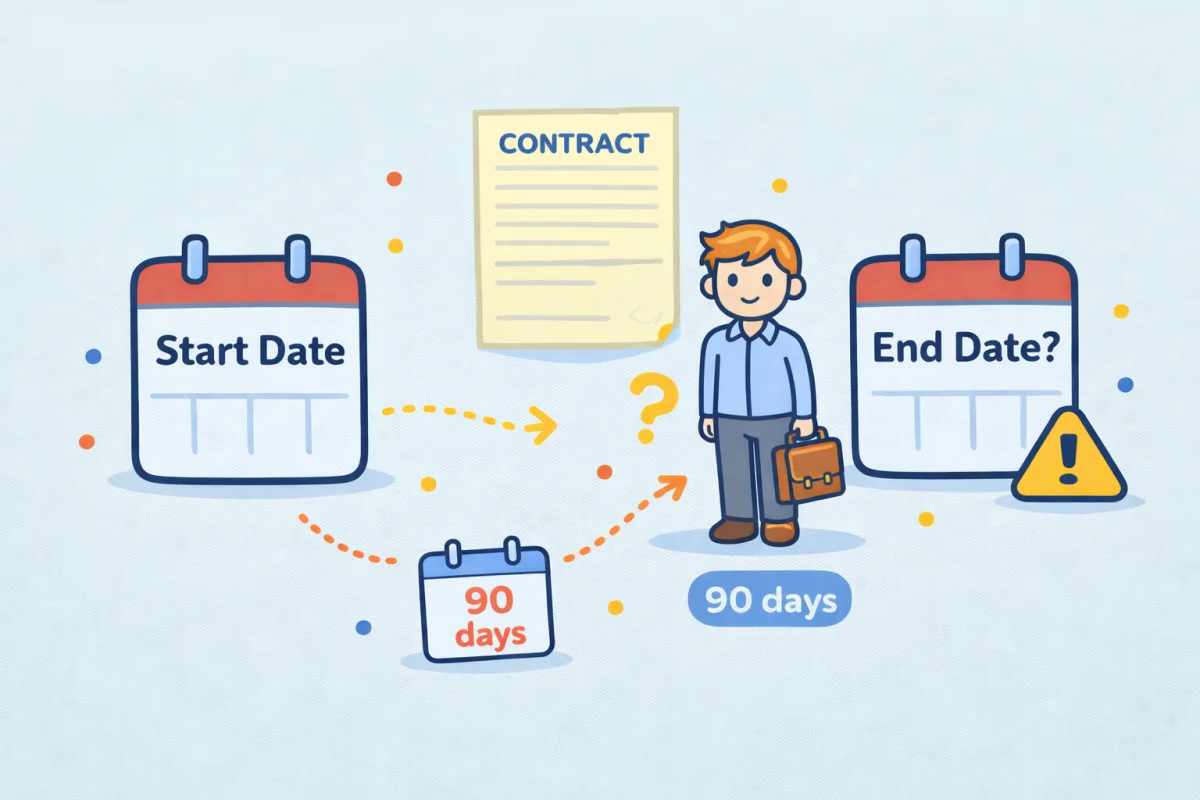
90-day warranty: 90 calendar days from the start date. Add exactly 90 days using the Date Calculator. Note that 90 days is not 3 months — 3 months is approximately 91 or 92 days depending on the months involved.
1-year warranty: Exactly 1 year from the start date — the same day and month in the following year. A product purchased on March 15, 2025 has a warranty expiring March 15, 2026. This is not 365 days; in a leap year, 365 days from March 15 would land on March 14 of the following year, one day short.
2-year warranty: Two years from the start date. Same day and month, two years later. A purchase on August 31 in a non-leap year with a 2-year warranty expires August 31 two years later — even if one of those years is a leap year.
3-year warranty: Three years from the start date. Same logic.
5-year warranty: Common for major appliances, HVAC systems, and some structural products. Five years from the purchase or delivery date.
Lifetime warranty: Defined differently by different manufacturers. Some mean the life of the product (as determined by the manufacturer). Others mean the original purchaser's ownership period. A very small number actually mean the purchaser's lifetime. Read the definition carefully — "lifetime" is the most variable warranty term.
Warranty Start Date Edge Cases
Leap year birthdays: A product purchased on February 29 (only possible in a leap year) has a warranty that expires February 28 in non-leap years and February 29 in leap years. Most warranty terms default to February 28 in non-leap years.
Month-end purchases: This is where exact date calculation matters. A product purchased on January 31 with a 1-month warranty expires February 28 (or 29 in a leap year), not March 3. Adding one month to a date always lands on the last valid day of the resulting month when the source day doesn't exist in that month. The Date Calculator handles this automatically.
Year-end purchases: A product purchased on December 31 with a 1-year warranty expires December 31 of the following year — straightforward. But a product purchased December 31 with a 2-month warranty expires February 28 (or 29) of the following year.
How to Track Multiple Warranty Expiry Dates
Most households have several products under warranty at any given time. A simple tracking system saves money — both by catching warranty claims before expiry and by avoiding unnecessary extended warranty purchases for products already well covered.
A minimal approach:
1. Keep receipts or order confirmations for major purchases (phones, laptops, appliances, tools, furniture) 2. Note the purchase or delivery date and the warranty period on a simple list 3. Calculate the expiry date for each item using the Date Calculator 4. Set a calendar reminder 30 days before expiry for expensive items
The 30-day reminder gives you time to decide whether to buy an extended warranty, schedule a service check, or file a preemptive repair claim if something seems off.
Practically, the products worth tracking are:
- Consumer electronics: phones, laptops, tablets (typically 1-year manufacturer warranty)
- Major appliances: washing machines, refrigerators, dishwashers (typically 1–2 years)
- HVAC and heating: often 5–10 years on parts, 1 year on labor
- Power tools: varies widely, from 1 year to lifetime for quality brands
- Cars: powertrain and bumper-to-bumper warranties (3/36,000 and 5/60,000 miles are common in the US)
Extended Warranties: When the Math Matters
Extended warranties are insurance products — their value depends on whether the expected cost of repairs during the extended period exceeds the premium cost.
Knowing the manufacturer's warranty expiry date is the starting point for this decision. An extended warranty that "starts at purchase" but runs concurrent with the manufacturer's warranty provides less value than one that starts after the manufacturer's warranty ends. Confirm when the extended warranty kicks in and whether there's a gap.
Some credit cards automatically extend manufacturer warranties by 1 year. If your card includes this benefit, a 1-year manufacturer warranty becomes effectively 2 years. Check your card's benefits before paying for a third-party extended warranty on an item you bought on that card — you may already have the coverage you're paying for.
Warranty Claims: What the Expiry Date Actually Means
The general rule: a defect must be reported while the warranty is still active. A claim filed one day after expiry is typically outside coverage, regardless of when the defect appeared.
Some jurisdictions have consumer protection laws that extend this in specific cases:
EU statutory warranty: EU law requires a minimum 2-year legal guarantee for all new goods, regardless of the manufacturer's stated warranty. In many EU countries, the 2-year period runs from delivery, not purchase. This is separate from and often more protective than the manufacturer's voluntary warranty.
US implied warranty: Most US states recognize an implied warranty of merchantability — that a product will work as reasonably expected — even if no written warranty is provided. The duration varies by state (typically 4 years under the UCC for goods). This doesn't replace the manufacturer's warranty but can provide recourse in cases where a product fails in a way that implies a defect existed at the time of sale.
Extended defect discovery: Some warranties include language that gives you a period after the defect is discovered to file a claim, not just from the expiry date. A product that fails in month 11 of a 12-month warranty may have a 30-day reporting window, meaning you can still file in month 13.
Read the warranty terms for your specific product. The expiry date matters most for straightforward claims; extended consumer rights often have additional protections layered on top.
Calculating Warranty Dates for Business Assets
Businesses tracking equipment warranties need the same date calculation but at scale. A common approach is to log purchase date, warranty duration, and calculated expiry date in an asset management spreadsheet.
For any row where warranty duration is expressed in years or months:
Expiry date = Purchase date + warranty duration
The Date Calculator calculates this for any combination of years, months, weeks, and days. For batch calculations in a spreadsheet, the EDATE function in Excel and Google Sheets adds months to a date: =EDATE(A2, 12) adds 12 months to the date in cell A2 and handles month-end clamping correctly.
For day-based warranties (90 days, 180 days): =A2 + 90 in a spreadsheet adds exactly 90 days. This is simpler than EDATE for fixed-day calculations and doesn't require any special handling.
Track warranty expiry dates alongside insurance renewals, maintenance schedules, and service contracts — they're all forms of date-bounded coverage that benefit from the same reminder system.