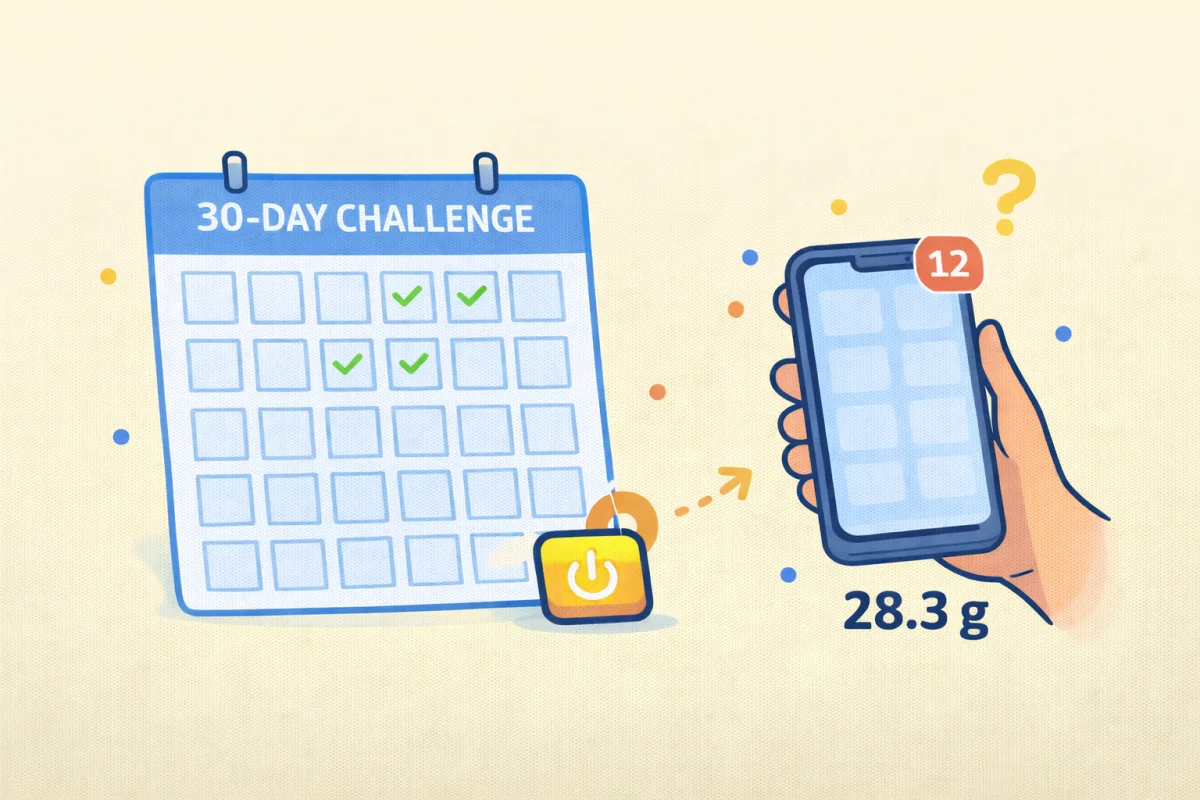
Why Printable 30-Day Challenge Trackers Help You Finish What You Start
Most people do not abandon a 30-day challenge because the goal stopped mattering.
They abandon it because the challenge slowly becomes invisible.
The first few days feel clear. The task is fresh, motivation is high, and progress feels easy to notice. Then life gets noisy. A missed day happens. The streak becomes fuzzy. The challenge stops feeling like a real project and starts feeling like an intention floating in the background.
That is why people search for printable 30-day challenge tracker, 30-day habit tracker printable, and how to stay consistent with a challenge. They are looking for more than motivation. They are looking for a structure that keeps progress visible.
Why Visible Tracking Works
A printable tracker turns a private intention into a visible system.
That matters because consistency becomes easier when:
- the next step is obvious
- progress is visible
- missing a day is noticeable
- the challenge feels real, not abstract
This is one of the simplest reasons 30-day challenges work well in the first place: the timeline is short enough to see and long enough to build momentum.
The 30-Day Challenge Builder fits naturally into that workflow because it helps define the challenge and create something you can actually follow day by day.
Why Print Beats “I’ll Remember”
People often assume they can track a challenge mentally or casually in notes.
That usually works for a few days.
Then one of these happens:
- they forget whether yesterday counted
- they lose the sense of streak and momentum
- the task slips behind other priorities
- one imperfect day turns into several
A printable or visible tracker reduces that drift because it removes the need to reconstruct the challenge from memory.
The Real Benefit Is Not the Paper
The value is not the paper itself. It is the clarity.
A good 30-day tracker creates:
- a clear start point
- a visible end point
- a daily moment of completion
- a growing record that feels harder to ignore
This is why many people finish challenges more reliably when there is something physical or visually explicit involved.
Why Challenge Trackers Help With Motivation
Motivation often feels unreliable because it depends on emotion.
Tracking helps by shifting the focus away from:
- “Do I feel like doing this today?”
and toward:
- “Did I complete today’s square?”
That is a much easier question to act on.
The challenge becomes less about identity and more about one visible daily action.
What Makes a Good 30-Day Tracker
A useful tracker is usually:
- simple
- visible
- easy to update in seconds
- tied to one clearly defined action
The more complicated the tracker becomes, the more likely it is to create friction instead of reducing it.
That is why the best trackers are usually the ones you can glance at and understand instantly.
Why One Missed Day Feels Different on a Tracker
This is one of the most underrated benefits.
When you miss a day mentally, it is easy to rationalize and drift.
When you miss a day on a visible tracker, the gap is obvious.
That does not mean the challenge is ruined. It simply makes the situation real early enough to recover. A tracker helps you notice the slip before it turns into abandonment.
Trackers Work Especially Well for Habit Challenges
Printable challenge trackers are especially useful when the daily action is small and repeatable.
Examples:
- reading every day
- writing every day
- walking every day
- stretching every day
- completing one focused task every day
The simpler the daily action, the more powerful the visual streak becomes.
Common Mistakes People Make
1. Making the Tracker More Complex Than the Habit
If tracking takes more effort than doing the challenge, the system is wrong.
2. Tracking a Vague Goal
A tracker only works well when “done” is clearly defined.
3. Hiding the Tracker
If it is not visible, it loses much of its power.
4. Treating One Gap as Failure
A tracker should reveal reality, not punish it. The goal is recovery, not perfection.
A Better Way to Use a 30-Day Tracker
The most practical approach is:
- define one clear daily action
- make the tracker visible
- mark it immediately after completion
- keep going even if the streak is imperfect
That creates a system built for completion, not just enthusiasm.
Final Takeaway
If you want to finish a challenge, a printable 30-day tracker helps because it makes progress visible and daily action harder to ignore. The tracker itself is not magic. The value comes from turning a loose intention into something concrete, measurable, and visible every day.
Use the 30-Day Challenge Builder to define the challenge clearly and give yourself a structure that makes day 30 much more likely than day 3 dropout.