How Many Calories Should I Eat to Lose Weight?
The answer is always some version of the same thing: eat fewer calories than your body burns. But that principle does not tell you the actual number, which is what makes the question practical rather than obvious.
The right calorie target for weight loss is specific to your body, your activity level, and your goal. Someone who burns 2,800 calories a day needs a different intake than someone who burns 1,900. Getting the number roughly right at the start saves a lot of frustration later.
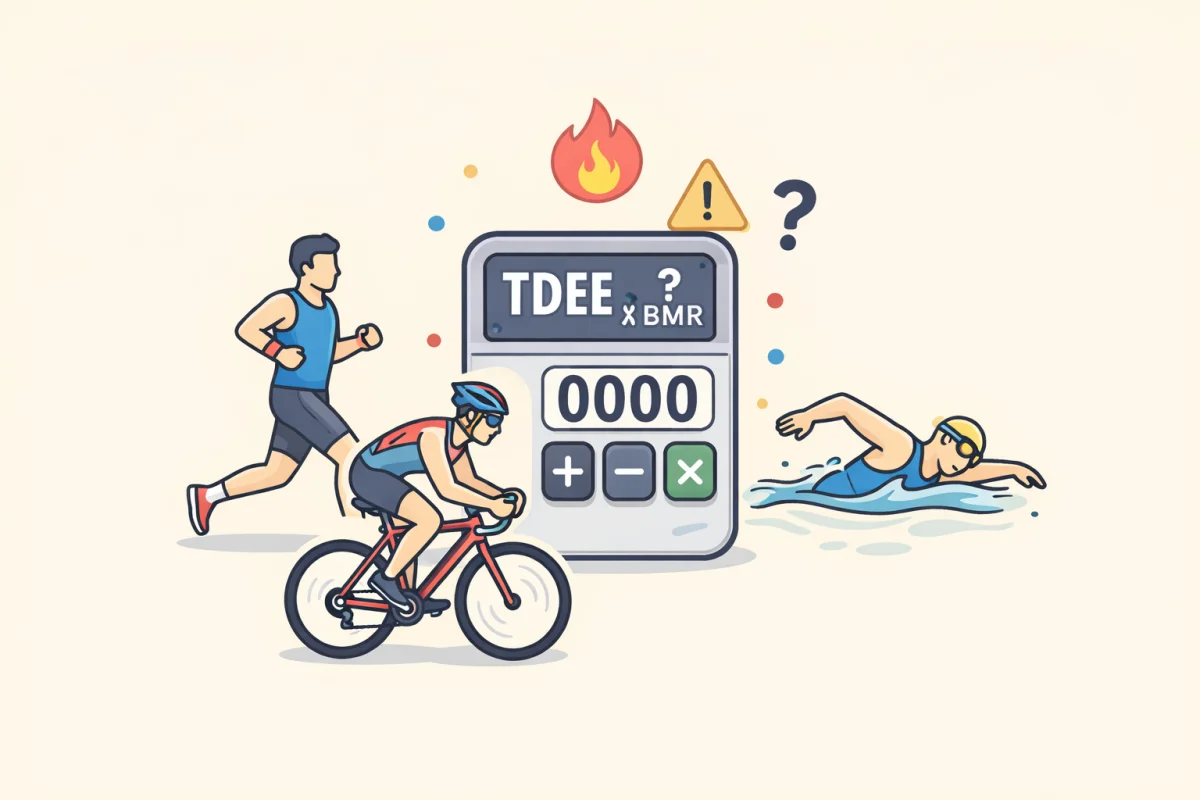
The starting point is your TDEE — Total Daily Energy Expenditure. Use the TDEE Calculator to get your estimate, then use the guidance below to set your deficit.
Step One: Find Your TDEE
TDEE is the total number of calories your body burns in a day, including both resting metabolism and all physical activity.
It is calculated in two stages:
1. BMR (Basal Metabolic Rate): the calories your body burns at complete rest — keeping organs functioning, maintaining temperature, and so on. For most adults this is 1,400–2,000 calories per day.
2. Activity multiplier: BMR is multiplied by a factor based on how active you are. A sedentary office worker might multiply by 1.2; someone who trains five days a week multiplies by 1.55; a manual labourer or competitive athlete might use 1.7–1.9.
The result is your estimated maintenance calories — the amount you need to eat to stay at your current weight.
Example:
- 35-year-old woman, 165 cm, 72 kg, lightly active
- BMR ≈ 1,490 kcal
- TDEE ≈ 1,490 × 1.375 ≈ 2,050 kcal
She needs around 2,050 calories per day to maintain her current weight. To lose weight, she needs to eat below that.
Step Two: Choose Your Deficit
A caloric deficit is the gap between what you eat and what you burn. The size of that gap determines how quickly you lose weight.
The standard rule: a deficit of 500 kcal per day leads to approximately 0.5 kg (about 1 lb) of fat loss per week, since 1 kg of fat contains roughly 7,700 calories.
| Daily deficit | Weekly loss (approximate) |
|---|---|
| 250 kcal | ~0.25 kg (½ lb) |
| 500 kcal | ~0.5 kg (1 lb) |
| 750 kcal | ~0.75 kg (1.5 lb) |
| 1,000 kcal | ~1 kg (2 lb) |
These figures are approximations. Real weight loss is rarely perfectly linear because water retention, glycogen fluctuations, and digestive contents all show up on the scale.
How large a deficit should you aim for?
For most people, a 500 kcal deficit (roughly 0.5 kg per week) is the most practical starting point. It produces steady progress without being aggressive enough to cause significant muscle loss, energy crashes, or the kind of hunger that makes adherence collapse.
A 250 kcal deficit is slower but very sustainable — useful for someone with only a small amount to lose, or anyone who has struggled with larger deficits before.
A 750–1,000 kcal deficit is more aggressive and produces faster results, but it comes with tradeoffs: more hunger, higher risk of muscle loss without resistance training, and greater metabolic adaptation. Deficits above 1,000 calories per day are generally not recommended unless under medical supervision.
A practical floor: Most nutrition guidelines suggest not eating below 1,200 kcal per day for women or 1,500 kcal for men, even in a significant deficit. Below these levels, it becomes very difficult to meet basic nutritional needs.
Applying the Deficit to Your TDEE
Using the example above:
- TDEE: 2,050 kcal
- Deficit: 500 kcal
- Daily calorie target: 1,550 kcal
That is the intake to aim for. On days with more exercise, some people eat slightly more; on rest days, slightly less. Some people prefer a consistent daily target regardless of activity. Both approaches work — the consistency approach is simpler; the flexible approach more closely matches actual energy expenditure.
Protein and the Quality of Weight Loss
Total calories determine whether you lose weight. Protein intake largely determines whether that weight is fat or muscle.
When you eat in a deficit, your body can draw energy from fat or from muscle. Higher protein intake strongly reduces muscle loss during a deficit, which matters both for how you look at the end and for keeping your metabolism from dropping more than necessary.
A practical target: 1.6–2.2 g of protein per kg of body weight during a fat loss phase.
For the example above (72 kg woman): 115–160 g of protein per day.
That sounds like a lot. It typically requires actively prioritising protein at each meal — eggs, chicken, fish, Greek yoghurt, cottage cheese, legumes, protein shakes. Many people find this is the single most useful dietary habit to build alongside tracking calories.
If you want to plan this precisely, the Macros Calculator sets protein, fat, and carbohydrate targets based on your goals once you have your calorie target from TDEE.
What to Do When Progress Stalls
Weight loss almost never continues at the same rate indefinitely. Plateaus are normal and have a few common causes:
Your TDEE has dropped. As you lose weight, you burn fewer calories — both because you are lighter and because of metabolic adaptation. A calorie target that created a 500 kcal deficit at 85 kg may create no deficit at 75 kg.
Calorie tracking has drifted. Portion sizes creep up, oils and sauces go unweighed, liquid calories are forgotten. Even with good intentions, calorie tracking typically becomes less accurate over time. A week of careful re-measurement often reveals the drift.
Water retention is masking fat loss. Stress, sodium, hormonal cycles, and strength training can all cause temporary water retention that offsets fat loss on the scale. The trend over 2–3 weeks is more informative than any single weigh-in.
When progress has genuinely stalled for 3+ weeks and tracking is accurate, the options are: 1. Reduce calories by 100–200 kcal/day 2. Increase activity to widen the deficit 3. Take a diet break at maintenance for 1–2 weeks, then resume
Recalculate your TDEE regularly — every 4–6 weeks, or whenever your weight changes by 4–5 kg. The TDEE Calculator takes less than a minute to update.
A Realistic Expectation
For someone with 10–15 kg to lose, a well-structured approach targeting 0.5 kg per week takes roughly 20–30 weeks. That is 5–7 months. It is not fast, and it is not supposed to be.
Faster loss is possible but harder to sustain. The approaches that produce 2 kg per week in the short term rarely continue at that rate for more than a few weeks, because the deficit required is large enough to cause significant hunger, muscle loss, and metabolic adaptation.
The most reliable outcome is a moderate deficit maintained consistently over time — not the largest deficit you can tolerate for a few weeks before abandoning it.
A 500 kcal deficit from a known TDEE, with adequate protein, maintained for long enough, produces predictable results. That is the whole framework.