How to Charge for Client Meetings as a Freelancer Without Losing Money
Freelancers rarely lose money because of one disastrous client call.
They lose money because meetings quietly multiply and nobody treats them like work.
A discovery call turns into a proposal review. The proposal review turns into a kickoff. The kickoff leads to weekly check-ins, ad hoc feedback calls, revision meetings, and “quick” conversations that still take half an hour once context switching is included. By the end of the month, a meaningful chunk of your schedule has been consumed by client communication that never made it into your pricing.
That is why so many independent professionals search for how to charge for client meetings, should freelancers bill for calls, and meeting cost for freelancers. The issue is not whether meetings are useful. The issue is whether your business model accounts for them honestly.
Why Client Meetings Become Unpaid Work So Easily
Freelancers often treat meetings as relationship maintenance rather than delivery time.
That sounds reasonable until you look at the economics.
A meeting uses:
- Time on the calendar
- Prep time before the call
- Follow-up time after it
- Energy that could have gone into billable work
- Focus that is harder to recover than people admit
If that time is not priced somewhere, you are effectively discounting your own work without saying so.
The Core Question: Are Meetings Part of the Service or Extra Time?
There are only a few defensible ways to handle this.
You can:
- Bill meetings separately
- Build expected meeting time into your hourly or project rate
- Include a fixed amount of meeting time, then charge beyond it
What does not hold up well is pretending the time does not matter.
The Real Cost of a “Quick Call”
Let’s say you charge the equivalent of $100/hour.
A 30-minute client call may look like a $50 event. In reality, the total cost can be closer to an hour once you include:
- Reviewing the project before the call
- Joining and settling into the conversation
- Sending notes or next steps afterward
- Losing the focused work block around the meeting
That is why freelancers who do not price meetings properly often feel fully booked without being fully profitable.
If you want the direct calendar-time cost of a meeting, the Meeting Cost Calculator is the fastest way to make that visible.
How Client Meetings Affect Your Effective Hourly Rate
This is where the math becomes useful.
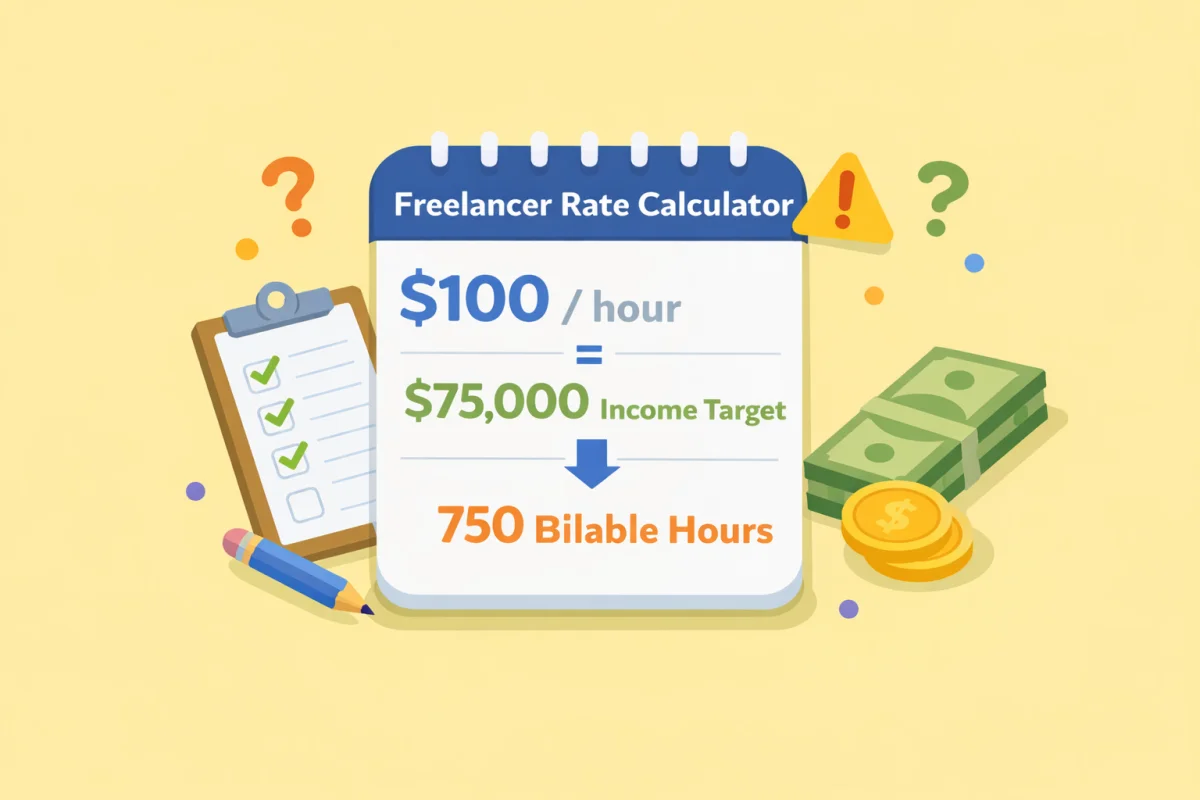
If you think you are charging $100/hour, but every week includes several hours of unpaid meetings, your effective hourly rate is lower than your listed rate.
Example:
- 20 billable delivery hours at
$100/hour=$2,000 - 4 unpaid meeting/admin hours in the same week
Now your actual earnings are spread across 24 hours of work time, not 20.
$2,000 ÷ 24 = $83.33/hour
That difference compounds quickly over months.
This is why the Freelancer Rate Calculator is closely related to meeting economics. If your pricing does not absorb non-billable communication, your target rate is probably too low.
Three Practical Ways to Charge for Client Meetings
1. Bill Meetings at Your Normal Hourly Rate
This is the cleanest option if you already work hourly.
Pros:
- Easy to explain
- Easy to invoice
- Protects your time directly
Cons:
- Some clients resist if they assumed communication was free
2. Include a Fixed Meeting Allowance in Project Pricing
This works well for fixed-fee projects.
Example:
- Project includes up to 2 hours of meetings
- Additional meeting time is billed separately
Pros:
- Feels clear and structured
- Reduces negotiation friction
Cons:
- Requires discipline to track the included time
3. Raise Your Overall Rate to Cover Expected Meeting Load
This can work if your process is stable and predictable.
Pros:
- Simpler client experience
- Fewer invoice line items
Cons:
- Risky if meetings expand beyond what you assumed
For many freelancers, the best model is a hybrid: include a reasonable amount, then bill extra when the project becomes meeting-heavy.
What to Put in Your Contract or Proposal
If you want fewer awkward conversations later, define the rule early.
Useful language usually covers:
- Whether meetings are billable
- How much meeting time is included, if any
- Your hourly rate for additional calls
- Minimum billable increments
- Whether internal review time after meetings is included
The goal is not to sound rigid. The goal is to make the economics explicit before the calendar fills up.
When You Should Absolutely Charge for Meetings
You should strongly consider charging when:
- The meeting is recurring
- Multiple stakeholders attend
- Prep is required
- The meeting replaces delivery time
- The project already involves heavy communication
- The client uses calls to explore work beyond the current scope
That last point matters. Meetings often become the place where scope creep begins.
When It May Be Reasonable Not to Charge Separately
There are cases where separate billing is not necessary:
- A short pre-sales discovery call
- A tightly scoped fixed-price project with minimal communication
- A long-term retainer where communication is already priced in
But even then, the time still needs to live somewhere in your model. “Not billed separately” is not the same thing as “free.”
Common Freelancer Mistakes Around Meetings
1. Treating Calls as Invisible Overhead
If meetings happen regularly, they are part of the service and need to be priced.
2. Underestimating Prep and Follow-Up Time
The calendar block is rarely the full cost.
3. Not Setting Boundaries Early
If you never define how meetings are handled, clients often assume unlimited access.
4. Using an Hourly Rate That Assumes 100% Billable Time
Almost nobody operates that way in reality. Your pricing has to account for non-delivery work.
A Simple Rule That Works
If the meeting is necessary for the project, it belongs in the project economics.
That can mean:
- billed directly
- included within a capped allowance
- or built into a rate that was set with realistic communication time in mind
The only weak option is ignoring the time and hoping the margin absorbs it.
Final Takeaway
If you are wondering whether freelancers should charge for client meetings, the practical answer is yes — either directly or indirectly. Meetings consume working time, reduce focused delivery capacity, and can lower your real hourly earnings if they are not accounted for.
Use the Meeting Cost Calculator to see the visible cost of time on the calendar. Use the Freelancer Rate Calculator to make sure your pricing model still works once meetings, admin, and non-billable communication are included.