
Free Unit Converters
Free online unit converters for length, temperature, weight, area, volume, time, and cooking. Instant results, no account needed.
Free online unit converters for length, temperature, weight, area, volume, time, and cooking measurements — no sign up, no install, runs instantly in your browser. Whether you're converting metres to feet, Celsius to Fahrenheit, kilograms to pounds, or cups to millilitres, every result is calculated immediately as you type.
These tools cover the conversions people search for most often: the ones that come up mid-recipe, mid-build, mid-workout, or while reading a foreign news article with unfamiliar units. They handle both directions simultaneously, so you never need to re-enter values or flip the tool.
About each converter
Length converter
Converts between metres, centimetres, millimetres, kilometres, inches, feet, yards, and miles — the full set of metric and imperial length units used in everyday and technical contexts.
The most common searches this covers: metres to feet, feet to metres, cm to inches, inches to cm, km to miles, and miles to km. These conversions come up constantly when reading product dimensions listed in the wrong system, understanding heights in a different country's format, or following construction or engineering specs written for a different market.
One thing worth knowing: the US, UK, and metric systems don't map cleanly onto each other, so rounding matters. A door frame specified at 80 inches is exactly 6 feet 8 inches (2,032 mm), but rounded metric conversions like "about 2 metres" miss by 3.2 centimetres — enough to matter in a tight fit. The converter shows full precision so you can round to whatever tolerance your project requires.
Temperature converter
Converts between Celsius, Fahrenheit, and Kelvin. The conversion between Celsius and Fahrenheit is non-linear (multiply by 9/5, then add 32 going one direction; subtract 32, then multiply by 5/9 going the other), which makes it easy to get wrong even if you remember the formula. Kelvin is included for scientific and technical use, where absolute temperature matters.
Common use cases: understanding weather forecasts when travelling, reading oven temperatures in a recipe from another country, and converting body temperature readings between clinical contexts. The crossover point — where Celsius and Fahrenheit read the same number (-40°) — is a useful sanity check if you suspect you've entered the wrong value.
Weight converter
Converts between kilograms, grams, pounds, ounces, and stones. This covers the three weight systems still in active everyday use: the metric system (kg and g), the US customary system (lb and oz), and the British stone system (st), which remains common in the UK for body weight.
Frequent conversions: kg to lbs for gym tracking apps that default to the wrong system, oz to grams for cooking ingredients in imported recipes, and stones to kg for medical or fitness contexts. A person weighing 11 stone is 69.85 kg or 154 lbs — the kind of conversion that's easy to look up but tedious to calculate manually each time.
Area converter
Converts between square metres, square feet, square kilometres, square miles, hectares, and acres.
This comes up most often in property: floor areas are listed in square feet in US real estate listings and square metres almost everywhere else. A 1,500 sq ft apartment is about 139 square metres; a 2,000 sq ft house is about 186. For land, the UK and US use acres while most of the world uses hectares — one hectare is 2.47 acres, one acre is 0.405 hectares. The converter handles all combinations without forcing you to remember which direction each formula runs.
Volume converter
Converts between litres, millilitres, US gallons, imperial gallons, US fluid ounces, UK fluid ounces, cups, pints, and quarts.
Volume is the most fragmented measurement system in everyday use. US gallons and imperial gallons are different (3.785 L vs 4.546 L). US fluid ounces and UK fluid ounces are different (29.57 mL vs 28.41 mL). US cups are 240 mL but some recipes assume 250 mL. The converter distinguishes between US customary and imperial units explicitly, so you get the right result rather than the close-enough one.
The most common use case is recipe conversion: a US recipe calling for 2 cups of stock, 1/4 cup of cream, and 3 tablespoons of butter requires converting all three to metric if you're working with European measuring equipment.
Time converter
Converts between seconds, minutes, hours, days, weeks, and years.
This is more useful than it sounds. In software development, timeouts and cache durations are often written in seconds or milliseconds, but humans think in minutes and hours — the converter bridges the gap instantly. Project planning often involves mixing days and weeks with hours-of-work estimates. Scientific and statistical data may report time spans in seconds that need contextualising into human-readable durations.
One edge case: "years" here uses an average of 365.25 days to account for leap years, which is the right choice for long-duration calculations but worth knowing if you need exact calendar arithmetic.
Cooking converter
Converts between cups, tablespoons, teaspoons, and millilitres for both liquid and dry cooking ingredients.
Liquid ingredients convert straightforwardly by volume. Dry ingredients are more complicated: a cup of flour and a cup of sugar weigh different amounts, and a sifted cup of flour weighs less than a packed one. The converter handles common dry ingredients by weight, using standard density values, which gives a more accurate result than a pure volume conversion.
This tool is most useful when working from recipes that mix measurement systems — a common pattern in adapted or aggregated recipe sites — or when scaling a recipe up or down and needing to convert impractical volumes like "3.5 cups" into something a kitchen scale can handle directly.
Which converter to use
Pick the converter that matches the units you already have. If you know the value in one unit and need the equivalent in another, type it in — the converter updates all outputs simultaneously.
For unit conversions that involve systems you don't use regularly (imperial, stone, US customary gallons), the converter prevents the most common errors: using the wrong gallon definition, forgetting to adjust for the non-linear Celsius/Fahrenheit relationship, or misremembering whether there are 12 or 16 ounces in a pound (the answer depends on whether you mean weight or volume).
A note on precision
All converters display results to several decimal places. For most everyday use — cooking, travel, rough construction estimates — rounding to one or two decimal places is appropriate. For engineering, scientific, or high-tolerance applications, use the full precision shown. The converters do not round internally; what you see is the full calculated result.
Frequently asked questions
How many metres are in a foot?
One foot equals exactly 0.3048 metres. Conversely, one metre equals approximately 3.281 feet. These are exact values: the international foot was defined as 0.3048 m in 1959 and has not changed since. For quick mental arithmetic, a rough rule is that 3 feet is just under 1 metre (0.9144 m), and 10 feet is about 3 metres.
How do I convert Celsius to Fahrenheit?
Multiply the Celsius value by 9/5 (or 1.8), then add 32. So 20°C is (20 × 1.8) + 32 = 68°F. To go the other direction, subtract 32 then multiply by 5/9. A few useful reference points: 0°C = 32°F (freezing), 100°C = 212°F (boiling), 37°C = 98.6°F (body temperature), and -40°C = -40°F (the one point where both scales are equal).
How many pounds are in a kilogram?
One kilogram equals approximately 2.205 pounds. One pound equals approximately 0.4536 kg. For body weight in stones (common in the UK), one stone equals 14 pounds or 6.35 kg. A person weighing 70 kg is about 154 lbs or 11 stone.
How many square feet are in a square metre?
One square metre equals approximately 10.764 square feet. One square foot equals approximately 0.0929 square metres. This conversion comes up most often in real estate — a 100 m² apartment is about 1,076 sq ft. For large areas, one hectare equals 10,000 m² or about 107,639 sq ft, and one acre equals 43,560 sq ft or about 4,047 m².
How many litres are in a gallon?
It depends on which gallon. A US liquid gallon equals 3.785 litres. An imperial (UK) gallon equals 4.546 litres — about 20% larger. This distinction matters for fuel economy comparisons: a car getting 40 MPG in the UK is not the same as 40 MPG in the US, both because the gallon sizes differ and because miles per gallon uses the same gallon unit in each country.
What is the difference between US and imperial fluid ounces?
A US fluid ounce is 29.574 mL. A UK (imperial) fluid ounce is 28.413 mL — slightly smaller. They are close enough that recipes usually work fine with either, but the difference becomes meaningful at larger volumes. A US cup is 8 US fluid ounces (236.6 mL); there is no standard cup unit in imperial measure, though 250 mL is commonly used in Australian and Canadian recipes.
How many cups are in a litre?
Using the US cup (240 mL), one litre equals approximately 4.167 cups. If a recipe uses 250 mL cups (common in Australia, Canada, and metric-adapted UK recipes), one litre equals exactly 4 cups. When converting recipes, it is worth checking which cup definition applies — the difference is small for one cup but adds up over several.
How many inches are in a centimetre?
One inch equals exactly 2.54 centimetres. One centimetre equals approximately 0.3937 inches. For common conversions: 30 cm ≈ 11.8 inches, 100 cm (1 metre) ≈ 39.37 inches, and 1 inch ≈ 2.54 cm. Screen sizes are measured diagonally in inches in most countries, so a 55-inch TV measures about 140 cm corner to corner.
How many seconds are in a day, week, and year?
One day equals 86,400 seconds (60 × 60 × 24). One week equals 604,800 seconds. One standard year equals 31,536,000 seconds (365 days), or 31,557,600 seconds using the average year of 365.25 days to account for leap years. These exact values are important in software development when setting timeouts, cache TTLs, or token expiry periods in seconds.
How do I convert kilometres to miles?
One kilometre equals approximately 0.6214 miles. One mile equals approximately 1.609 km. A quick mental approximation: multiply km by 0.6 for a rough miles figure (5 km ≈ 3 miles, 10 km ≈ 6.2 miles, 42 km marathon ≈ 26.1 miles). Speed limits and road distances in the UK and US are in miles; most of the rest of the world uses kilometres.
How do I convert cooking measurements from cups to grams?
Cup-to-gram conversions depend on the ingredient, because a cup is a volume measure while grams measure mass. One cup of water is 240 g, but one cup of flour is roughly 120–130 g (depending on how it is scooped), and one cup of sugar is about 200 g. The cooking converter handles common dry ingredients by weight using standard density values, which gives a more accurate result than applying a fixed multiplier.
Do these converters require an account or sign up?
No. All converters run entirely in your browser. No account, no email address, and no sign up is required. Nothing is sent to a server — your inputs stay on your device.
From the blog
View more posts Baby Birth Weight Conversion: Grams to Pounds and Ounces Guide
Convert baby birth weight between grams, kilograms, and pounds-ounces. Reference tables, percentile context, and how to read hospital records across units.
 Square Meters to Square Yards — Conversion Guide for Flooring and Fabric
Converting square meters to square yards comes up in flooring, carpet, fabric, and landscaping. Here is the conversion factor, the formula, and a reference table for common areas.
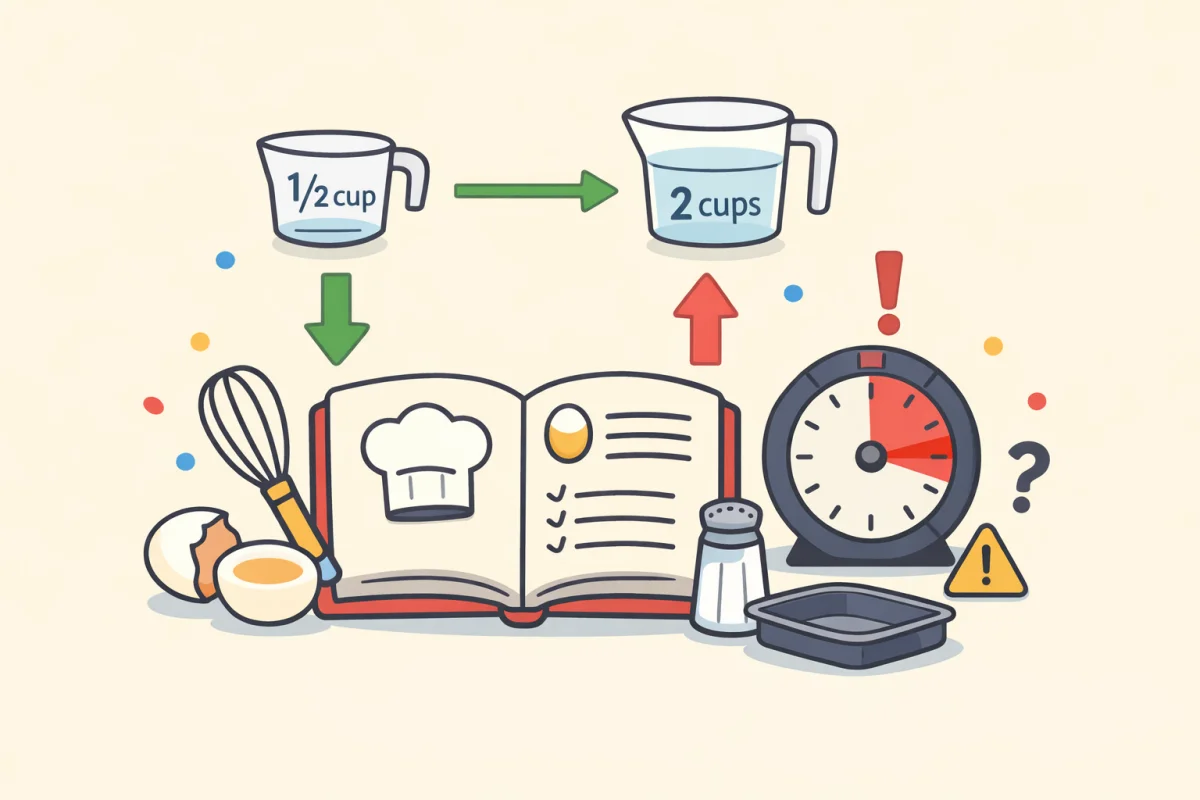 How to Scale a Recipe Up or Down — The Complete Guide
Scaling a recipe sounds simple but gets complicated fast with leavening, eggs, cooking times, and pan sizes. Here is how to do it correctly for any ingredient type.
- Greenhouse Temperature Guide for Plants — Celsius and Fahrenheit by Season
Maintaining the right temperature is the most critical factor in greenhouse growing. Here are the temperature ranges for common crops and how to manage heat and cold in every season.