Baby Birth Weight Conversion: Grams to Pounds and Ounces Guide
If you've ever looked at a hospital discharge sheet that reads "3,402 g" and wondered whether that's a big baby or a small one, you're not alone. Most of the world records infant weight in grams or kilograms, while parents, grandparents, and baby announcements in the US and UK still speak in pounds and ounces. Converting baby birth weight between these units sounds simple, but doing it in your head — with a sleep-deprived brain — is harder than it should be.
This guide walks through the math, gives you clean reference tables, and explains what the numbers actually mean in context. You can always skip the arithmetic and paste the figure straight into the weight converter, but it helps to understand what's happening underneath.
Why baby weight gets recorded in grams
Hospitals almost universally log newborn weight in grams because grams give you finer resolution than ounces. A newborn who loses 180 grams in the first three days has dropped about 6.3 ounces — a clinically meaningful amount for a 3 kg baby, but a number you'd round off if you were only tracking ounces. Pediatricians look at weight trends day by day, and grams are the unit that makes those small shifts visible.
The World Health Organization growth charts, the ones most developed countries benchmark against, are built on grams and kilograms. So even if your birth announcement says "7 lb 8 oz," the data in your baby's electronic health record almost certainly reads "3,402 g."
The conversion factors you actually need
There are really only three numbers to remember for newborn weight conversion:
- 1 pound = 453.592 grams
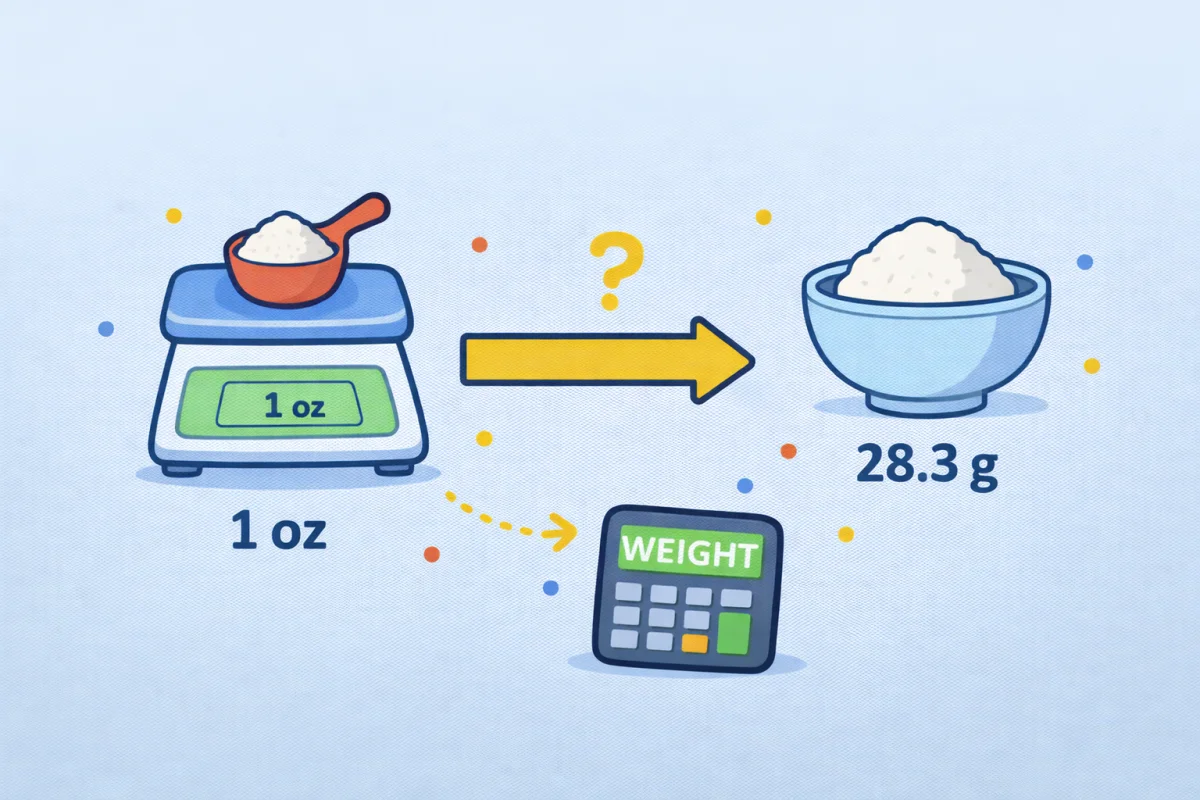
- 1 ounce = 28.3495 grams
- 1 kilogram = 2.2046 pounds
From those, everything else follows. To go from grams to pounds-and-ounces, divide the total grams by 453.592 to get whole pounds, then take the remainder and divide by 28.3495 to get the ounces.
Worked example: a baby weighs 3,650 g.
3,650 ÷ 453.592 = 8.046 pounds. The whole-pound part is 8. The leftover is 0.046 pounds, which equals 0.046 × 16 = 0.74 ounces. So 3,650 g ≈ 8 lb 0.7 oz, which rounds to 8 lb 1 oz on a birth announcement.
Going the other way is easier: multiply pounds by 453.592, multiply ounces by 28.3495, and add them. A 7 lb 5 oz baby weighs (7 × 453.592) + (5 × 28.3495) = 3,175 + 142 = 3,317 g.
Birth weight reference table: grams to pounds and ounces
Here's a range that covers almost every full-term newborn, rounded to the nearest ounce.
| Grams | Kilograms | Pounds + Ounces |
|---|---|---|
| 2,000 g | 2.00 kg | 4 lb 7 oz |
| 2,250 g | 2.25 kg | 4 lb 15 oz |
| 2,500 g | 2.50 kg | 5 lb 8 oz |
| 2,750 g | 2.75 kg | 6 lb 1 oz |
| 3,000 g | 3.00 kg | 6 lb 10 oz |
| 3,250 g | 3.25 kg | 7 lb 3 oz |
| 3,500 g | 3.50 kg | 7 lb 11 oz |
| 3,750 g | 3.75 kg | 8 lb 4 oz |
| 4,000 g | 4.00 kg | 8 lb 13 oz |
| 4,250 g | 4.25 kg | 9 lb 6 oz |
| 4,500 g | 4.50 kg | 9 lb 15 oz |
| 5,000 g | 5.00 kg | 11 lb 0 oz |
The average full-term newborn in the US weighs about 3,300 g (7 lb 4 oz), and the range considered normal is roughly 2,500 g to 4,000 g.
What the thresholds mean clinically
Certain weight cutoffs are medical shorthand, and it helps to know which side of the line your baby's number falls on.
Low birth weight is defined as below 2,500 g (5 lb 8 oz), regardless of gestational age. This threshold matters because babies under it tend to need extra monitoring — temperature regulation, feeding support, sometimes a NICU stay. It's not automatic cause for alarm, especially if the baby was born slightly early, but it's the number that triggers extra attention.
Very low birth weight is below 1,500 g (3 lb 5 oz), and extremely low birth weight is below 1,000 g (2 lb 3 oz). These are premature-infant categories and almost always involve NICU care.
On the other end, macrosomia — a "big baby" — is usually defined as above 4,000 g (8 lb 13 oz) or 4,500 g (9 lb 15 oz) depending on which guideline your provider uses. Large babies carry their own risks during delivery, and the weight estimate can affect decisions about how the birth is managed.
Converting early weight loss and regain
Newborns typically lose 5–10% of their birth weight in the first week before climbing back up. Pediatricians care about this percentage, and tracking it across units can get confusing.
If your 3,500 g baby is now 3,290 g, that's a loss of 210 g, or 210 ÷ 3,500 = 6.0% — well within normal. In pounds and ounces, you'd be going from 7 lb 11 oz down to 7 lb 4 oz, a drop of 7 ounces. The percentage matters more than the absolute number, which is exactly why grams make the tracking easier.
Most babies regain their birth weight by day 10 to 14. If yours doesn't, that's when the pediatrician starts asking harder questions about feeding.
Reading international baby products and car seats
Car seats, baby carriers, and strollers sold internationally often list weight limits in whichever unit the manufacturing region uses. A European infant car seat might specify "from 2.3 kg to 13 kg," while a US version says "4 lb to 30 lb." When you're comparing products across markets, quick conversion matters:
- 2.3 kg = 5 lb 1 oz
- 9 kg = 19 lb 13 oz (a common toddler-seat transition point)
- 13 kg = 28 lb 11 oz
- 18 kg = 39 lb 11 oz
- 36 kg = 79 lb 6 oz (the upper end of many booster seats)
If you're shopping from a country that uses different units than your own, running the numbers through the weight converter takes the ambiguity out of whether a product will fit your kid for another six months or only another six weeks.
Twin, triplet, and preterm weight comparisons
Multiples and preterm babies deserve their own mental frame of reference because the numbers look alarmingly small in pounds and ounces. A 28-week preemie might weigh 1,100 g — that reads as 2 lb 7 oz, which sounds tiny, but it's within the expected range for that gestational age. Converting to ounces alone (1,100 g ≈ 38.8 oz) sometimes makes the weight feel more concrete, especially when you're tracking day-by-day gains of 20 to 30 grams.
For twins, the average combined birth weight in the US is around 5,100 g (about 11 lb 3 oz), with each twin averaging 2,500 g — right at the low-birth-weight threshold. Twin parents often live in grams for the first few weeks because the gains are small enough that ounces would mask them.
Quick mental shortcuts
You don't always need a calculator. A few approximations get you close enough for casual conversation:
1. Kilograms to pounds: double the kilos and add 10%. 3.5 kg → 7 + 0.7 = 7.7 lb, which is 7 lb 11 oz. Actual answer: 7 lb 11 oz. Spot on. 2. Grams to ounces: divide by 28, or divide by 30 and add a bit. 500 g ÷ 30 ≈ 16.7 oz. Actual: 17.6 oz. 3. Pounds to kilograms: halve the pounds and subtract 10%. 8 lb → 4 − 0.4 = 3.6 kg. Actual: 3.63 kg.
These shortcuts are fine for "is this a big baby or a small baby" conversations. For medical records, shipping paperwork, or anything where the exact number matters, use the real conversion factors.
Wrapping up
Baby birth weight conversion comes down to three constants — 453.592 grams per pound, 28.3495 grams per ounce, and 2.2046 pounds per kilogram — and a bit of care with the pound-plus-ounces format. Whether you're translating a hospital record, comparing a European car seat spec, or just trying to text a grandparent a number they'll recognize, the math is the same. Keep the reference table handy for the common weights, and when a figure needs to be exact, the weight converter will handle it in one step.