
ISO week number calculator
Find the ISO 8601 week number for any date. Browse the full year calendar and see which dates fall in each week.
Related tools
What is an ISO week number?
ISO 8601 defines weeks as starting on Monday. Week 1 is the week that contains the first Thursday of the year, which is equivalent to the week containing January 4. Because of that rule, some days at the start of January can belong to week 52 or 53 of the previous ISO week year, and some days at the end of December can belong to week 1 of the following ISO week year.
ISO week numbering is used widely in business, finance, logistics, and reporting. A year has either 52 or 53 ISO weeks. Years with 53 weeks happen when January 1 falls on a Thursday, or on a Wednesday in a leap year.
How to find the ISO week number for any date
Choose a date in the calculator above. The tool returns the ISO week number immediately, together with the ISO week year, the week of the month, and the exact Monday-to-Sunday range for that week. This is the fastest way to answer questions like “week number by date” or to confirm which week a deadline, invoice, booking, or delivery belongs to.
Manual counting is unreliable around New Year because ISO week numbering does not reset cleanly on January 1 every year. The calculator applies the ISO 8601 rules directly, so the week stays correct even when the ISO week year differs from the calendar year.
How ISO week 1 is defined
ISO week 1 is the week containing the first Thursday of the year. Another equivalent definition is the week containing January 4. This guarantees that every ISO week starts on Monday and that the first ISO week has at least four days in January.
That definition explains why early-January dates can sometimes belong to the previous ISO week year, while late-December dates can sometimes belong to week 1 of the next ISO week year. If you need an exact ISO 8601 answer rather than a local convention, this distinction matters.
Why some years have 53 ISO weeks
Most years contain 52 ISO weeks, but some contain 53. That happens when January 1 falls on a Thursday, or when it falls on a Wednesday in a leap year. In those cases, the way Mondays and Thursdays align across the year boundary creates an extra ISO week.
This matters in planning systems that work week by week. Manufacturing schedules, payroll cycles, delivery plans, and sprint calendars often need an accurate week count so recurring events and reports line up correctly.
When week numbers are useful
ISO week numbers are common in supply chain management, manufacturing, project planning, broadcast calendars, retail operations, and agriculture. In many workplaces, saying week 12 or week 40 is more practical than repeating full date ranges in every report, meeting, or shipment plan.
They are also built into spreadsheet and enterprise software. Excel, Google Sheets, ERP platforms, HR systems, and scheduling tools often use week numbers in formulas, exports, and dashboards. If your workflow expects ISO numbering, the calculator above gives the correct value for the selected date.
Frequently asked questions
What week number is a date in?
Enter any date into the calculator and it returns the ISO 8601 week number for that date, along with the ISO week year, the week of the month, and the Monday-to-Sunday date range for that week. ISO weeks run Monday to Sunday, and week 1 is the first week of the year that contains a Thursday.
How is ISO week 1 defined?
ISO week 1 is the week containing the first Thursday of the year, which is also equivalent to the week containing January 4. This guarantees the first ISO week always has at least four days in January. As a result, January 1 is not always in week 1 — if it falls on a Friday, Saturday, or Sunday, it belongs to the final ISO week of the previous year.
Can a date in December be in week 1?
Yes. If December 29, 30, or 31 falls on a Monday, Tuesday, or Wednesday, that date belongs to ISO week 1 of the following year because its week contains the first Thursday of the new year. For example, December 30, 2024 is in ISO week 1 of 2025. The ISO week year shown by the calculator reflects this and may be one year ahead of the calendar year for late-December dates.
How do I calculate the week number in Excel or Google Sheets?
Use the ISOWEEKNUM function: =ISOWEEKNUM(A1) returns the ISO 8601 week number for the date in cell A1. This matches the result from this calculator. Avoid the WEEKNUM function with mode 1 or 2, which uses US-style week numbering that starts on Sunday or Monday from January 1 rather than following ISO 8601 rules.
Why does my system show a different week number than this calculator?
Different systems use different week numbering conventions. This calculator uses ISO 8601, where weeks start on Monday and week 1 is defined by the first Thursday of the year. Some US software uses a system where week 1 starts on January 1 and weeks may begin on Sunday. The two systems can differ by 1–2 weeks near the start and end of the year. Check whether your system uses ISO or US-style week numbering.
Which industries use ISO week numbers?
ISO week numbers are standard in manufacturing, supply chain management, logistics, retail, broadcasting, agriculture, and project management — particularly in Europe and in international workflows. ERP systems, payroll platforms, HR software, and scheduling tools commonly reference weeks by ISO number. If a colleague or system refers to 'week 42' or 'week 1', they are almost certainly using ISO week numbering.
Related articles
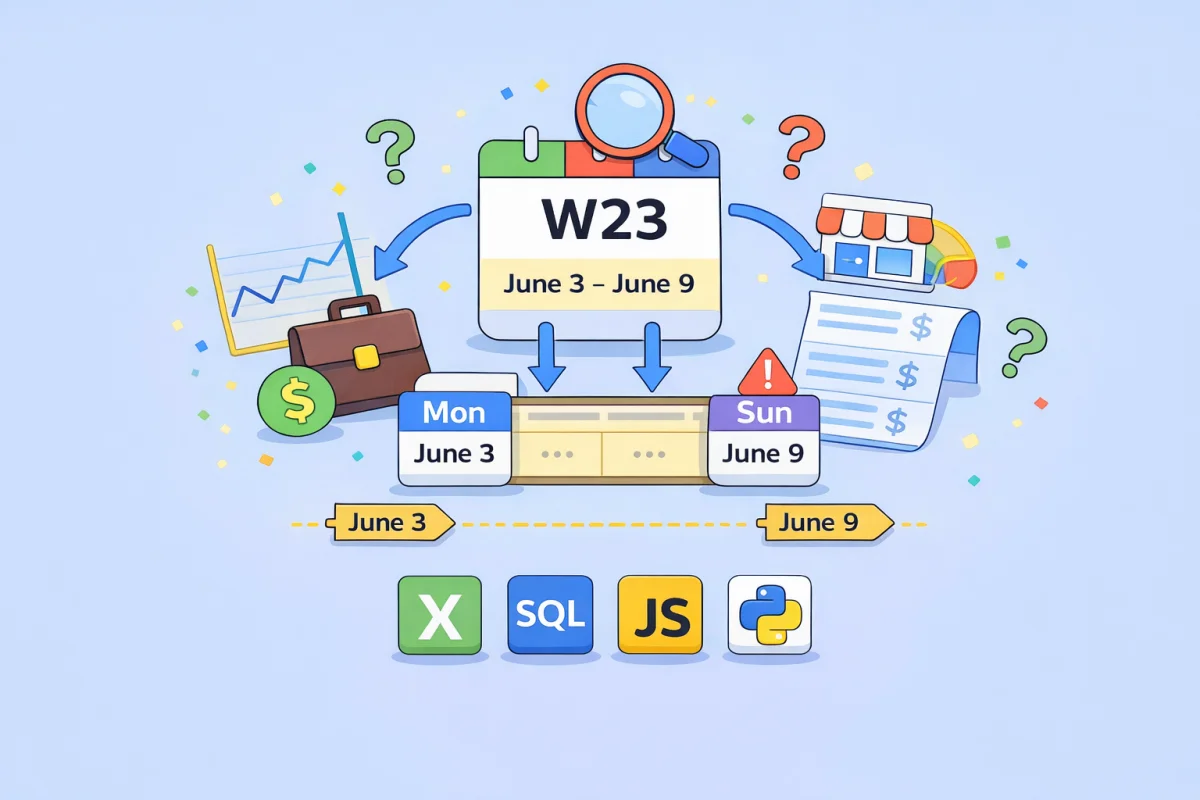 How to Convert a Week Number to a Date Range — The Complete Guide
If you know the week number but need the actual dates, the conversion is trickier than it looks — especially near year boundaries. Here's exactly how to do it in plain maths, Python, JavaScript, Excel, and SQL.
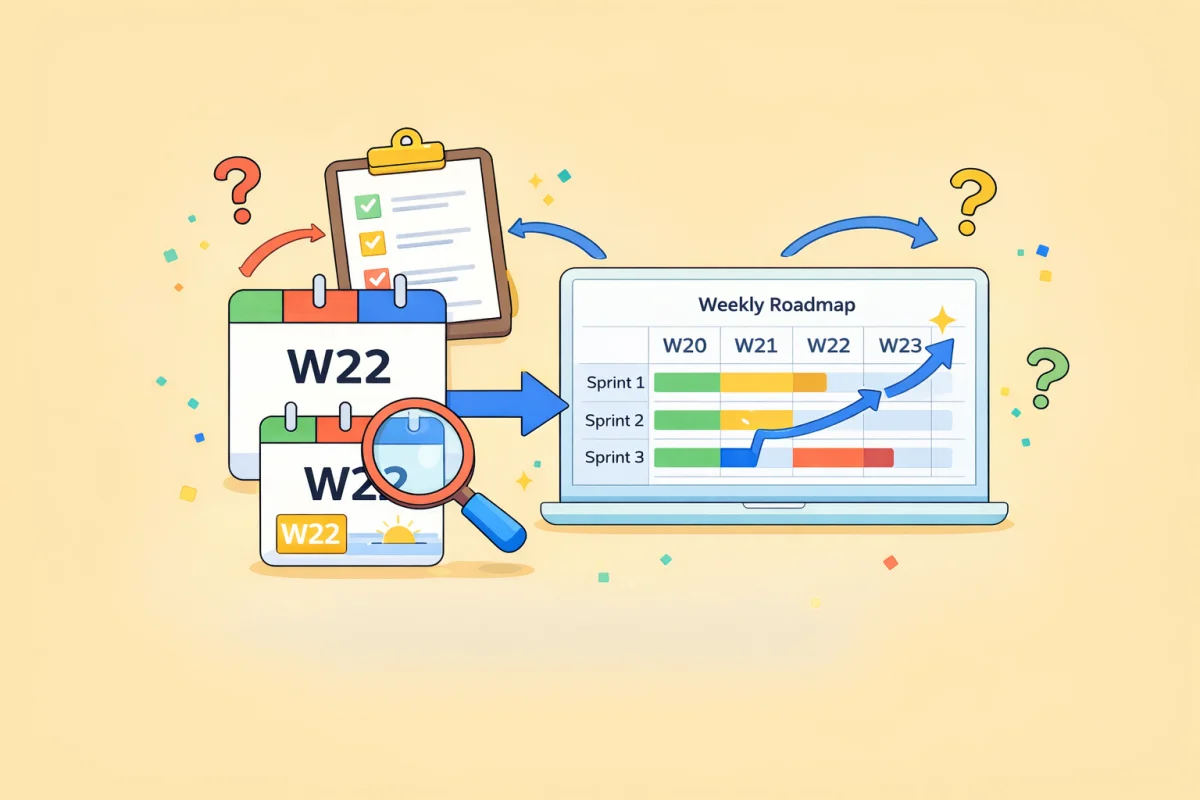 Using Week Numbers in Project Management — Sprints, Roadmaps, and the Hidden Coordination Traps
Week numbers seem like a clean way to plan projects across teams and time zones. They are — until a US engineer and a European PM discover they're talking about different weeks. Here's how to use them without the traps.
 53-Week Years — When They Happen and Why They Cause Problems in Payroll, Retail, and Finance
Most years have 52 ISO weeks. Some have 53. That extra week happens on a predictable schedule — but it still catches payroll systems, retailers, and financial teams off guard every time.