How to Set Your Freelance Hourly Rate (And Stop Undercharging)
Freelancers undercharge constantly. Not because they lack skill or confidence — but because they set rates the wrong way.
The most common method is some version of: look at what others in your field charge, pick a number that feels competitive, and hope it works out. That approach ignores your actual costs, your real working capacity, and the structural difference between being an employee and running a business.
The result is a rate that looks reasonable on the surface but quietly produces less income than a salaried job — without the benefits, security, or paid time off.
That is why people search for how to set freelance hourly rate, freelance rate calculator, how much should I charge as a freelancer, freelance day rate, and how to price freelance work. They are not looking for a market survey. They are looking for a method they can actually trust.
This guide gives you that method.
Why Most Freelancers Underprice Themselves
Before getting into the math, it helps to understand why undercharging is so common.
1. Comparing rates to employee salaries, not total cost of employment
If a salaried employee earns $60,000 per year, that does not mean the business pays $60,000. The true cost includes:
- employer payroll taxes (roughly 7–8% in the US)
- health insurance (often $5,000–$15,000+ per year)
- retirement contributions
- paid vacation and sick days (typically 15–20 days per year)
- office space, equipment, software
- HR overhead
The actual cost to an employer for a $60,000 salary employee is often $80,000–$90,000 or more. That is the economic baseline a freelancer should compare against — not the take-home salary.
2. Treating every hour of the day as billable
A freelancer working 40 hours per week does not bill 40 hours per week. A significant portion of every week goes toward:
- business administration (invoicing, contracts, accounting)
- client communication and meetings
- marketing and sales
- skills development
- proposal writing
A realistic billable percentage for most freelancers is 60–75% of working hours. Setting a rate based on 40 billable hours when you actually bill 25–30 guarantees you will fall short of your income target.
3. Ignoring business costs
Employees do not pay for their own software, office equipment, health insurance, retirement, or professional memberships. Freelancers do. These costs must be factored into the rate — not absorbed out of profit.
Step 1: Calculate Your Target Annual Income
Start with what you actually want to take home after taxes.
This is your net income target — not revenue, not gross income. The number you want to land in your bank account after paying income taxes, self-employment taxes, and business expenses.
Be honest about:
- your lifestyle and living costs
- savings goals (retirement, emergency fund, vacation)
- any major purchases or life expenses coming up
For this example, we will use $70,000 net annual income.
Step 2: Gross Up for Taxes
As a freelancer or sole proprietor, you pay both the employee and employer portions of Social Security and Medicare (self-employment tax), plus income tax.
A rough rule for grossing up your net income target in the US:
- Self-employment tax: ~15.3% (on ~92.35% of net earnings)
- Add federal and state income tax: varies by bracket and state, commonly 20–30% combined
A practical estimate: to net $70,000, you typically need to earn $90,000–$100,000 in gross revenue, depending on your tax situation and deductions.
For this example, we will use a $95,000 gross revenue target.
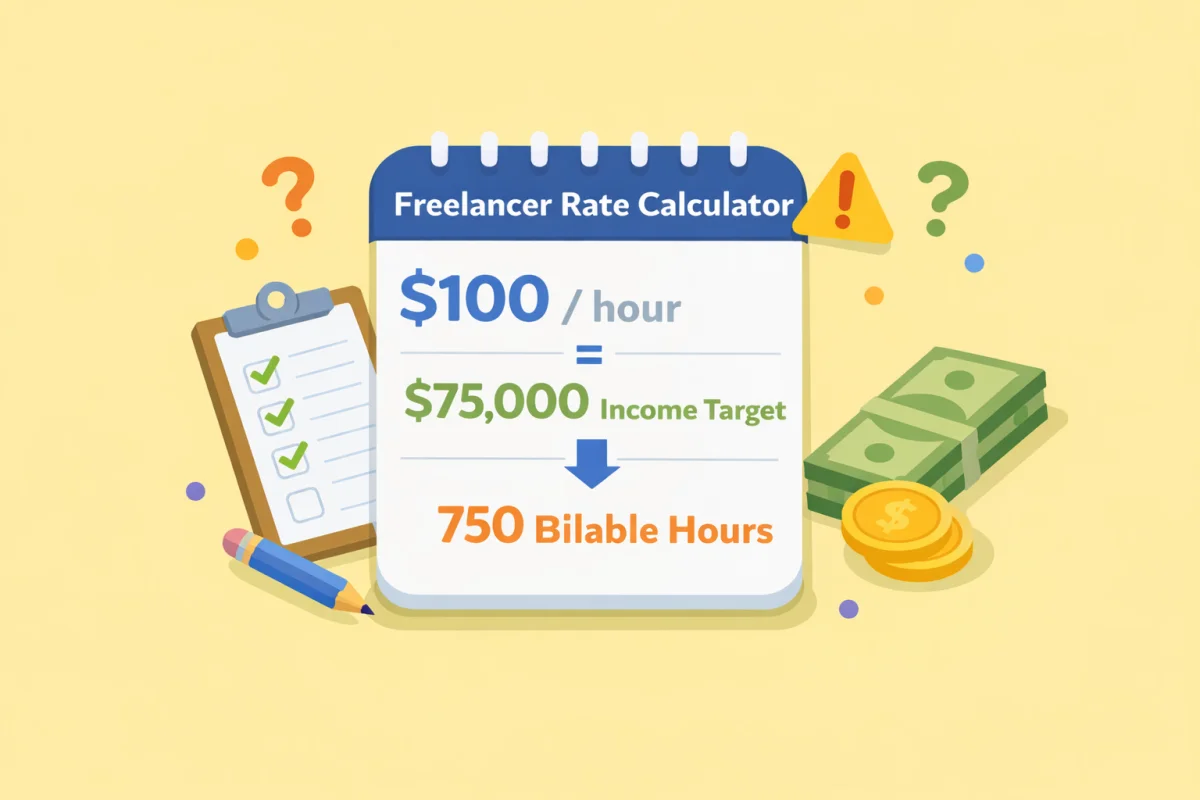
You can also use this as your starting revenue target and build the rate calculation from there. The Freelancer Rate Calculator handles this automatically.
Step 3: Add Business Expenses
List everything you pay for as part of running your freelance business:
| Expense | Annual Cost |
|---|---|
| Health insurance | $6,000 |
| Software and tools | $1,200 |
| Professional development | $500 |
| Home office / equipment | $800 |
| Accounting and legal | $600 |
| Professional insurance | $400 |
| Total | $9,500 |
Add this to your gross revenue target: $95,000 + $9,500 = $104,500 total revenue needed
Step 4: Calculate Realistic Billable Hours
Now determine how many hours per year you can actually bill.
Start with your working hours per week. If you work 45 hours per week: 45 hours × 52 weeks = 2,340 total working hours
Subtract non-billable time:
- Vacation and personal days: 15 days × 8 hours = 120 hours
- Admin, invoicing, bookkeeping: ~3 hours/week × 50 weeks = 150 hours
- Sales, proposals, networking: ~3 hours/week × 50 weeks = 150 hours
- Sick days and buffer: 5 days × 8 hours = 40 hours
Total non-billable: 460 hours
Realistic billable hours per year: 2,340 − 460 = 1,880
If you work fewer hours per week or run heavier on admin and sales, this number can drop to 1,500 or even 1,200. Be realistic — setting the number too high is exactly how freelancers end up underselling their time.
Step 5: Calculate Your Minimum Hourly Rate
Minimum hourly rate = Total revenue needed ÷ Billable hours per year
Using our example:
$104,500 ÷ 1,880 = $55.59 per hour
That is your floor — the minimum rate at which you break even on your income target and business costs. Charging less than this means you either earn less than you planned or work more hours than accounted for.
Most freelancers should charge above this floor to:
- build a buffer for slow months
- account for gaps between clients
- create room for raising rates over time
- reflect the value delivered, not just time spent
A 20–30% buffer above the minimum is a reasonable starting point: $55.59 × 1.25 = ~$69/hour as a working rate
How to Convert an Hourly Rate to a Day Rate
If you pitch project work in day rates, the conversion is straightforward:
Day rate = hourly rate × hours in your working day
For an 8-hour working day at $69/hour: $69 × 8 = $552/day
Many freelancers round to clean numbers and use $550–$600/day in this scenario. Day rates are common in consulting, design, development, and creative work where it is easier to estimate days than hours.
Adjusting Your Rate for the Market
The calculation above gives you your cost-based floor. Market rates are the ceiling — what clients in your field, geography, and experience level are willing to pay.
If your calculated floor is below market rates: charge more. You are leaving money on the table.
If your calculated floor is above typical market rates: either your income target is high relative to the local market, or you may need to specialize, build more expertise, or target higher-budget clients.
Where to research market rates:
- Freelance platforms (Upwork, Toptal, Contra) for a broad sense of ranges
- Industry salary surveys, adjusted upward for freelance premium
- Direct conversations with other freelancers in your network
- Job postings for full-time roles (reverse-engineer cost of employment)
A rough rule used in many industries: freelance rates should be 1.5–2.5× the equivalent employee hourly rate to account for non-billable time, taxes, benefits, and risk.
Why Value-Based Pricing Often Beats Hourly Pricing
Once you have your hourly floor, it is worth knowing when to move beyond it.
Hourly pricing aligns payment with time. It protects you from scope creep and works well for ongoing retainers and open-ended work.
Value-based pricing aligns payment with the outcome delivered. If you build a landing page that generates $200,000 in sales, charging $75/hour for 20 hours ($1,500) dramatically undervalues the work.
Value-based pricing makes sense when:
- the output has a clear, measurable impact on revenue or cost
- you can quantify the value to the client
- your expertise means you deliver the result much faster than an inexperienced person would
- the project scope is well-defined
The hourly floor calculation still matters in value-based pricing — it sets the absolute minimum below which any project becomes unprofitable.
Accounting for Meetings in Your Rate
One often-overlooked factor in freelance rate-setting is meeting time.
If a client expects weekly calls, discovery sessions, revision rounds, and status updates, those hours are part of your working time — but they often do not appear in the project scope.
Options for handling this:
1. Include a meeting allowance in your project fee: estimate the expected meeting hours and include them in the project price 2. Charge a client communication rate: some freelancers bill meetings at their standard hourly rate, explicitly stated in the contract 3. Set a meeting-inclusive retainer: if meetings are frequent, a monthly retainer that covers a set number of hours is cleaner than billing per call
The Meeting Cost Calculator is useful for showing clients — or yourself — what recurring calls actually cost. A weekly 1-hour review with you and a client contact at $70/hour is $70 × 50 weeks = $3,500/year in meeting cost alone.
When and How to Raise Your Freelance Rate
Most freelancers raise rates too rarely and too timidly.
A practical framework for when to raise:
- At contract renewal: every 6–12 months is reasonable for ongoing clients
- When demand exceeds capacity: if you are regularly turning down work, your rate is below market
- After significant skill development: new certifications, tools, or demonstrable results justify higher rates
- When onboarding new clients: new clients get your current rate; existing clients get a scheduled increase
How to raise rates with existing clients: Give notice (4–8 weeks is common), frame it around the value you provide rather than your costs, and give the client time to plan. Most long-term clients accept reasonable annual increases.
A 10–15% annual increase keeps pace with both inflation and skill growth without triggering pushback in most cases.
Common Freelance Rate Mistakes
Setting rates based on what you feel comfortable charging
Comfort and value are not the same. Discomfort with a number is often a sign it is closer to accurate, not that it is too high.
Accepting the first pushback without holding the rate
Clients often push back on rate as a reflex, not as a genuine limit. Holding your rate and explaining the value — rather than immediately discounting — is a skill worth developing.
Offering discounts for long-term work without a floor
Volume discounts can make sense, but there is a minimum below which you are simply working for less than your costs. Define that floor and protect it.
Not raising rates for years
A rate set in year one of freelancing is almost certainly too low by year three. Inflation alone justifies regular increases. Skill growth, client results, and market positioning justify more.
Quoting a rate before understanding scope
Giving a rate before knowing what the project entails creates pressure to honor a number that may not fit the actual work. Understand the scope, then price it.
A Complete Example From Start to Finish
Profile: Freelance content strategist, working 40 hours/week, targeting $65,000 net income in a medium cost-of-living city.
| Input | Value |
|---|---|
| Target net income | $65,000 |
| Gross up for taxes (~35% effective rate) | $100,000 |
| Annual business expenses | $7,200 |
| Total revenue needed | $107,200 |
| Total working hours/year (40h × 52w) | 2,080 |
| Less non-billable (admin, sales, PTO) | −500 |
| Billable hours/year | 1,580 |
| Minimum hourly rate | $67.85 |
| With 25% buffer | ~$85/hour |
| Day rate (7-hour days) | ~$595/day |
Starting point: $85/hour or $595/day, with room to move higher based on specialization and client results.
Final Takeaway
If you want to know how to set your freelance hourly rate, start from your real income needs — not from what feels safe or what others seem to charge.
The process: 1. Set a net income target 2. Gross up for taxes 3. Add business expenses 4. Calculate realistic billable hours 5. Divide to get your floor rate 6. Add a buffer and compare to market rates
Use the Freelancer Rate Calculator to run this calculation for your specific situation. If you also want to account for meeting time in your pricing, the Meeting Cost Calculator helps you quantify exactly how much client communication is costing you.
A rate you calculate from real numbers is a rate you can defend with confidence.