How to Raise Your Freelance Rate Without Losing Clients
Most freelancers undercharge. They set a rate when they start, pick up clients, and then continue charging the same rate two or three years later — even as their skills improve, their portfolio strengthens, and the market rate for their work climbs.
The reluctance to raise rates is understandable. Clients might say no. Relationships might get awkward. Someone might leave. But staying at the same rate year after year means your real income is declining as inflation rises, and you are potentially signalling that your work is not worth more than it was on your first day.
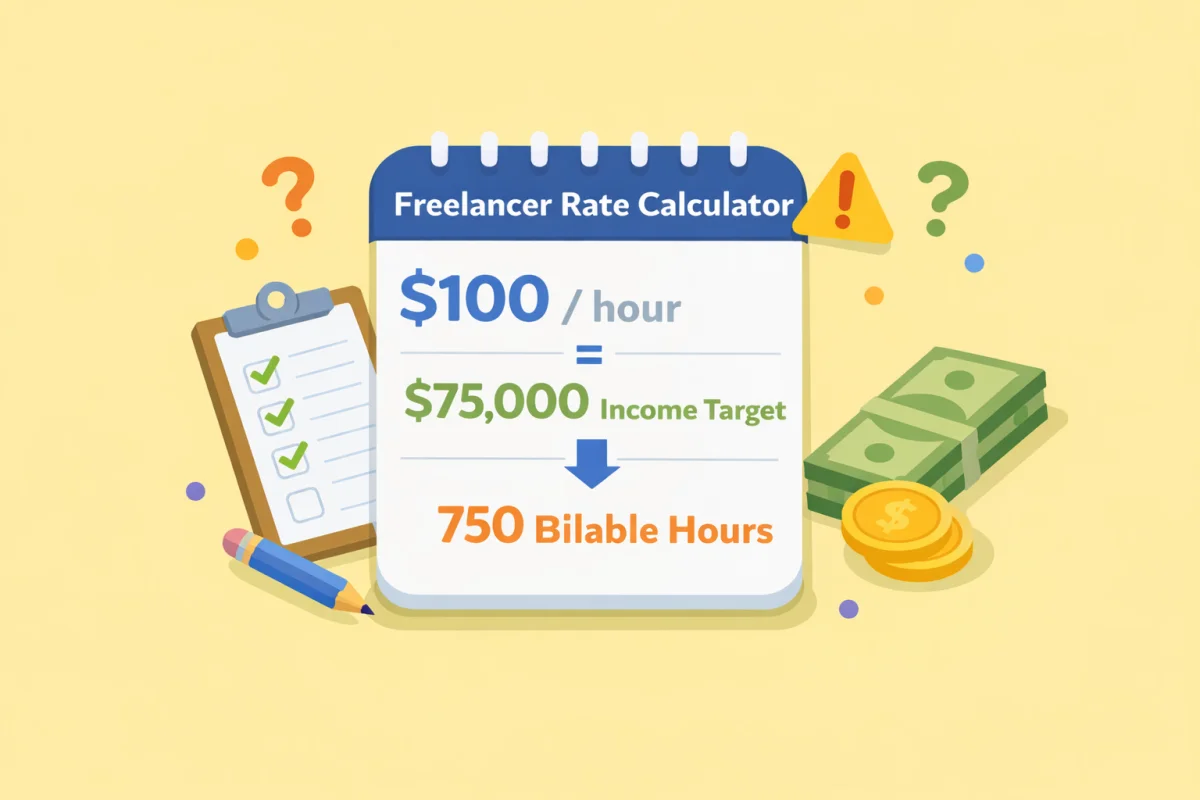
The Freelancer Rate Calculator shows what you actually need to charge based on your income target and expenses — use it to confirm whether your current rate is sustainable before you decide whether and how much to raise it.
When to Raise Your Rate
Before deciding how to raise your rate, it helps to be clear about why you are raising it. The reasons matter because they shape how you communicate the increase to clients.
You have not raised your rate in over a year. Inflation erodes the real value of a fixed rate. If your rate has been the same for 18 months and inflation has run at 4–5%, your real income has dropped without anyone doing anything. Annual rate reviews are not unreasonable.
Your skills or output have improved significantly. A freelancer with three years of experience and a strong portfolio is genuinely more valuable than the same person was on day one. The rate should reflect that.
Your market rate has risen. If the going rate for your type of work has moved up and you are still charging what you charged three years ago, you are effectively subsidising clients who would pay more.
You are fully booked and turning work away. If demand for your time exceeds your supply, that is a clear market signal that your rate is too low. The point of pricing is to find the level at which supply and demand balance — if you are always fully booked and always turning people down, your rate is below that level.
You have taken on a new type of work or specialisation. Specialist work commands higher rates. If you have developed expertise in a specific area since setting your original rate, the rate should reflect the new level of skill.
How Much to Raise It
There is no universal answer, but some practical frameworks:
Inflation adjustment: If you have not raised your rate in a year, a 5–8% increase keeps your real income flat. This is the minimum — it is not a raise, it is maintenance.
Skills premium: If your capabilities have meaningfully improved, 10–20% is reasonable. If you have developed a specific specialisation with demonstrably higher value, more may be justified.
Market correction: If you have discovered that your current rate is well below market — through conversations with peers, job listings, or freelance platforms — correcting to market may require a larger one-off adjustment. A 20–30% jump is uncomfortable but not unusual when someone has been significantly undercharging.
Prospective client rate: Whatever rate you quote existing clients, your rate for new clients should be at your new level from day one. Never give new clients your old rate. Raise the starting point with each new engagement.
Raising Rates With Existing Clients
Existing clients are the harder conversation. They have a relationship with you at a known price, and a rate increase requires them to re-evaluate that relationship.
Give adequate notice
A minimum of 30 days notice before a rate increase takes effect is professional. 60–90 days is better for clients whose budgets need approval cycles. Springing a rate increase on someone at invoice time is bad practice and damages trust.
Frame it as a review, not a demand
You are not demanding more money — you are reviewing your pricing on an annual basis, the same way any professional service does. "I wanted to let you know that I will be updating my rates from [date]. My new rate will be [X]." Clear, professional, no apology.
An apology makes the increase seem like you know it is unjustified. It invites pushback. State the new rate as a fact, not a request.
Explain without over-explaining
You do not owe clients a detailed justification, but a brief context helps. "I review my rates annually — this reflects the rising cost of running my business and the skills I have developed over our time working together" is enough. Do not list every reason or you will sound like you are seeking approval.
Apply it to new work, not existing contracts
If you have a project currently in progress under an agreed budget, honour that agreement. Apply the new rate to future projects or to the next renewal of a retainer. Changing the rate mid-project is unfair and likely to cause conflict.
Give your best clients a courtesy period
For long-term clients who have been particularly good to work with — reliable payment, respectful communication, interesting work — you can offer a short grace period at the old rate, or a smaller initial increase with the full increase phased in over two cycles. This is a discretionary courtesy, not an obligation.
When a Client Says No
Some clients will push back. Some will leave.
Pushback does not always mean no — it often means they want to negotiate. You can hold your rate, offer a small discount for a multi-month commitment, or offer a phased increase. What you should not do is back down immediately, which signals that your stated rate was never real.
Clients who leave because you raised your rate to a reasonable level were often not sustainable at the old rate anyway. The clients worth keeping are the ones who value the work at a fair price.
If several clients leave, that is a signal worth investigating. Either the increase was too large for the market, or your positioning needs work so clients understand the value they are paying for. A blanket "my rate is going up" without demonstrating value is harder to justify than a rate increase accompanied by evidence of improved output, stronger results, or a clearly articulated specialisation.
Building Rate Increases Into Your Practice
The most effective way to handle rate increases is to make them routine rather than exceptional.
Annual rate reviews, communicated in advance, normalise the process. Clients come to expect it. It becomes a standard business practice rather than an uncomfortable one-off conversation.
New clients always get your current rate. Never grandfather new clients into old pricing — you would have to raise it again later, which is harder than starting at the right number.
Recalculate your minimum viable rate every year using the Freelancer Rate Calculator. Factor in actual billable hours (not theoretical maximum), updated business expenses, and your target income. The gap between your current rate and your minimum viable rate tells you the minimum increase you need — anything above that is a buffer for growth.
A freelance business that never raises its rates is, in real terms, slowly declining. Rate increases, done professionally and with adequate notice, are a normal part of running a sustainable practice.