How to Price a Freelance Project — Flat Fee vs Hourly Rate
The pricing question comes up on almost every new project: should you charge a flat fee or an hourly rate? Neither is universally better — the right choice depends on the nature of the work, how well you can scope it, and what kind of client relationship you're building.
Getting this decision wrong is expensive. Charging hourly on a project that runs long is fine; charging a flat fee on a project with vague scope is how freelancers lose thousands of dollars. The good news is the choice has a logic to it, and once you understand it, it becomes easier to make quickly.
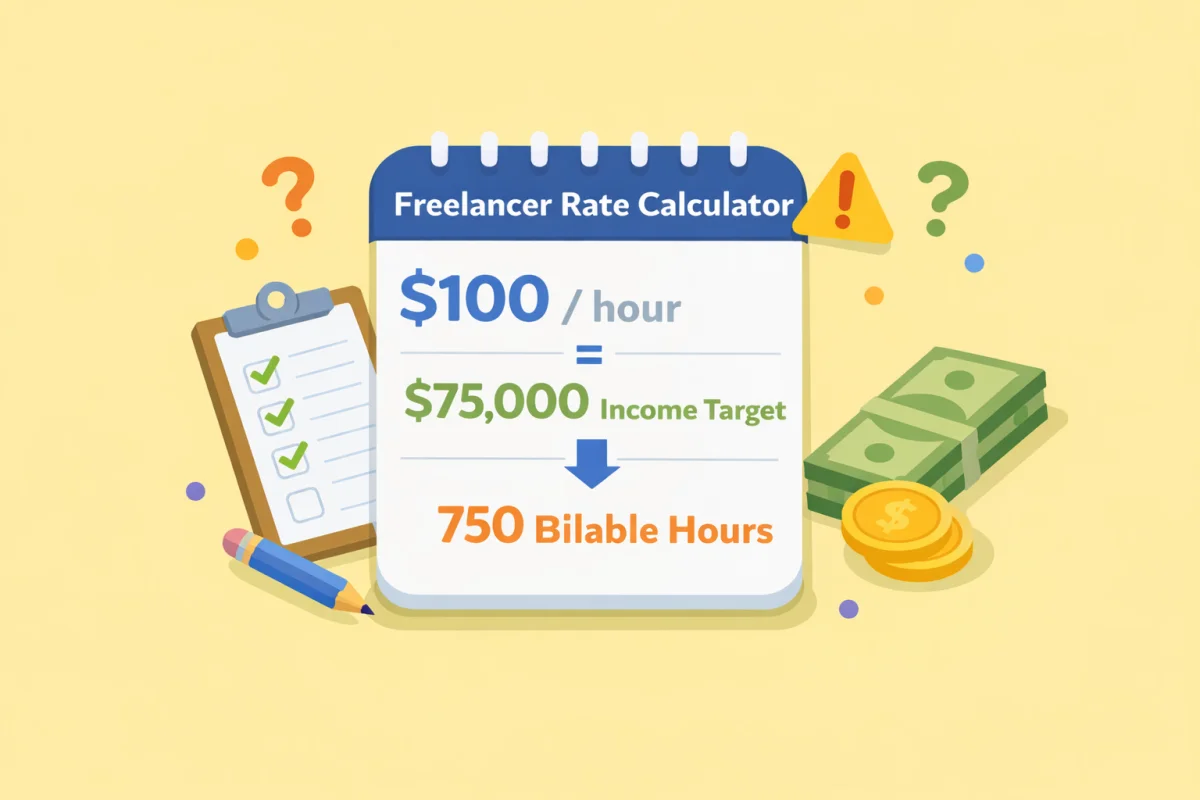
Use the Freelance Rate Calculator to establish your minimum viable hourly rate before deciding which pricing model to apply.
How Hourly Pricing Works
You charge a set rate per hour and invoice based on actual time worked. The client pays for the time you spend, not a fixed output.
When hourly works well:
- The project scope is genuinely unclear or likely to change
- The client wants to be involved in the process and makes decisions that affect your time
- The work is ongoing support, consulting, or maintenance rather than a discrete deliverable
- You're new to the project or client and can't accurately estimate effort
The main risk with hourly billing: clients can feel like they're watching a meter run. Every email, every call, every small revision adds to the invoice. Some clients respond to this by second-guessing the time tracking or pulling back on asking questions. It can create friction that's absent from fixed-price engagements.
The other risk is that you don't benefit from getting faster. If you complete a task in 3 hours that used to take you 8, you earn less — even though your skill level is higher. Hourly billing can inadvertently punish efficiency.
How Flat Fee Pricing Works
You agree on a total price for a defined scope of work, regardless of how long it takes. If you're fast, you earn more per hour. If you underestimate, you absorb the loss.
When flat fee works well:
- The scope is clearly defined and the deliverables are specific
- You've done similar work before and can estimate effort accurately
- The client cares about certainty — knowing the total cost upfront
- You want to reward your own efficiency and expertise
The main risk with flat fee billing: scope creep. A client adds "just one more thing" multiple times and you end up doing double the work for the same price. Without a clear scope document and a change process, flat fee projects can eat your margins entirely.
The Scope Document Is the Foundation
If you're going to price projects at a flat fee, the scope document is non-negotiable. Before quoting a number, you need to be specific about exactly what's included — and what's not.
A scope document doesn't need to be elaborate. It can be a single-page bullet list that covers:
- What you will deliver (specific outputs, not vague descriptions)
- How many rounds of revisions are included
- What constitutes a revision vs a new request
- What's explicitly out of scope
- What you need from the client and by when
- The timeline and any milestones
When scope changes happen — and they will — you have a reference point for a conversation. "This falls outside the original scope; here's what it would add" is a professional response that flat fee work requires.
How to Estimate Hours for a Flat Fee Quote
The mistake most freelancers make when quoting flat fees is estimating the hours it will take to do the work and pricing that directly. The problem: this ignores all the unbillable time that surrounds the work itself.
A better approach is to think through every component:
1. Core work hours. The actual time to produce the deliverable. 2. Revision cycles. How many rounds of feedback are typical for this type of project? Build them in. 3. Client communication. Calls, emails, question-answering. For a 4-week project with an active client, this can add 10–15% to your total time. 4. Project management overhead. Setting up files, tracking progress, writing status updates. 5. Buffer for surprises. Something always takes longer than expected. Add 15–20% on top of your honest estimate.
Total that up, multiply by your hourly rate, and that's your floor — the minimum you should charge. Quote at or above that number, not below it.
Example: A web copywriting project.
- Core writing: 12 hours
- Revisions (2 rounds): 4 hours
- Client calls and communication: 3 hours
- Admin: 1 hour
- 20% buffer: 4 hours
- Total: 24 hours
At $80/hour, the floor is $1,920. A reasonable flat fee quote might be $2,000–2,200.
When to Use Which Model
There's no single answer, but a useful framework:
| Situation | Better model |
|---|---|
| Clearly scoped project, predictable deliverables | Flat fee |
| Ongoing support or maintenance | Hourly |
| Strategy, consulting, or advisory work | Hourly or retainer |
| First project with a new client where scope is uncertain | Hourly |
| Repeat project type you know well | Flat fee |
| Client who makes frequent change requests | Hourly |
Some freelancers use a hybrid: flat fee for the core deliverable, with a day rate available for work beyond the agreed scope. This gives clients certainty while protecting you from unlimited revision requests.
What a Retainer Model Adds
A retainer is a recurring flat fee in exchange for ongoing availability or a set number of hours per month. It's different from project pricing in that the client is paying for access and consistency, not a specific output.
Retainers benefit freelancers because they provide income predictability — you know what next month looks like rather than hunting for new projects. They benefit clients because they get priority access and don't need to re-scope every time a new need arises.
Retainers work well for ongoing content creation, maintenance, advisory relationships, and any work where the client has a continuous need rather than discrete projects.
How to Raise Your Rates Mid-Project
You generally shouldn't — which is why getting the initial price right matters so much. But scope changes are different. Any work that wasn't in the original agreement is fair to price separately.
The language is simple: "This falls outside what we originally scoped. I can take it on for an additional [rate/fee]." Most clients understand this when you handle it professionally and reference the original scope clearly.
For your next project with the same client, you raise the rate in the new proposal. If you've delivered good work, the rate increase is usually accepted. If you've been charging below your market rate for a while, a 20–30% increase in the next project proposal is usually receivable, particularly if you can point to the quality of your previous work.
Knowing Your Floor Rate Before You Quote
Before you can make smart pricing decisions, you need to know the minimum you can charge and still meet your financial goals. That means calculating your target annual income, your expected business expenses, your tax obligations, and your actual billable hours per year.
The Freelance Rate Calculator walks through this calculation. Put in your target take-home income, your tax rate, your expenses, and your available hours, and it tells you the minimum hourly rate that makes the numbers work. Quote below that, and you're subsidizing your clients out of your own standard of living.
That floor rate is what gives you confidence in pricing conversations. When you know a $75/hour project doesn't work for you because your minimum is $90, you stop second-guessing and either negotiate or walk away from a bad-fit project.