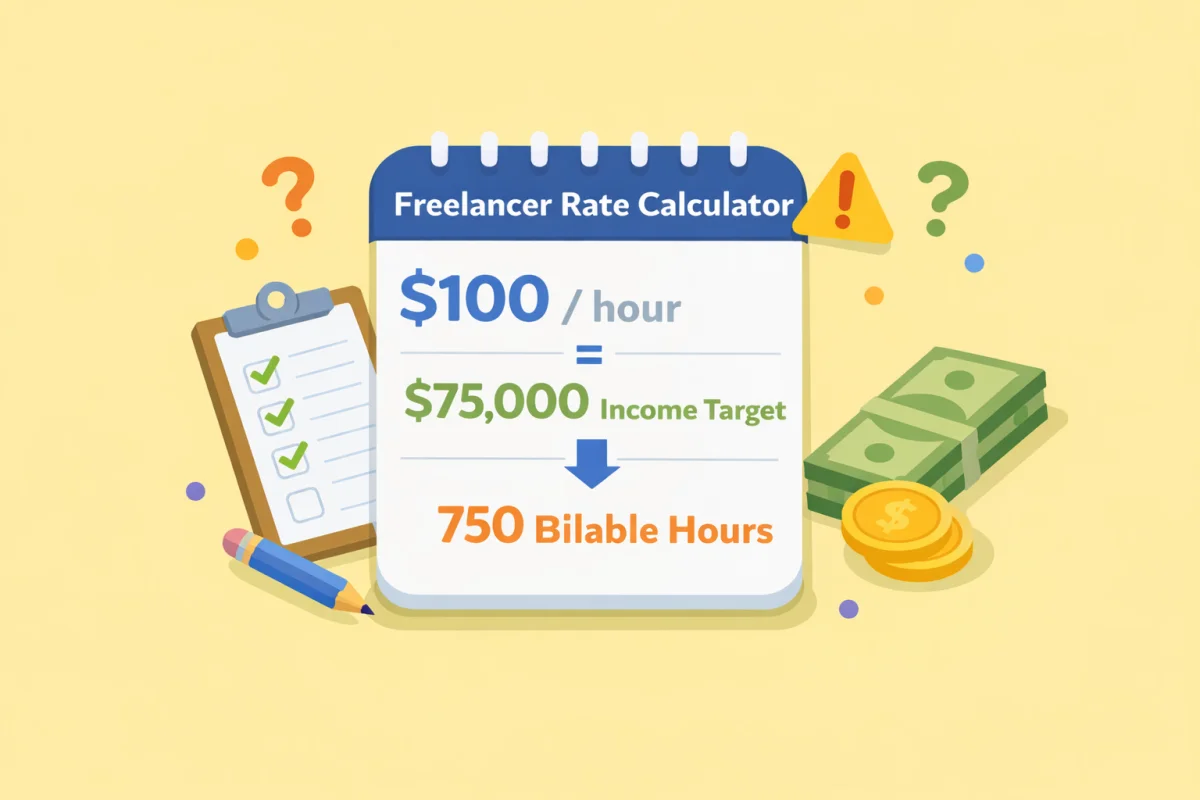
How to Calculate Your Freelance Rate After Taxes
Most guides on freelance pricing start with "what do you want to earn?" and stop there. That's the wrong starting point — or at least, an incomplete one.
The number that matters isn't what you bill. It's what you keep after taxes, self-employment contributions, and the costs of running your business. If you don't price with the full picture in mind, you'll hit your revenue target and still feel broke.
The Core Problem: Freelancers Pay More Tax Than Employees
This trips up a huge number of people going freelance for the first time. If you earned $75,000 as a salaried employee and you want to match that as a freelancer, you can't just divide $75,000 by your billable hours.
An employer paying you $75,000 is actually spending significantly more. They're covering their share of payroll taxes, your health insurance, any retirement match, paid leave, and equipment. You never saw those costs — but they were real.
As a freelancer, you pay all of that yourself. And in most countries, you pay the combined employee-and-employer portion of social insurance contributions, not just the employee side.
In the US, that means self-employment tax of 15.3% on top of your regular income tax. A freelancer targeting $75,000 in net income needs to earn roughly $100,000–$110,000 in gross revenue to end up in the same place as a salaried employee at the same income level, depending on their state and deductions.
Start From the Number You Actually Want
The freelance rate calculator works backwards from your target net income — what you want to take home — rather than forward from some market rate. That's the right direction.
Here's the logic:
Step 1: Decide your target net income. Not gross, not revenue — the actual after-tax amount you want to live on. Be specific. $60,000/year means $5,000/month. Does that cover your rent, savings contributions, and everything else? Start there.
Step 2: Gross it up for taxes. If your effective tax rate (income tax plus self-employment or national insurance contributions) is 35%, then:
gross income = $60,000 ÷ (1 − 0.35) = $92,308You need to earn $92,308 before tax to keep $60,000.
Step 3: Add business expenses. Software, hardware, insurance, accountant fees, co-working space, professional development — add these on top of your gross income target. If your annual expenses are $8,000:
annual revenue target = $92,308 + $8,000 = $100,308Step 4: Divide by realistic billable hours. If you work 48 weeks a year at 25 billable hours per week:
billable hours = 48 × 25 = 1,200 hours
minimum rate = $100,308 ÷ 1,200 = $83.59/hour
And that's before any profit margin. Add 20–25% to give yourself breathing room for slow months and unpaid invoices, and you're looking at $100–$105/hour as a sustainable rate.
The Billable Hours Number Most People Get Wrong
25 billable hours per week sounds conservative if you're used to a 40-hour workweek. It's not.
In a freelance practice, billable work — the hours you can actually invoice — typically runs between 50% and 70% of your total working time. The rest goes to:
- Finding and closing new clients
- Writing proposals and contracts
- Invoicing and chasing payments
- Bookkeeping and tax preparation
- Onboarding new projects, offboarding completed ones
- Learning, staying current, maintaining your skills
If you work 40 hours a week and assume you can bill all 40, you'll chronically under-price yourself. Use 25–28 hours as your billable baseline if you're in a project-based practice. Retainer-heavy practices can push closer to 30–35, since less time goes to sales and onboarding.
Tax Rates to Use for Different Situations
Exact figures depend on your country, filing status, and deductions, but here are rough starting points:
US freelancers: Self-employment tax is 15.3% up to the Social Security wage base, then 2.9% above it. Add federal income tax (22% bracket starts at $47,150 for single filers in 2024) plus state income tax if applicable. An effective total rate of 30–38% is typical for a mid-income US freelancer.
UK sole traders: Class 4 National Insurance (9% on profits between £12,570 and £50,270, 2% above) plus income tax (20% basic rate, 40% higher rate). Effective combined rate of around 29–49% depending on income.
Canadian self-employed: CPP contributions (both employee and employer portions) plus federal and provincial income tax. Effective rates of 28–40% depending on province and income level.
EU freelancers: Varies significantly by country. Germany, France, and the Netherlands tend toward higher effective rates for the self-employed; some Eastern European countries have flat-rate systems that work out lower.
If you're not sure of your rate, talk to an accountant who works with self-employed clients. Paying for one hour of their time before setting your rate is worth it.
Why You Need a Margin on Top of the Minimum
The calculation above gives you a break-even rate — the minimum to cover your income target and costs. That's not the rate you should charge.
A few things the minimum doesn't cover:
Slow months. Client projects end, new ones are delayed, invoices take 60 days to clear. Even a two-week gap in work means your annual billable hours come in under plan.
Unpaid invoices. Late payment is common. Some invoices don't get paid at all. Budget for losing 3–5% of your billed revenue to this.
Scope creep and rework. Projects run over. Clients change direction. Some of that extra time won't be billable.
Reinvestment. Buying better equipment, taking a course, upgrading your software — these come from somewhere.
Standard advice is to add 20–30% above your minimum rate as a buffer. If your minimum rate calculates to $83/hour, charge $100–$105. The margin is what separates a sustainable freelance practice from one where a single bad month creates a cash crisis.
When Your Market Rate and Your Calculated Rate Don't Match
Sometimes you run the numbers and find your minimum rate is above what clients in your market will pay. That's important information.
The gap can mean a few things:
1. Your income target is too high for your current market — either reduce expenses, adjust the income target for now, or move up-market. 2. Your billable hours estimate is too low — some freelancers can push utilization higher by building retainer relationships or productizing services. 3. You're in the wrong niche or geography — rates for the same skill set can vary by 2–3x depending on who the client is and where they're based. A web developer serving local small businesses earns very differently from one serving US tech startups remotely.
The calculation doesn't tell you what to charge — it tells you what you can't afford to charge less than. What the market will actually pay is a separate question, one answered by testing, research, and conversations with peers.
Putting It Together
Run the numbers in the freelance rate calculator with your actual figures: the income you want to take home, your realistic tax rate, your expected annual expenses, and your honest estimate of billable hours. The result is your floor — the number below which you're effectively subsidizing your clients.
Then add your margin. Then see how that compares to market rates in your field.
If the gap is large, that's a signal — either the market, the niche, or the business model needs to change. If it lines up, you've got a rate you can confidently quote without doing mental math every time a client asks.