Freelance Rate vs Salary — What You Actually Need to Charge to Come Out Ahead
The most common mistake new freelancers make is pricing their services like they're still an employee. A developer earning $80,000 as a salaried employee looks at $40/hour freelance work and thinks "that's the same thing, more or less." It isn't — and the difference can be the gap between a sustainable freelance practice and one that slowly bleeds them dry.
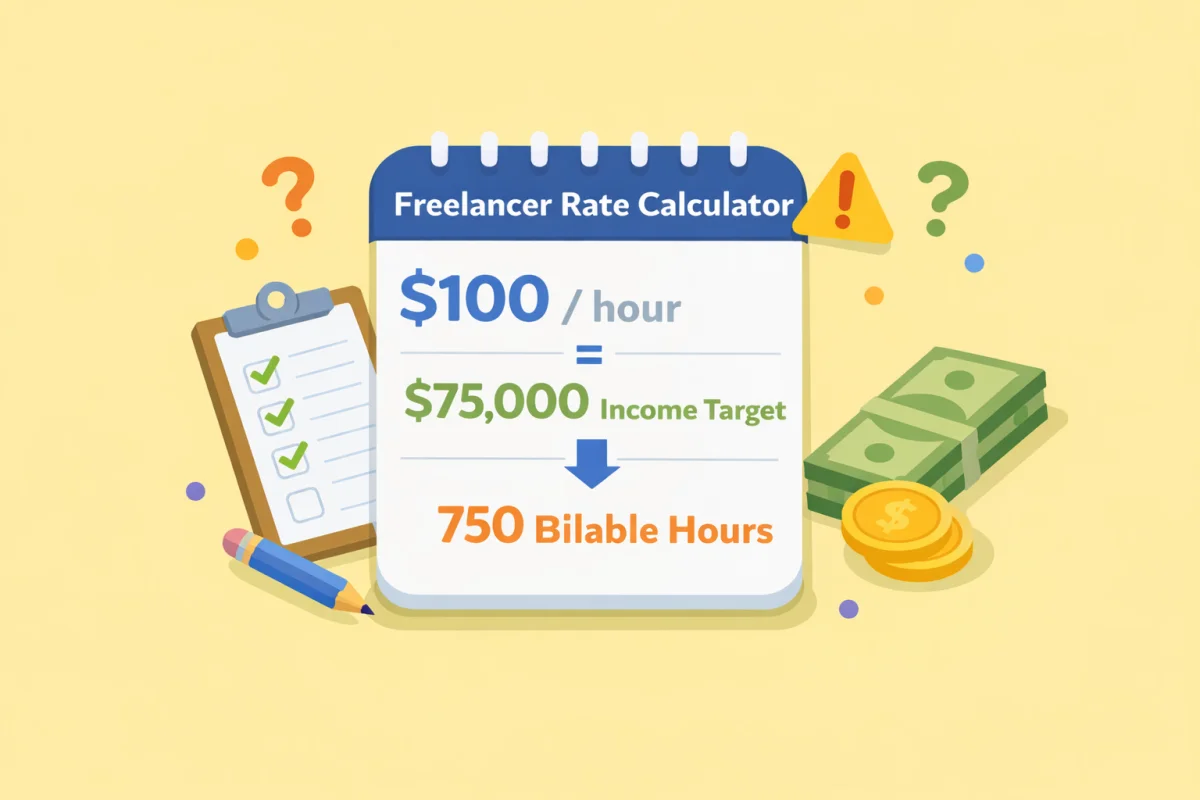
The Freelancer Rate Calculator works backwards from your target take-home income to find the minimum hourly rate you need to charge. This article explains the logic behind that calculation and what most people miss when making the freelance-vs-salary comparison.
What a Salary Actually Costs an Employer
When a company hires someone at $80,000/year, they're not spending $80,000. They're spending considerably more. The full employer cost typically includes:
- Gross salary: $80,000
- Payroll taxes (employer portion): ~7.65% in the US = $6,120
- Health insurance: $5,000–$15,000/year depending on plan and family size
- Retirement contributions: often 3–5% match = $2,400–$4,000
- Paid time off: 10–15 days = about $3,100–$4,600 of paid non-working time
- Equipment and software: $2,000–$5,000/year
- Office overhead allocation: varies widely
A realistic total employer cost for an $80,000 salary is $100,000–$120,000 per year. That's what the work is actually worth to the employer — and it's the real benchmark for what a freelancer doing the same work should charge.
At 1,700 billable hours per year (a realistic figure after accounting for downtime, admin, and business development), $110,000 in annual revenue works out to about $65/hour. An $80,000 salaried employee billing at $40/hour is working for significantly less than their employment equivalent.
The 1.5×–2× Rule of Thumb
A commonly cited rule: freelancers should charge 1.5–2× the equivalent employee hourly rate to come out at the same net financial position. The multiplier accounts for:
- Self-employment taxes (paying both employee and employer portions)
- No employer-provided benefits (health insurance, retirement match)
- Unpaid time: vacation, sick days, downtime between projects
- Business expenses: software, hardware, accounting, insurance
- Non-billable working time: sales, admin, professional development
The exact multiple depends on your tax situation, expenses, and billable utilization rate. The Freelancer Rate Calculator gives you the precise number based on your inputs rather than a rough estimate.
Breaking Down the Calculation
The math works in four steps:
Step 1: Gross up for taxes
Start with the net income you want to take home. To find the gross revenue you need to generate, divide by (1 − tax rate).
If you want $60,000 net and your effective tax rate is 30%: Gross needed = $60,000 ÷ 0.70 = $85,714
For US freelancers, remember that self-employment tax adds approximately 15.3% on top of regular income tax. If you'd pay 22% in regular income tax as an employee, your effective total rate as a self-employed person is closer to 35–37% on business income. Most new freelancers underestimate this by 10+ percentage points.
Step 2: Add business expenses
Business expenses are a revenue cost, not a take-home reduction. They need to be covered by billing before you get to take anything home.
Common freelance expenses:
- Health insurance: $3,600–$12,000/year (solo or family, ACA marketplace)
- Accounting software or accountant: $500–$2,000/year
- Professional software/tools: $500–$3,000/year
- Hardware refresh (amortized): $500–$1,500/year
- Professional liability/E&O insurance: $500–$2,500/year
- Marketing, website, portfolio: $200–$1,000/year
Total: easily $6,000–$20,000/year depending on field and circumstances.
Annual revenue target = gross income needed + annual expenses
Continuing the example: $85,714 + $12,000 expenses = $97,714 annual revenue needed.
Step 3: Calculate realistic billable hours
This is where most people are overly optimistic. A 40-hour work week does not produce 40 billable hours. In a typical freelance practice:
- Time spent on sales, proposals, and client acquisition: 5–10 hours/week
- Admin, invoicing, bookkeeping: 2–5 hours/week
- Professional development: 2–3 hours/week
- Onboarding new clients: variable but real
If you work 45 hours/week and bill 25–28 hours, your utilization is about 60%. Over a 48-week year (4 weeks vacation), that's 1,200–1,344 billable hours.
Using 1,250 billable hours as a conservative-but-realistic figure:
Step 4: Divide revenue target by billable hours
Minimum hourly rate = $97,714 ÷ 1,250 = $78/hour
That's the floor for breaking even. To build in a 25% profit margin: $78 × 1.25 = $97.50/hour.
For a developer who was earning $80,000 as an employee, $97–$100/hour is roughly 2.4× the equivalent employee hourly rate ($80,000 ÷ 2,080 hours = $38.46/hour). That's on the higher end of the 1.5–2× rule, and it's appropriate — this calculation assumed significant expenses and conservative billable hours.
The Hidden Tax Difference
The tax comparison between employee and freelancer is the piece most people underestimate the most.
As a W-2 employee in the US, payroll taxes (Social Security and Medicare) are split between you and your employer: you pay 7.65%, your employer pays 7.65%. You never see the employer's share.
As a freelancer (self-employed), you pay both halves: 15.3% self-employment tax on top of regular income tax. On $85,000 of net self-employment income, self-employment tax is about $12,000 — before federal and state income tax.
A freelancer earning $100,000 in gross revenue keeps significantly less than $100,000. After self-employment tax and a 22% federal income bracket, you're looking at $60,000–$65,000 net depending on deductions. An employee earning $80,000 gross might net $57,000–$62,000. The gross revenue gap is $20,000, but the net income difference is much smaller — sometimes negligible.
This is why the 1.5×–2× rule exists: once you account for the full tax and benefits picture, a freelancer charging twice the employee hourly rate may only be slightly ahead financially — and needs that margin to absorb the volatility and administrative burden of freelancing.
When Freelancing Actually Pays Better
The math above shows the break-even point. Freelancing genuinely pays better than employment when:
You bill more hours at higher rates. A freelancer with strong demand who bills 1,600+ hours at a premium rate pulls ahead significantly. The non-billable time shrinks as a proportion once client acquisition is established.
You work in a high-skill niche. Specialist freelancers — security consultants, specialized attorneys, senior product designers — often charge $150–$400/hour. The employer equivalent might be a $120,000 salary. At those billing rates, even with conservative utilization, freelancing produces far more net income.
You reduce expenses strategically. A freelancer who qualifies for ACA subsidies (if income is variable year to year), contributes to a SEP-IRA or Solo 401(k) to reduce taxable income, and keeps overhead lean can close the tax gap significantly.
You add leverage. Subcontracting work, productizing services, or charging project-based fees (which aren't capped by hours) can push earnings well above the hourly rate equivalent.
Checking Your Rate
Use the Freelancer Rate Calculator to run your specific numbers. The key inputs to get right:
- Desired net income: What you actually want to take home, not what your salary was
- Tax rate: Include self-employment tax; estimate conservatively (35–40% for most US freelancers)
- Annual expenses: Health insurance is usually the biggest one to not forget
- Vacation weeks: 0 weeks means you work every week; 4 weeks is more realistic
- Billable hours per week: Be honest — 25–30 hours of actual client work per week is typical for a full-time freelancer
The result is your floor. Add 20–30% on top for a sustainable rate that covers slow months and unpaid invoices. The Meeting Cost Calculator can also be useful for freelancers who bill time-based services — it makes the cost of unbillable client calls visible and helps you decide which meetings are worth taking.