How to Set a Freelance Rate at Every Experience Level
One of the most persistent problems in freelancing is undercharging. It happens at every level — not just when you are starting out. Experienced freelancers with 10 years of work still often charge rates that do not reflect the value they provide or the market they operate in.
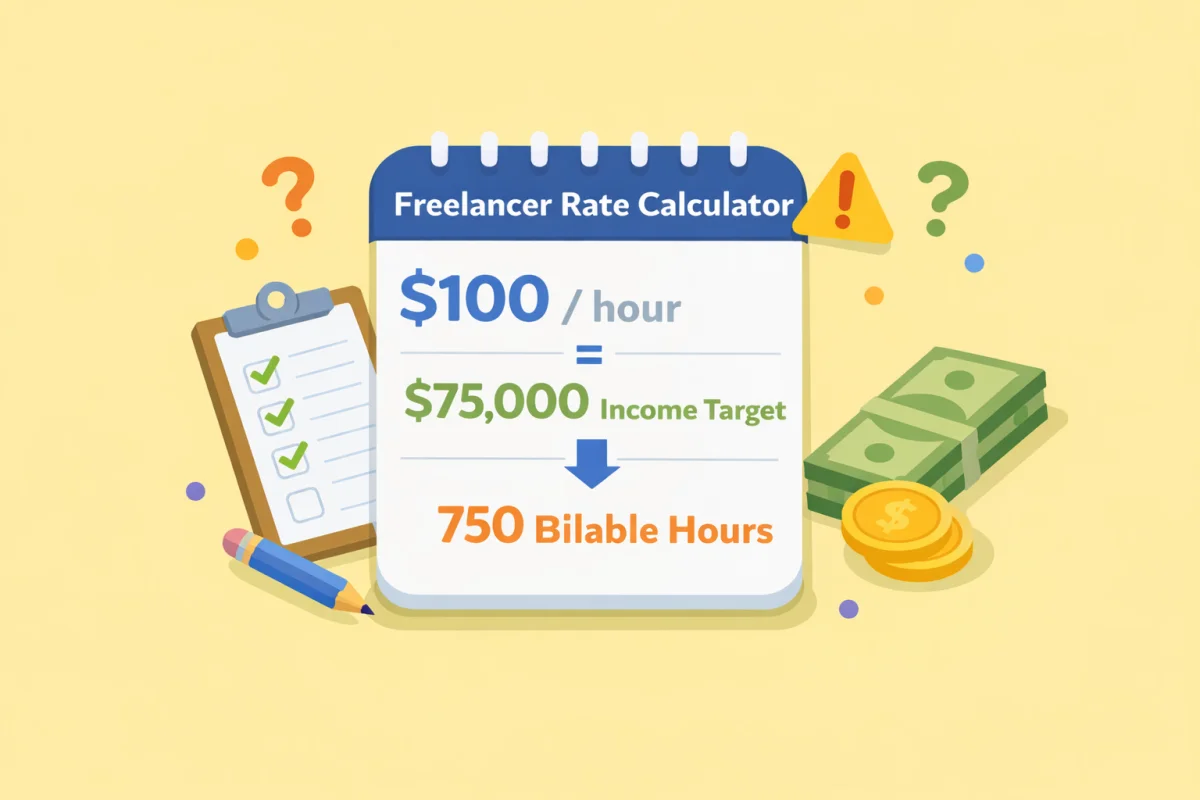
The Freelancer Rate Calculator works backwards from your income target to tell you what you need to charge per hour. This article explains how rate-setting changes at different stages of a freelance career, and what indicators tell you that you are in the wrong band.
The Starting Point: What You Must Cover
Before discussing what to charge by experience, it helps to understand the floor. Your rate must cover:
- Your desired take-home income
- Taxes (including the self-employment tax premium most freelancers pay that employees do not)
- Business expenses: software, equipment, insurance, accounting fees
- Non-billable time: business development, admin, downtime between projects, professional development
- A margin for slow months and unpaid invoices
The Freelancer Rate Calculator handles this math. But the output is a minimum — not a market rate. Many freelancers make the mistake of treating the minimum as the target.
Early Career (0–2 Years): Building a Track Record
At this stage, you have limited or no client work to show, and clients cannot verify your quality through references. This justifiably reduces what you can charge relative to experienced practitioners.
Typical rate range: 60–80% of mid-level rates in your market
What "junior" means in practice:
- You are still building speed and quality on real client work
- Your problem-solving is competent but slower than an expert
- You need more direction and revision cycles
This does not mean you should accept poverty rates. Your floor is still your minimum viable rate. The market-based discount from a mid-level rate is because clients take on more perceived risk with you.
What to focus on instead of competing on price:
- Niche down early. Generalist junior freelancers compete on price. Junior freelancers who specialize in one industry or tool compete on fit.
- Over-deliver on a small number of clients to build strong testimonials quickly
- Keep a portfolio updated with every completed project
One common mistake at this stage: taking low-paying work because you feel you cannot charge more. Low-paying clients are usually more demanding, provide worse briefs, and take longer to pay. They also consume the time you need to improve.
Rate increase trigger: When you are consistently turning down work or booked 6+ weeks ahead, your rate is too low.
Mid Career (3–7 Years): Pricing on Value, Not Time
By mid-career, you have:
- A portfolio of completed work
- References and repeat clients
- Clear areas of expertise
- Faster delivery than early-career work (same output, fewer hours)
This last point is critical and counterintuitive. As you get faster, a naive hourly rate model actually punishes your expertise. If a junior takes 10 hours to do what you do in 4, charging the same hourly rate means you earn less for better work.
Typical rate range: Market standard in your field
At this stage, you should be at or above what the Freelancer Rate Calculator shows as your minimum, with a meaningful markup for value. "Value" means the outcome you deliver relative to what it would cost the client otherwise — not your hours.
Signs you are undercharging at mid-career:
- Clients accept your rate without negotiation in more than 80% of conversations
- You regularly earn less for a project than you expected because of scope expansion
- You are fully booked and cannot take on new clients
If clients rarely push back on your rate, you have pricing room. The right rate creates some friction — some clients decline, and that is expected and healthy.
Rate increase trigger: Annual raise of 10–20%, or whenever you land a significantly better client.
Senior and Specialist Level (7+ Years): Charging for Outcomes
At the senior level, you are selling expertise, judgment, and outcomes — not time. Clients at this level often do not care about hourly rates because they are buying a result.
Typical rate range: 1.5–3× mid-level rates for the same market
What justifies this:
- Significant reduction in client risk (proven track record, strong references)
- Speed: your experience reduces project time considerably
- Judgment: you catch problems before they become expensive
- Network: senior specialists often bring value beyond the deliverable
At this level, hourly rates become a less useful framing. Project-based pricing, retainers, or value-based fees are more appropriate and often more profitable.
Value-based pricing example: If your work helps a client launch a product that generates $500,000 in revenue, charging $5,000 is pricing on inputs (your hours). Charging $25,000 is pricing on outcomes (your contribution to their result). Both can be appropriate depending on the relationship and the client.
Signs you are undercharging at senior level:
- Clients express surprise at how much they got for what they paid
- You are regularly asked to do "just one more thing" without additional fee
- Competitors at equivalent skill levels charge significantly more
How Much Should You Raise Your Rate Each Year?
A rough framework:
| Inflation | Skill growth | Productivity growth | Suggested raise |
|---|---|---|---|
| 3% | None | None | 3–5% |
| 3% | Meaningful | Some | 8–12% |
| 3% | Significant | Significant | 15–25% |
The baseline is inflation — just keeping your real income stable requires an annual increase. Skill and productivity growth justify more on top.
Most freelancers raise rates too rarely and in too-small increments. Raising by 3% after three years of no increase means you have been taking pay cuts every year for three years. A single larger increase every 18–24 months is psychologically harder but financially more accurate.
What to Say When Raising Your Rate
The most effective approach is direct and brief. You do not need to justify a rate increase extensively — doing so actually undermines it.
For existing clients: > "From [date], my rate will be £X per day/hour. Happy to answer any questions."
For new clients, just quote the new rate. Never quote an old rate to a new client.
If a client pushes back:
- Offer to lock in the current rate for a defined period (3 months, one more project) to give them time to plan
- Do not apologize for the increase
- Some clients will leave. That is normal and often positive — it creates room for better-paying clients.
Checking Your Rate Against the Market
Knowing what the market pays in your area and specialty is essential. Sources:
- Freelance-specific salary surveys for your industry (many creative and tech industries publish these annually)
- Job boards that list contract and freelance roles with day rates
- Peer conversations — most freelancers will discuss rates openly if asked
- Agency intermediaries who place freelancers often know market rates well
The Freelancer Rate Calculator tells you your floor. Market research tells you the ceiling. Your rate should be somewhere between the two — closer to the ceiling as your experience grows.