Freelance Day Rate vs Hourly Rate — Which Should You Charge?
When you start freelancing, or when you take on a new type of client, one of the first practical questions is how to structure your pricing. Do you charge by the hour, or by the day?
Both are common. Both work. But they suit different situations, and choosing the wrong one can create problems that are hard to fix once a client relationship is established.
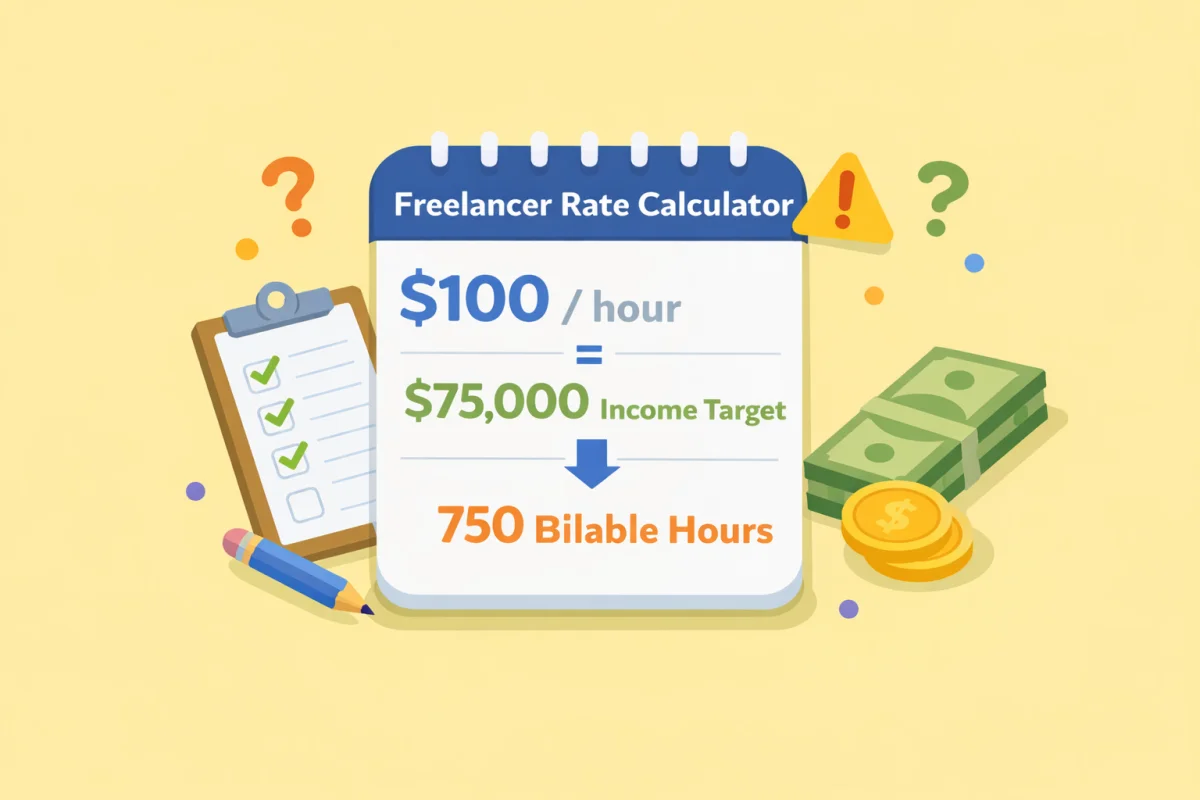
This article breaks down the difference, where each structure works best, and how to set the actual numbers. For the underlying rate calculation, the Freelancer Rate Calculator works backwards from your income target to tell you the minimum you need to charge.
What Is a Day Rate?
A day rate is a fixed fee for one day of work, typically defined as 7 or 8 hours. Instead of tracking individual hours, you and the client agree that you will work on their project for a set number of days, and you invoice per day.
A $800/day rate on a 5-day project is a $4,000 invoice. Simple.
Day rates are standard in several fields: creative and design work, consulting, photography, video production, and much of the tech contracting world. In the UK, day rates are the dominant pricing model for contractors across almost all professional services.
What Is an Hourly Rate?
An hourly rate means you charge for the exact number of hours worked, tracked and billed precisely.
An $80/hour rate on a project that takes 42 hours is a $3,360 invoice. The client pays for the actual time spent.
Hourly rates are more common in fields where work scope is highly variable, difficult to estimate upfront, or where clients want tight control over costs — legal work, bookkeeping, some technical support, ongoing maintenance retainers.
The Core Difference: Where Does the Risk Sit?
This is the most useful way to think about the choice.
With an hourly rate, the client bears the scope risk. If the project takes longer than expected, they pay more. If it runs short, they pay less. The freelancer is protected from underestimating.
With a day rate, you are selling your time in blocks rather than tracking every hour — but you are still essentially paid for time spent, not outcomes. A well-scoped day rate project ("we need you for four days") shifts some of the estimation risk onto you. If you misread the scope and it takes six days, you either absorb the loss or have a difficult conversation.
The third model — project-based or fixed-price — is where the freelancer fully owns the scope risk. That is a different structure entirely and carries higher risk alongside the potential for higher reward.
When a Day Rate Works Better
Day rates tend to work well when:
The work happens in blocks. If you are on-site at a client, running a workshop, shooting a campaign, or doing a focused consulting engagement, billing by the day is natural. The client books you for a day; you show up and work.
You want to simplify scope conversations. "This will take three days" is easier for a client to evaluate than "this will take 22–24 hours." Day rates reduce the incentive for clients to nickel-and-dime individual hours and make the overall engagement feel cleaner.
Your work does not lend itself to hourly tracking. Creative work — strategy, writing, design — does not flow in perfectly trackable increments. A designer might spend 20 minutes solving a problem that took a week of background thinking. Hourly billing penalises efficiency in these cases.
You work with larger organisations. Corporate clients often prefer day rates because they fit neatly into project budgets, PO systems, and procurement processes. A day rate makes you look more like a contractor than a hired hand.
When an Hourly Rate Works Better
Hourly rates tend to work well when:
Scope is genuinely unpredictable. Ongoing maintenance, technical support, advisory retainers, and troubleshooting are hard to day-rate because you do not know in advance how much time any given issue will require. Hourly billing protects you from open-ended engagements.
You are working on small tasks. If a client needs two hours of bookkeeping per week, a day rate does not make sense. Hourly billing fits naturally.
The client insists on tracking. Some clients — especially smaller businesses — are uncomfortable with day rates because they feel like they are paying for time they cannot verify. Hourly billing, especially with time-tracking software, gives them visibility.
You are early in your freelance career. Hourly billing is simpler to explain and defend when you are still building your reputation. Once you have clear evidence of the value you deliver, moving to day rates or project rates becomes easier.
Converting Between the Two
If you have an hourly rate and want to set a day rate, the conversion is straightforward:
day rate = hourly rate × hours in your workday
Most freelancers define a day as 7 or 8 hours. At $80/hour, that is a day rate of $560–$640. Some freelancers round up slightly when converting to a day rate — partly to account for the fact that a full day of client work leaves less time for admin, business development, and context switching.
If you want to go the other way, your hourly equivalent from a day rate:
hourly equivalent = day rate ÷ 7 (or 8)
The Freelancer Rate Calculator gives you a minimum hourly rate based on your income target, tax rate, expenses, and billable hours. From there, multiply by your chosen day length to arrive at your day rate.
The Practical Problem With Partial Days
Day rates create an awkward situation when a project requires less than a full day.
A client asks for a two-hour call plus some follow-up work — maybe three hours total. Do you charge half a day? A third of a day? Most freelancers handle this with a minimum engagement policy: a half-day minimum (or full-day minimum for on-site work) clearly stated in their contract or proposal.
Without a minimum, day-rate freelancers often end up doing hour-and-a-half jobs for a quarter of a day rate because they felt awkward charging a full half day. Decide your policy in advance and state it clearly.
Which Looks Better to Clients?
Day rates often feel more reasonable to clients even when they are equivalent to or higher than an hourly rate, simply because the number is different.
A $600/day rate and a $85/hour rate for 7 hours produce identical invoices. But a client who fixates on the $85 hourly number might push back, while the same client finds $600/day reasonable for a full day of focused work. The day rate frames the engagement differently — you are buying someone's focused day, not counting every quarter hour.
This framing effect is real, and it is one reason experienced freelancers often prefer day rates once they are established.
Switching From Hourly to Day Rates
If you currently charge hourly and want to move to day rates, the transition is easier with new clients than existing ones.
For new clients: simply quote in day rates from the start. Most clients will not ask you to justify the structure.
For existing clients: the cleanest approach is to raise the topic at contract renewal or the start of a new project. Frame it as simplifying your billing and making the engagement easier for both sides — not as a price increase (even if the effective rate goes up slightly).
Avoid changing the billing structure mid-project. It creates confusion and makes clients feel the ground has shifted.
A Note on Scope Creep
Whichever structure you use, scope creep — projects expanding beyond what was agreed — is the most common profitability problem in freelancing.
Day rates do not automatically prevent scope creep. If a client books you for three days and the project balloons into five, you still have to have the conversation about additional days and fees.
The protection against scope creep is not the billing structure. It is a clear contract that defines what is included, what is out of scope, and what happens when scope changes. Both hourly and day rate arrangements benefit from that clarity.