How to Use Week Numbers for Annual Planning
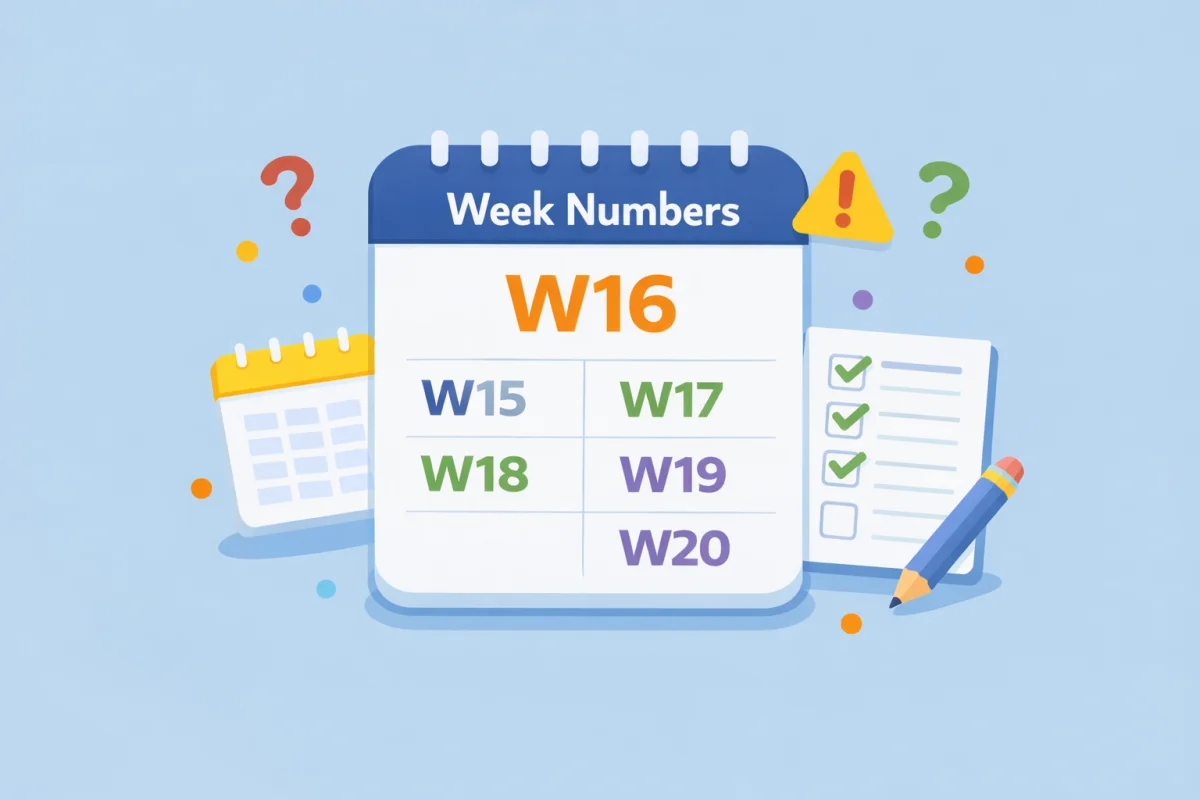
If you've ever tried to plan a year using months, you know the problem: months vary in length, quarters don't divide evenly into workweeks, and "early March" means something different depending on who you ask. Week numbers solve this. There are 52 or 53 weeks in a year, they start on Monday and end on Sunday, and every week has a number. That consistency makes them useful for anyone who plans in regular cycles — project managers, operations teams, freelancers scheduling client work, or anyone who runs quarterly or annual goals.
The Current Week Number tool shows today's ISO week number and the date range it covers. That single number is often the most useful thing to know when you're building a week-based plan.
What Week Numbers Give You That Months Don't
Months feel intuitive but they create planning friction. February has 28 or 29 days. Some months have 31. A "month-long" deadline means different things in February than in October. Weeks don't have this problem. Week 10 is always 7 days. Week 36 is always 7 days.
This matters when you're planning workloads. If you know a project takes 6 weeks of effort, you can count 6 week numbers forward from your start date and have an exact end date. You don't need to figure out how many days are in each intervening month. The Week Number Calculator handles the lookup if you need to convert a specific date to its week number.
Week numbers also make it easy to see where you are in the year at a glance. Week 26 is roughly the midpoint. Week 40 is early October — you have about 12 weeks until the year closes. Week 48 means you have roughly one month left.
The ISO Week Year Has 52 or 53 Weeks
Most years have 52 ISO weeks. Some — called long years — have 53. This happens when January 1 falls on a Thursday, or when it's a leap year and January 1 falls on a Wednesday or Thursday. The last 53-week year was 2020. The next is 2026.
If you're building an annual plan using week numbers, this matters at the year boundary. In a 53-week year, week 53 is a real week with real days in it — it's not just an accounting artifact. Your Q4 plans may need to accommodate it.
The practical implication for annual planning: don't assume the year ends at week 52. Check whether the current year is a long year, and plan accordingly.
Building a 52-Week Annual Plan
One practical approach is to divide the year into blocks of weeks rather than into months or quarters. Here's a simple structure many teams use:
Q1: Weeks 1–13 Q2: Weeks 14–26 Q3: Weeks 27–39 Q4: Weeks 40–52 (or 53)
Each quarter is exactly 13 weeks — something calendar quarters can't claim. This makes it easier to compare performance across quarters, plan recurring work, and estimate capacity.
Within each quarter, you can set milestone weeks:
- Week 4: first monthly checkpoint
- Week 8: mid-quarter review
- Week 12: final sprint before quarter close
- Week 13: retrospective and next-quarter prep
The exact weeks shift every year as the calendar shifts, but the structure stays consistent: 13-week cycles, with milestones at weeks 4, 8, 12, and 13 within each block.
Using Week Numbers in Project Planning
Week-based project planning is common in industries where work spans multiple months — construction, software development, manufacturing, and product launches. Instead of writing "deliver by end of March," a project plan might say "deliver by W13." Everyone on the team knows what that means regardless of timezone or regional calendar conventions.
When you plan this way, a few techniques help:
State week ranges in deliverable lists. Instead of "content review in mid-February," write "content review W7–W8." It's unambiguous and easy to update if the project slips.
Use weeks to flag capacity conflicts. If you're managing multiple projects, mapping each to its week range quickly reveals where two projects overlap — both are in heavy delivery mode in W18, for example. That's harder to see on a month-by-month view.
Plan buffer weeks explicitly. Rather than adding vague "buffer" time to a project estimate, you can reserve specific weeks. "W22 is our buffer week before the W23 launch" is concrete. It shows up on a calendar and it's easy to reclaim or protect.
Week Numbers and Annual Recurring Events
Many organizations run events, reviews, or initiatives on annual cycles. Week numbers make these easier to standardize. Instead of "we do our all-hands in late January," you commit to "W4 is all-hands week." It moves by a day or two year over year, but the week is consistent.
Common examples of recurring events that benefit from week-number anchoring:
- Annual performance reviews: W50–W51 (before end-of-year closedown)
- Budget planning cycle: W38–W44
- Annual conference: W28 (same week, every year)
- Onboarding cohorts: W1, W14, W27, W40 (one per quarter)
- Year-end audit prep: W45–W48
If you use W4 for your annual kickoff, you can block that week years in advance without caring what the Gregorian date falls on. The work doesn't change; only the calendar date shifts by a day or two.
Year-Boundary Issues to Watch For
ISO week numbering has one well-known quirk: late December dates can belong to week 1 of the following year, and early January dates can belong to week 52 or 53 of the previous year.
For example, if January 1 falls on a Friday, Saturday, or Sunday, it belongs to the last ISO week of the previous year — not to week 1 of the new year. Week 1 of the new year begins on the following Monday. If your annual plan says "kick off in W1," make sure you know which Monday that actually is.
The Current Week Number tool shows both the ISO week number and the ISO week year, which can differ from the Gregorian calendar year near January 1 and December 31. That's the number to use for planning — not the calendar year alone.
A Simple Weekly Review Habit Built on Week Numbers
One of the quieter uses of week numbers is as a review anchor. At the end of each week, you record the week number and note what happened. Over time, this creates a searchable log organized by week rather than by date.
Instead of searching for "what I shipped in the second week of March 2024," you search for "W11 2024." The week number is more stable as a reference — it's a smaller, more memorable integer than a full date, and it maps to a specific Monday-to-Sunday period without ambiguity.
Some people pair this with a quarterly retrospective. At W13, W26, W39, and W52, they look back at the last 13 weeks and forward at the next 13. The even intervals make patterns easier to spot — you can compare W1–W13 this year against the same period last year directly, without adjusting for month length.
Week numbers won't replace every other planning tool. But for anyone who needs a consistent, year-round unit for tracking and scheduling work, they're more reliable than months and more human-readable than raw dates. The hardest part is usually just remembering what week number it is today — which is exactly what the Current Week Number tool is for.