How To Use Week Number For Project Management — Sprints, Roadmaps, and the Hidden Coordination Wahala
Week numbers na strong thing for project planning. “Target release: W22” clean pass “week of May 27” and e precise pass “late May.” Roadmaps, sprint calendars, and delivery schedules dey look more tidy when dem write am as week numbers.
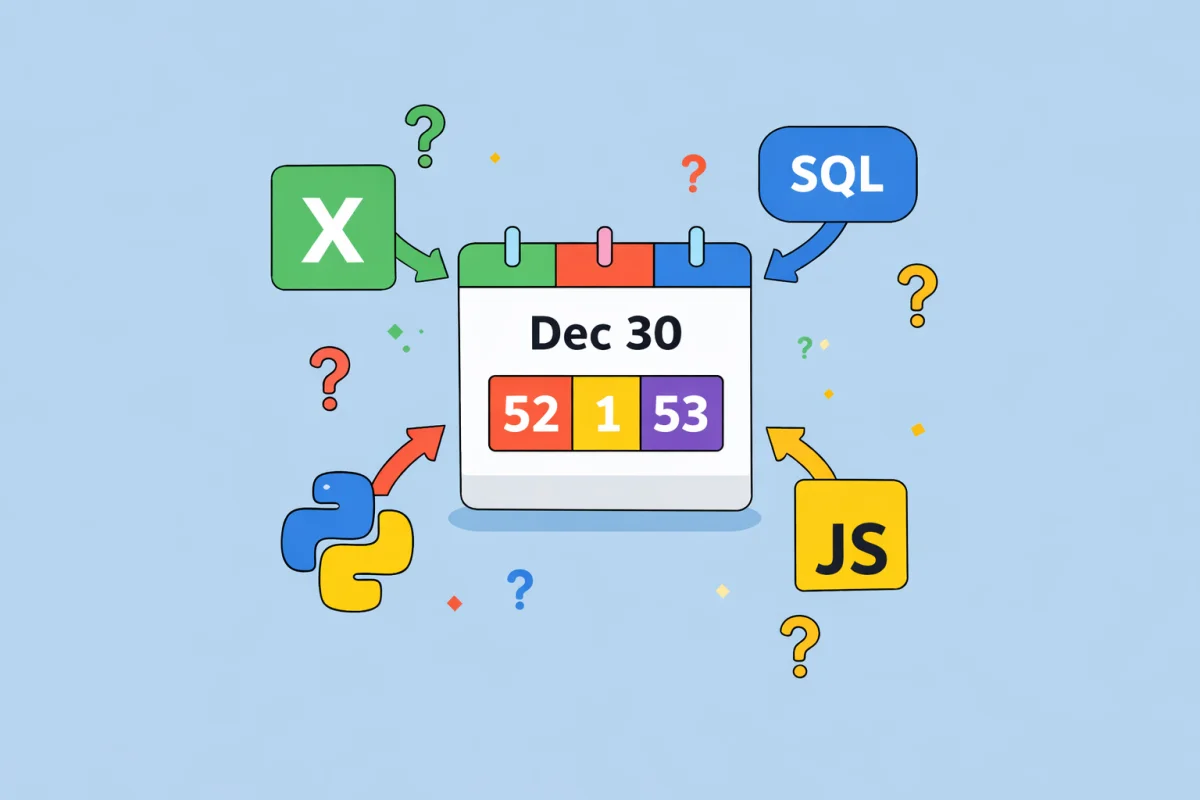
But week numbers carry hidden assumptions — like where week dey start, which week be week 1, and which numbering system your tools dey use. If na one-country team wey dey use one tool, those assumptions go align and you no go notice. For distributed team, dem go show face as missed handoff, deadline wey people read wrong, and delivery windows wey no overlap the way everybody expect.
Why Teams Dey Use Week Numbers For Planning
Calendar dates get problem for project management: dem too specific. Roadmap wey you build with exact dates dey imply precision wey almost never dey true six months ahead. “Feature X by March 14” go become wrong as soon as timeline shift, and to update every date na friction.
Week numbers dey sit between vague quarters and brittle exact dates:
- E granular enough to plan sprints and milestones
- E abstract enough to shift without rewriting the whole document
- E easy to reason with relative talk (“3 weeks from now” = current week + 3)
- E consistent for the whole year — every week na the same length, unlike months
For teams wey dey run two-week sprints, the structure dey very natural. Sprint 1 na W1–W2, sprint 2 na W3–W4, and so on. Sprint number and week number fit stay in sync all year.
The Two-Week Number Problem
The trap: US and Europe dey use different week numbering systems by default.
ISO 8601 (Europe, most of the world): Weeks dey start Monday. Week 1 na the week wey get the first Thursday of the year. Most European project tools dey use am by default, and any tool wey dem label “ISO” dey mean this.
US system: Weeks dey start Sunday (sometimes Monday). Week 1 na the week wey contain January 1. Plenty US-headquartered tools dey use this by default.
For most of the year, the numbers go match or differ at most by one. But around year boundary, dem dey diverge well-well — and you no go notice unless you know say you suppose check.
Example — late December 2026:
| Date | ISO week | US week (Sun start) |
|---|---|---|
| Dec 21, 2026 (Mon) | W52 | W52 |
| Dec 28, 2026 (Mon) | W53 | W53 |
| Jan 1, 2027 (Fri) | W53, year 2026 | W1, 2027 |
| Jan 3, 2027 (Sun) | W53, year 2026 | W1, 2027 |
| Jan 4, 2027 (Mon) | W1, 2027 | W2, 2027 |
Engineer for Berlin go see January 1 as W53 of 2026. PM for New York go see am as W1 of 2027. “Make we wrap up for W1” go mean different thing to both.
Jira, Linear, Asana, Monday.com — Which One Dem Dey Use?
Answer dey depend on the tool and how the tool set up. Most tools no dey make am obvious.
Jira: Sprint dates na calendar dates, no be week numbers. When week numbers show for reports or board views, dem follow the locale of the Jira instance — usually ISO for Europe instances, US-style for US instances. The setting dey hidden for admin.
Linear: E dey show weeks for roadmap view. E dey use ISO 8601 by default. Monday start, Thursday rule.
Asana: Timeline view dey label weeks. E follow the locale wey you set for workspace settings. Default for new workspaces na Sunday start (US-style).
Monday.com: Week number column dey follow Monday start but e dey use US-style week 1 (first week wey contain January 1, no be first Thursday). This one dey produce different result from ISO for 3–4 weeks every year.
Notion: Database date properties no dey show week numbers natively. Week number formulas wey people share online often wrong — many use ceil(dayOfYear / 7), wey no be ISO and no be US standard.
Google Sheets / Excel (when people use am for planning): Default na US-style as we don cover elsewhere. If you use ISOWEEKNUM() explicitly, e safer.
Practical meaning: two teams wey dey use different tools, or the same tool with different locale settings, fit get valid week number for one system wey mean different thing for another.
Sprint Planning With Week Numbers
Two-week sprint cycles dey map well to ISO weeks when sprints dey start Monday. Sprint N cover ISO weeks 2N-1 and 2N. Sprint 1 = W1+W2, Sprint 2 = W3+W4, and so on.
The complication na 53-week years. For year wey get 53 ISO weeks, 2-week sprint cycle wey start for W1 go land well-well for the 53-week boundary — leaving one week “left over” for the end. Teams dey handle am different ways:
- Absorb am: Sprint 26 become 3-week sprint. If you announce early, e fit help to clear tech debt or create buffer before major release.
- Ignore am: No align sprints to calendar weeks at all. Just dey count from when the year start. The disconnect go grow small-small and nobody go notice until Q4 planning.
- Replan for summer: Some teams reset sprint calendar for mid-year, so second half go align cleanly.
53-week years na 2026, 2032, 2037. If your sprint calendar dey run close to perfect ISO alignment now, plan for the extra week ahead of time.
The Year-Boundary Sprint Problem
Even if no be 53-week year, year end still dey cause planning confusion.
Most orgs dey plan by calendar year. Roadmap reset for January. Budget reset. Headcount changes. But ISO week 1 no always start on January 1 — for some years, the first few days of January dey inside the last week of the previous year.
2027: January 1 (Friday) dey inside ISO Week 53 of 2026. First Monday for 2027 na January 4, wey be ISO Week 1 of 2027.
If your team dey treat “first sprint of the year” as W1, and you start am January 4, that mean January 1–3 no dey inside last year final sprint and no dey inside this year first sprint. Dem fall inside one no-man’s-land week wey technically belong to the previous year.
The clean solution: accept say sprint calendar and fiscal/calendar year no always start the same day. No force both to align on January 1.
Roadmap Week Numbers and the “Relative Week” Trap
Roadmaps often show week numbers as fixed column — W1, W2, W3 — as if dem refer to specific calendar weeks. But some teams dey use week numbers as relative counter from project start, no be real calendar week numbers.
“Target launch for W8” fit mean:
- ISO week 8 of the current year (specific date range)
- The 8th week since project kick off (depend on start date)
- The 8th sprint (wey fit be 2 calendar weeks or no)
This ambiguity no dey hurt if everybody share the same mental model. E become problem when:
- Stakeholder outside the team read the roadmap and assume calendar week 8
- Contractor join mid-project and assume ISO week numbers
- Person keep the roadmap and review am one year later
Best practice: Any roadmap or planning doc wey use week numbers, add one reference row wey show which calendar dates W1 correspond to. That one anchor the whole doc make e no get ambiguity.
Cross-Time-Zone Handoffs and Week Boundaries
Teams wey dey across time zones get one specific issue: the week boundary (Sunday/Monday midnight) dey happen at different clock time for different people.
For most planning, e no matter — deadline like “end of W14” people dey understand am as end of business Friday for the relevant team local time. But for automated systems — deploys, scheduled jobs, report generation — week boundary na precise thing, and job wey run “start of W15 Monday” go fire different UTC times depending on server timezone.
The failure mode: Weekly report wey dem generate “at the start of the week” run midnight Monday UTC. For team for San Francisco, that na Sunday evening — the previous week never finish. The report go include current week data but exclude Sunday data, and you go get consistent off-by-one for weekly aggregation.
The fix na always: use UTC for server-side week calculations and convert to local time only for display. Store week boundaries as explicit timestamps, no be week numbers.
Week Numbers For Release Planning
Release schedules wey dem write as week numbers common for software teams:
- “Code freeze W19, release W20”
- “RC cut for W47, GA for W49”
E clear and workable with one caveat: the reader must know which year week 19 you mean. When you write am, e obvious, but roadmap wey you write for Q1 and you mention “W47” fit become ambiguous for Q4 if the doc no state the year.
The convention wey dey work well: always write the year with the week number. 2026-W19, no be just W19. ISO 8601 get standard format for this: YYYY-Www.
This matter especially for:
- External release notes
- Dependency schedules wey you share with other teams or vendors
- Any doc wey people fit still dey reference after the year end
Practical Checklist For Teams Wey Dey Use Week Numbers
Before you start project:
- Agree on one week numbering system (ISO na safe default for international teams)
- Check say your main planning tool dey use that system
- Write down which calendar dates W1 of your project map to
For roadmaps and schedules:
- Always include the year:
2026-W22, no beW22 - Add date anchor row wey show what week 1 map to
- Note whether “end of W22” mean Friday EOD or Sunday midnight
For 53-week years (2026, 2032, 2037):
- Flag the year for your annual planning session
- Decide ahead how una go handle the extra sprint week
- Check say payroll, reporting, and scheduling systems fit handle 53 iterations
For automated systems:
- Use UTC for all week boundary calculations
- Store week boundaries as timestamps, no be week numbers
- Test with dates for last week of December and first week of January
Use the ISO Week Number Calculator to check the Monday–Sunday date range for any week number, or check the current week number right now.